



Low Pressure Die Casting (LPDC): The Practical Guide to Process, Design, and When It's Worth It


Low pressure die casting has an image problem: the name makes it sound like the budget option, something you settle for when you can't afford real die casting. It's closer to the opposite. LPDC exists because there's a category of parts — wheels, structural brackets, anything headed for a heat-treat oven — where the speed that makes HPDC attractive is precisely what causes the part to fail later, not sooner.
The mix-up shows up on drawings often enough that it stopped surprising us a while ago. A customer writes "HPDC" in the title block because that's the process they know, and the part underneath is a wheel, or a bracket that's about to get T6 heat treated, or a housing that needs to hold a pressure seal. Nine times out of ten, the fix isn't a new drawing — it's a different process. HPDC faces a real physical ceiling on porosity that no amount of parameter tuning fully closes; LPDC's slower, gentler fill avoids the problem by design rather than by careful control.
This guide covers how LPDC actually works, why it produces fewer defects than the alternatives, the design rules that keep a part out of trouble, what typically goes wrong and why, how it stacks up against HPDC and gravity casting, and what it actually costs at the volumes most of our customers are running.
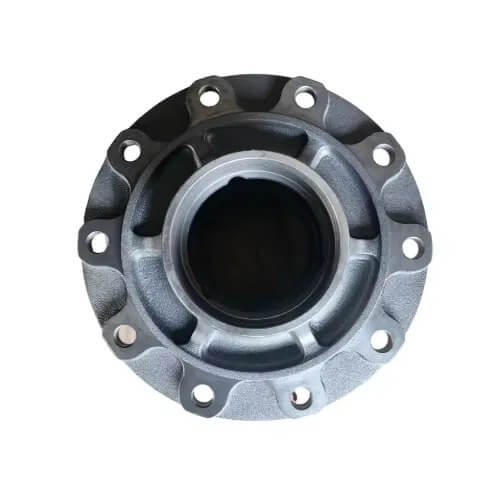
How Does Low Pressure Die Casting Actually Work?
Metal gets pushed upward into the mold from a sealed furnace below it, using gas pressure low enough to fill the cavity without splashing, tumbling, or trapping air on the way in. That's the whole idea in one sentence, and it's also the reason almost everything else about LPDC looks different from HPDC.
The furnace sits directly beneath the mold, connected by a riser tube. Low-pressure gas — usually compressed air or an inert gas like nitrogen — pushes down on the surface of the molten metal in the furnace, forcing it up the riser tube and into the cavity from the bottom. Working pressure typically runs 0.01–0.2 MPa, at a fill speed of roughly 0.01–0.5 m/s — two to three orders of magnitude gentler than the 10–150 MPa injection HPDC uses to fill a cavity in a fraction of a second. Machine builders don't get there by dialing down an HPDC unit — it takes a different furnace, a different pressure system, different tooling, start to finish.
The cycle runs in six stages, each one worth knowing since a shortcut on any of them is usually where a defect traces back to:
- Step 1: Melt and hold — the metal is brought to temperature and held in the sealed furnace
- Step 2: Close and clamp — the mold closes and locks under enough force to resist the fill pressure
- Step 3: Apply gas pressure — low-pressure gas drives the fill up the riser tube and into the cavity
- Step 4: Hold pressure through solidification — the riser tube keeps feeding metal into the cavity as it shrinks
- Step 5: Release pressure — unused metal drains back into the furnace rather than getting trimmed off as scrap
- Step 6: Open the mold and eject — the part is removed once it's rigid enough to hold its shape
That pressure-holding step during solidification is doing more work than people give it credit for — it's a continuous feed compensating for shrinkage in real time, which is a large part of why LPDC castings come out dense instead of full of shrinkage porosity.
One distinction worth knowing before you spec a machine: sealed versus unsealed systems. A sealed furnace holds pressure across the entire melt surface in a fully enclosed chamber, which gives tighter pressure control and is generally the choice for parts with strict porosity or leak-tightness requirements. Unsealed systems are simpler and cheaper to run, and cover a lot of mid-complexity parts perfectly well — the choice is really about how much margin your part's porosity tolerance gives you, not a universal upgrade.
Worth being precise about terminology here: LPDC isn't a slower branch of high pressure die casting, in the way cold chamber and hot chamber are both branches of HPDC. It's an independent process with its own equipment, its own filling physics, and its own reason to exist — sitting alongside HPDC and gravity casting as three genuinely different ways to get metal into a mold, not three points on one dial.
Why Does Low Pressure Die Casting Produce Fewer Defects?
Because nothing about the fill is violent. HPDC's high-speed injection is fast enough to trap air and fold oxide film into the casting as a structural fact of the process; LPDC's slow, bottom-up fill and continuous pressure feed during solidification largely avoid both problems by design, not by careful tuning.
In 18+ years running both processes side by side, our own production data shows internal defect rates on LPDC parts typically under 1%, against roughly 5–10% for HPDC, and that gap shows up directly in mechanical properties: tensile strength, yield strength, and elongation on LPDC aluminum parts commonly land 10–20% higher than the same alloy run through HPDC, simply because there's less porosity interrupting the metal's grain structure.
Getting there depends on a short list of parameters actually being controlled, not just set once and forgotten. Melt temperature for aluminum alloys typically runs 650–700°C, held within a tight band — a few degrees too cold and fluidity drops enough to risk cold shuts and short fills; a few degrees too hot and oxidation picks up. Pressure-holding time after fill runs roughly 10–60 seconds and cooling another 20–100 seconds, both scaled to wall thickness, because the whole point of that holding phase is giving the riser tube enough time to keep feeding metal into the thickest sections as they shrink. Cut that phase short and you've reintroduced the exact shrinkage porosity the process exists to avoid.
In practice, the parts that come back to us with porosity complaints almost never have a mysterious root cause — they have a pressure-holding phase that got shortened somewhere along the way to hit a cycle-time target.
Flow simulation software has become a normal part of qualifying a new LPDC tool before it's cut, modeling fill sequence and solidification pattern against the actual part geometry rather than relying on the operator's experience alone. On the equipment side, automation matters more here than the "low-tech, low-pressure" framing suggests — robotic part extraction and integrated inspection stations do more for shot-to-shot consistency than any single process parameter, largely by removing the variability that comes from a human hand doing the same repetitive motion for eight hours.
Design Guidelines for Low Pressure Die Cast Parts
Most of the design rules that apply to HPDC — uniform wall thickness, adequate draft, generous fillets — apply here too, for the same underlying physics. What's different is where LPDC's own failure modes concentrate, and that's where a design review earns its keep.
Wall thickness and directional solidification. Because LPDC fills and solidifies from the bottom up, wall sections need to support that directional cooling path back toward the riser tube — a thick section isolated above a thin one can solidify before the riser tube finishes feeding it, defeating the entire pressure-holding mechanism. Gradual thickness transitions matter here even more than they do in HPDC, precisely because the process is relying on a continuous feed path, not a single fast shot.
Gating and riser placement. This is the one design decision LPDC has that HPDC simply doesn't. Riser and gate positions need to route the fill through the part in a sequence that keeps every section connected to the feed path until it's solidified — get this wrong and you can strand a thick section on the wrong side of an early-freezing thin one, which shows up as shrinkage porosity in a spot that looks, on paper, like it should have been fine.
Draft angles and fillets. Same physical logic as any other casting process — sharp corners concentrate stress and disrupt flow, insufficient draft fights ejection — so the standard guidance applies: generous fillets at wall intersections, and enough draft on every surface that has to release from the mold.
Industry design references such as NADCA's guidelines are a reasonable starting point for wall-thickness and draft minimums regardless of where a part is actually being manufactured — the physics doesn't change by region, even when the standard bodies do. Where those general references run out is exactly where riser and gating design for a specific part geometry needs an actual engineering review, not a lookup table.
If you're at the stage of finalizing a part for LPDC tooling, send it to our engineering team for a DFM review before the mold gets cut — gating and riser placement in particular are much cheaper to fix on a screen than in steel.
Common LPDC Defects and How to Trace Them
Porosity, shrinkage, cold shuts, short fills, and slag inclusions show up in LPDC just like they do in any casting process — what's different is where the root causes tend to sit. A leaking riser tube, an unstable fill pressure curve, or poor mold venting are LPDC-specific failure points that don't have a direct equivalent in HPDC troubleshooting.
| Defect | Typical LPDC-Specific Cause |
|---|---|
| Shrinkage porosity | Pressure-holding cut short, or a thick section isolated from the riser feed path by design |
| Cold shuts / short fills | Melt temperature too low, or fill pressure inconsistent during the slow rise |
| Gas porosity | Riser tube or furnace seal leaking, introducing air into a process designed to exclude it |
| Slag or oxide inclusions | Furnace melt not adequately skimmed before the cycle begins |
In production reviews, our engineers apply the same habit we've documented for aluminum die casting defects generally: locate the defect on the part first, before touching a single process parameter. A void near the riser side of a thick section points at a feeding problem. A void far from the riser, in a thin section, points at gas or venting. Adjusting melt temperature because a defect showed up somewhere is how a team spends three weeks chasing the wrong variable.
Acceptance standards such as ASTM E155 for radiographic porosity reference are a useful benchmark for what "acceptable" actually means on a given part, wherever it's being produced — internal porosity isn't something you can sign off by eye, and a documented radiographic standard is what turns "looks fine" into an actual pass criterion.
LPDC vs HPDC vs Gravity Casting: Which One Actually Fits Your Part?
The honest answer is that this isn't a "which is better" question — it's a question of what your part can't tolerate. A part that can't have internal porosity, needs T6 heat treatment, or requires a sand core for an internal cavity has usually already answered the question before cost or cycle time even enter the conversation.
| Factor | LPDC | HPDC | Gravity Casting |
|---|---|---|---|
| Pressure | 0.01–0.2 MPa | 10–150 MPa | None (gravity fill) |
| Internal defect rate | Under 1% | Roughly 5–10% | Moderate, mold-dependent |
| Mechanical properties | High | Moderate | Moderate to low |
| T6 heat-treatable | Yes | Usually not — trapped gas blisters during solution treatment | Yes |
| Sand cores for internal cavities | Yes | No | Yes |
| Dimensional tolerance / surface finish | IT10–IT12, Ra ≤1.6μm | Tighter — typically IT6–IT7 | Loosest of the three |
| Production rate | Roughly 1/3 to 1/5 of HPDC | High | Low |
| Typical parts | Wheels, cylinder heads, structural brackets | Thin-wall housings, high-volume consumer parts | Large or low-volume single-piece parts |
Heat treatment. In our DFM reviews, this is usually what settles the argument by itself. HPDC parts trap enough gas during the high-speed fill that running them through T6 solution heat treatment risks blistering — the trapped porosity expands under heat and pushes the surface out. LPDC parts, with their much lower internal gas content, take heat treatment without that risk, which is a large part of why they show up on load-bearing structural parts and HPDC parts almost never do.
Sand cores. The same logic applies to internal cavities. HPDC's fast, turbulent fill would simply erode or collapse a sand core on its way into the mold, where LPDC's slow, controlled rise leaves it intact — which is what makes complex internal passages like a water jacket or hydraulic gallery possible in LPDC and off the table in HPDC.
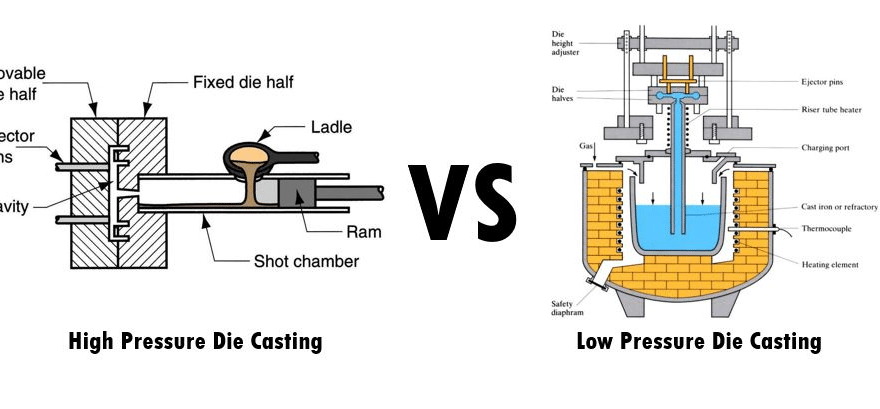
None of this makes LPDC a strictly better process — it isn't. What it trades away is precision: HPDC typically holds tighter dimensional tolerances and a smoother as-cast surface than LPDC's slower, lower-pressure fill can match, which is exactly why a thin-wall consumer housing with no porosity requirement almost never gets specified in LPDC. The honest way to put it is that LPDC buys density and mechanical integrity by giving up some of the dimensional precision HPDC's high-speed fill delivers for free.
On the material side, A356 and A357 are the aluminum grades that show up most often in LPDC work, and for good reason — both cast cleanly at LPDC's slower fill rates and respond well to T6 treatment, which is the whole point of choosing this process in the first place. Specifying a die-casting-only alloy for an LPDC part is a mismatch that shows up later, usually during heat treatment qualification rather than at the mold trial.
Common Low Pressure Die Casting Products and Applications
More than 80% of automotive aluminum alloy wheels are produced by LPDC — which is as clear a signal as any of what this process is actually good at: a part that has to be both structurally trustworthy and light, produced at real volume, where a single internal void is a safety recall waiting to happen.
Beyond wheels, the pattern repeats across a few industries with genuinely similar requirements — pressure-tightness, load-bearing strength, or a porosity spec that simply can't fail:
- Automotive — engine cylinder heads, chassis and suspension brackets, needing pressure-tightness and load-bearing strength together
- Aerospace — structural brackets and hydraulic system components, under the same non-negotiable no-porosity requirement, just a different set of inspection standards
- Electrical equipment — switchgear housings and motor stators, where dimensional consistency and defect-free conductivity paths both matter
- Medical devices — precision housings, where regulatory traceability leaves little room for a batch with hidden internal porosity
What Does LPDC Cost, and Is It Worth It at Your Volume?
Tooling for LPDC is generally less expensive than for HPDC, because the mold doesn't have to survive repeated high-pressure injection impact — LPDC clamping forces typically run in the 10–500 ton range, well below what an HPDC machine of comparable part size needs to resist. It's common in the industry for an HPDC machine to cost roughly four times what an equivalent LPDC setup runs, which flips the usual "die casting is expensive to tool up for" assumption on its head for this specific process.
Where the economics shift the other way is cycle time. LPDC typically runs at somewhere between one-third and one-fifth the production rate of HPDC — a cycle that might take HPDC a few seconds can run 30 to 120 seconds on an LPDC machine, most of it in that pressure-holding and cooling phase doing the work that keeps porosity down. At genuinely high volume, on a part that doesn't need LPDC's defect ceiling, that slower cycle adds up fast. At the mid-volume, high-value-per-part range most of our customers actually run — wheels, structural brackets, pressure-tight housings — it rarely matters, because the part wouldn't have passed inspection coming out of HPDC in the first place.
Material utilization also runs higher on LPDC — typically 90–95%, against roughly 85–90% for HPDC — since unused metal in the riser tube drains back into the furnace for reuse rather than getting trimmed off as scrap. Post-processing costs follow the same logic as any casting process: deburring and gate removal are close to unavoidable, T6 heat treatment adds real time and cost but is exactly the step LPDC parts are built to survive, and machining allowances should get priced in at the design stage rather than discovered on the first invoice.
The Bottom Line
Low pressure die casting earns its place for one specific reason: it fills a mold gently enough, and feeds it long enough during solidification, to produce parts that are structurally sound in a way HPDC's speed doesn't allow. That's not a marginal quality improvement — it's the difference between a part that passes T6 heat treatment and one that blisters, between a wheel that survives a fatigue test and one that doesn't.
None of that makes LPDC the right call for every part. It's slower, and for a thin-wall housing with no structural or porosity requirement, that slower cycle is just cost with no offsetting benefit. The parts where LPDC is worth the wait are the ones that would fail HPDC's own defect ceiling — and knowing which category your part falls into, before tooling gets cut, is the entire decision.
Not sure whether your part needs LPDC, HPDC, or something else?
Send us the CAD file and your production volume. Our engineering team will review the geometry, flag porosity or heat-treatment risks, and tell you plainly which process actually fits — plus a free DFM review either way.
Talk to Our Engineering Team →Frequently Asked Questions
What is low pressure die casting and how does it differ from high pressure die casting?
LPDC pushes molten metal upward into a mold from a furnace below it, using gentle gas pressure (0.01–0.2 MPa) and a slow, controlled fill. HPDC injects metal at 10–150 MPa in a fraction of a second. The pressure difference is why LPDC produces far fewer internal defects, at the cost of a slower cycle.
Which aluminum alloys are best suited for low pressure die casting?
A356 and A357 are the most common choices — both cast well at LPDC's slower fill rates and respond reliably to T6 heat treatment, which is usually the reason LPDC was chosen for the part in the first place.
Can low pressure die cast parts be heat treated (T6)?
Yes, and reliably so. LPDC's low internal gas content means parts can go through T6 solution heat treatment without the blistering risk that trapped porosity causes in HPDC parts — it's one of the main reasons LPDC gets specified for structural components.
What are the typical defects in low pressure die castings and how can they be prevented?
Shrinkage porosity, cold shuts, gas porosity, and slag inclusions are the most common. Most trace back to a shortened pressure-holding phase, inconsistent fill pressure, a leaking riser seal, or an under-skimmed melt — prevention is mostly about process discipline rather than design changes alone.
How should I design a part for low pressure die casting to avoid defects?
Keep wall thickness transitions gradual so every section stays connected to the riser's feed path until it solidifies, add generous fillets at intersections, and get gating and riser placement reviewed early — that placement decision has no direct equivalent in HPDC and is where LPDC-specific defects most often originate.
What's the difference between a sealed and an unsealed low pressure die casting system?
A sealed system encloses the entire furnace under pressure, giving tighter control for parts with strict porosity or leak-tightness requirements. Unsealed systems are simpler and less expensive to run, and cover most mid-complexity parts without issue — the choice comes down to how little porosity tolerance your part actually has.
How does the cost of LPDC compare to gravity casting and high pressure die casting at medium production volumes?
LPDC tooling typically costs less than HPDC tooling, since the mold doesn't need to withstand high-pressure injection. Its slower cycle time (roughly a third to a fifth of HPDC's rate) matters most at very high volume; at the mid-volume, high-value-per-part range where LPDC usually gets specified, the defect-rate advantage outweighs the cycle-time gap.
What post-casting operations are required for LPDC parts?
Deburring and gate or riser removal are standard on nearly every part. T6 heat treatment is common where the application calls for it, along with CNC machining for critical features and surface treatments such as anodizing or coating, depending on the part's functional requirements.
Hot Articles
Hot Tags
Stay Connected!


Manufacturing on Demand
Please fill in the following information to obtain plan details (information is confidential and not disclosed publicly), we will contact you within 24 hours, please keep your phone available!
Upload a 3D/2D model to see instant pricing, lead time, and DFM feedback.