



Cold Chamber Die Casting: How It Works, When to Choose It, and Key Design Considerations


Is cold chamber die casting the right process for the aluminum, magnesium, or copper part sitting on your desk right now — or is it just the process everyone defaults to because it's the one they've heard of?
That's usually the real question behind "how does cold chamber die casting work." Engineers rarely need a process definition in isolation. They need to know whether it fits their material, their part geometry, their production volume, and their budget — and whether hot chamber, permanent mold casting, or something else would actually serve the project better.
Choosing a manufacturing process is rarely just about speed or cost per part. Material characteristics, tooling investment, dimensional requirements, production volume, and manufacturability all pull in different directions, and cold chamber die casting only wins that trade-off under specific conditions.
This guide walks through how cold chamber die casting actually works, which materials and applications it suits, its real advantages and disadvantages, the design decisions that determine whether a part machines and ejects cleanly, the manufacturing challenges worth planning for before tooling starts, and how experienced engineers decide whether it's the right call for a given project.
What Is Cold Chamber Die Casting?
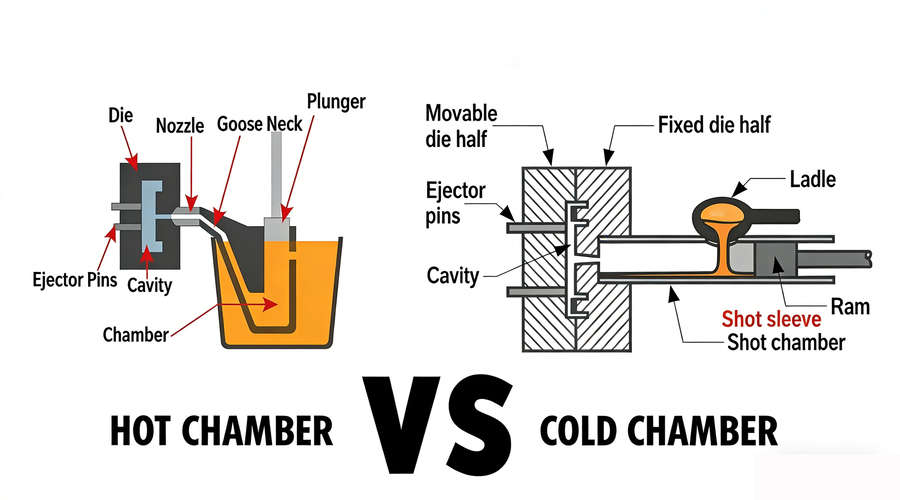
Cold chamber die casting is a high-pressure casting process in which molten metal is ladled into an unheated injection chamber — separate from the melting furnace — before a hydraulic plunger forces it into a steel die at high pressure. It's one of the two core branches of high pressure die casting, the other being hot chamber die casting.
The name comes from that separation: unlike hot chamber machines, where the injection mechanism sits submerged in molten metal at all times, a cold chamber system only sees metal briefly, during each shot. That gap between furnace and injection chamber is what makes the process usable for aluminum, magnesium, and copper alloys — metals with melting points too high, and too corrosive to steel, for a submerged injection system to survive.
Manufacturers reach for cold chamber die casting specifically because it's the only high pressure die casting route that can handle these higher-melting-point alloys at production speed, while still holding the dimensional accuracy and repeatability the process is known for.
Engineer's Insight: cold chamber die casting isn't defined by the temperature of the molten metal itself — it's defined by how that molten metal is introduced into the injection system, and that single design choice determines which alloys the process can run.
How Does the Cold Chamber Die Casting Process Work?
The process runs in six repeatable steps — die preparation, molten metal transfer, high-pressure injection, solidification and cooling, part ejection, and trimming — and the machine repeats this cycle for every shot.
- Die preparation — the mold closes and clamps, gets coated with release agent, and the cooling channels bring cavity temperature into range before injection.
- Molten metal transfer — metal is ladled from the holding furnace into the cold chamber, either manually or through an automated ladling system, which is now the more common approach for shot-to-shot consistency.
- High-pressure injection — the plunger drives metal into the cavity in two stages: a slow shot to avoid trapping air, followed by a fast shot that fills the cavity before the metal starts solidifying prematurely.
- Solidification and cooling — the die's cooling system pulls heat out of the casting under continued pressure, which is what keeps shrinkage porosity down.
- Part ejection — pins push the solidified casting free of the cavity once it's rigid enough to hold its shape.
- Trimming and secondary operations — runners, gates, and flash are removed, and the part moves to any required finishing, machining, or inspection.
What factors affect production cycle times?
- Alloy type and its solidification behavior
- Part geometry and wall-thickness distribution
- Mold design, including gating and cooling layout
- Machine tonnage relative to part size
- Cooling-circuit efficiency
Takeaway: the slow-to-fast shot transition is the single step most likely to determine whether a part comes out with cold shuts, gas porosity, or neither — worth confirming before assuming a defect is a material problem.
Why Is Cold Chamber Die Casting Used for High-Melting-Point Metals?
Because the injection chamber isn't submerged in molten metal between shots, it doesn't need to survive continuous exposure to the temperatures and corrosion that aluminum, magnesium, and copper alloys would cause in a hot chamber system. That single design difference is what opens the process up to metals with melting points above roughly 600°C — and it's also why alloy selection inside that group is rarely as simple as just picking "aluminum."
Within aluminum specifically, the four grades engineers reach for most often — A380, ADC12, A360, and the broader AlSi family — aren't interchangeable, even though they're often treated that way in early-stage part specs. Each one trades castability against mechanical or corrosion performance in a slightly different place:
| Grade | Castability | Strength & Corrosion | Typical Use |
|---|---|---|---|
| A380 | Excellent fluidity, good die release, the North American default | Good strength; corrosion resistance limited by copper content | General-purpose housings, brackets, high-volume structural parts |
| ADC12 | Essentially the JIS-standard equivalent of A380 | Comparable properties to A380 | Same applications as A380, more commonly specified in Asia-sourced projects |
| A360 | Lower fluidity than A380 — needs tighter process control to fill well | Better corrosion resistance and mechanical properties than A380 | Parts facing outdoor or corrosive exposure where A380's copper content is a liability |
| AlSi alloys (general) | Higher silicon content improves fluidity and reduces shrinkage porosity | Trade-off varies by exact composition | Thin-wall or geometrically complex parts where flow behavior is the limiting factor |
In practice, A380 and ADC12 cover the majority of general-purpose cold chamber parts — they're specified so often mainly because the process tolerates them well, not because they're the strongest option available. A360 earns its higher cost when a part will actually see corrosive exposure; specifying it for a part that lives indoors is usually money spent on a property the application never uses.
| Alloy Family | Common Grades | Typical Application |
|---|---|---|
| Aluminum | A380, ADC12, A360, AlSi alloys | Structural housings, brackets, engine and transmission components |
| Magnesium | AZ91D, AM60 | Lightweight housings, automotive structural parts |
| Copper-based | Brass and bronze alloys | Electrical connectors, plumbing and marine components |
Why isn't zinc commonly manufactured using cold chamber die casting? Zinc's low melting point means hot chamber die casting handles it faster and at lower cost — there's no advantage to cold chamber's slower ladling step for a metal that a submerged injection system can process safely.
Advantages and Disadvantages of Cold Chamber Die Casting
The advantages and disadvantages both trace back to the same design choice — a separate injection chamber that trades cycle-time speed for the ability to process higher-melting-point alloys under high pressure. Almost every item on both lists below is a direct consequence of that one trade-off, not an independent strength or weakness.
Advantages
- Excellent dimensional accuracy
- Ability to form complex geometries
- Thin-wall capability
- Good as-cast surface finishes
- High production efficiency at volume
- Strong repeatability across long runs
- Well suited to automated production
Disadvantages
- Higher tooling costs than sand or permanent mold casting
- Longer cycle times than hot chamber die casting
- Not economical for very low-volume production
- Restricted to alloys compatible with the process
- Potential porosity challenges if process parameters aren't controlled
The pattern worth noticing is that the advantages cluster around part quality and consistency, while the disadvantages cluster around cost and speed. That's not a coincidence — high pressure injection into a precision steel die is what produces the accuracy and repeatability, and ladling metal by hand or by robot into a separate chamber before every shot is what adds the time and tooling investment. A project that needs both the quality and the speed usually has to look at automation and cycle-time optimization to close that gap, rather than expecting the process itself to deliver both for free.
Engineer's Insight: manufacturing process selection is rarely about finding the "best" process — it's about identifying the process that best aligns with a project's requirements, production goals, and manufacturability considerations.
Cold Chamber vs Hot Chamber Die Casting: What's the Difference?
The difference comes down to whether the injection mechanism sits in the molten metal or stays separate from it — and that one design choice cascades into every other difference between the two processes.
| Factor | Cold Chamber | Hot Chamber |
|---|---|---|
| Injection mechanism | Separate from furnace; metal ladled per shot | Submerged in molten metal at all times |
| Suitable materials | Aluminum, magnesium, copper alloys | Zinc, tin, lead, some magnesium alloys |
| Typical cycle time | Longer — ladling adds time per shot | Shorter — no transfer step |
| Injection pressure | Higher, up to roughly 150 MPa | Lower, typically 10–50 MPa |
| Part size and weight | Larger, heavier parts | Smaller, thinner-walled parts |
| Tooling investment | Higher | Lower |
When should engineers choose each process? If the alloy has a melting point above roughly 450°C, cold chamber isn't a stylistic choice — it's the only viable high pressure die casting route. Below that threshold, for high-volume small parts in zinc or similar alloys, hot chamber die casting usually wins on cycle time and cost per part.
If you're weighing this decision against another process on an active project, sending us the part geometry and alloy is faster than working through it in the abstract — our engineering team can tell you which process fits before you commit to tooling.
Common Materials Used in Cold Chamber Die Casting
The aluminum grade comparison above covers selection within a single family. The harder decision for a lot of projects happens one level up — choosing between aluminum, magnesium, and copper in the first place, since that choice usually matters more to the part's outcome than which aluminum grade gets specified afterward.
Aluminum is the default starting point for most cold chamber projects, and for good reason: it combines a reasonable strength-to-weight ratio with the lowest material cost of the three families, which is why it dominates automotive structural parts, housings, and heat-dissipating components where thermal conductivity matters as much as strength.
Magnesium goes a step further on weight — roughly two-thirds the density of aluminum at comparable strength — which makes it worth specifying wherever every gram matters, such as automotive structural brackets and handheld electronics housings. The trade-off is a narrower corrosion-resistance window and a higher material cost, so magnesium tends to get chosen only when the weight saving is worth paying for, not by default.
Copper-based alloys, mainly brass and bronze, trade weight and cost for electrical conductivity and corrosion resistance in wet or marine environments. They show up less often in cold chamber production overall, but where a part needs to conduct electricity reliably or survive constant moisture exposure, nothing in the aluminum or magnesium families competes with them.
Once the family is settled, the same short list of practical questions narrows the final choice:
- Strength requirements — load-bearing structural parts push toward higher-strength aluminum or copper alloys
- Weight considerations — magnesium offers the best strength-to-weight ratio of the three families
- Corrosion resistance — copper-based alloys and certain aluminum grades hold up better in marine or outdoor environments
- Heat resistance — matters for parts near engines, motors, or other heat sources
- Production quantities — alloy availability and cost stability matter more at high volume
- Cost requirements — aluminum generally offers the lowest material cost of the three families
- Secondary processing requirements — machinability, platability, and weldability vary meaningfully by alloy
See the full range of grades on our materials page, including aluminum die casting and magnesium die casting capabilities.
Applications of Cold Chamber Die Casting Across Industries
Cold chamber die casting shows up wherever a product needs a lightweight, high-strength metal part produced at volume — which spans a wider range of industries than most people expect, because "lightweight and strong at once" is a combination few other processes deliver as economically once tooling is paid for.
- Automotive — engine and transmission housings, structural brackets
- Electronics — heat sinks, enclosures, connector housings
- Industrial equipment — pump housings, gearbox components
- Medical devices — precision mechanical housings and structural components
- Aerospace — lightweight structural and mounting components
- Consumer products — durable housings and hardware
- Energy equipment — structural and thermal-management components
The common thread across all seven is volume plus performance requirements that rule out cheaper alternatives: automotive and aerospace need the strength-to-weight ratio, electronics need the thermal conductivity aluminum and magnesium provide, and medical devices need the dimensional consistency that comes from injecting into a precision steel die rather than a lower-cost mold. Take away any one of those requirements — drop the volume, or accept a heavier part — and a different process usually becomes the more economical choice.
Common parts manufactured using cold chamber die casting:
- Motor housings
- Heat sinks
- Pump housings
- Gearbox components
- Structural brackets
- Electronic enclosures
- Precision mechanical components
Design Considerations for Cold Chamber Die Casting Parts
Most defects and cost overruns trace back to decisions made at the design stage, not on the shop floor — which is why part design deserves as much engineering attention as material selection, not a quick check after the geometry is already locked.
Part design
These five factors govern how well molten metal actually fills the cavity and releases from the die, which is why they get reviewed before anything else:
- Wall thickness — keep it as uniform as the part allows, since abrupt changes create the hot spots behind most shrinkage porosity
- Draft angles — needed on every surface that has to release from the die without tearing or sticking
- Fillets and radii — sharp internal corners concentrate stress and restrict metal flow at exactly the point where a crack is most likely to start
- Ribs and bosses — support structure without creating local hot spots that solidify out of sequence with the rest of the part
- Parting lines — placement affects both tooling cost and how much visible flash ends up on a cosmetic surface
Manufacturing considerations
Once the part geometry itself is sound, four more questions determine whether the finished casting will actually meet spec without expensive rework:
- Surface finish requirements — as-cast, or does the part need secondary finishing?
- Machining allowances for any post-cast features
- Hole and thread features that may need secondary operations rather than being cast directly
- Dimensional requirements, and whether they're realistic for what the process can hold as-cast
Design guidance published by NADCA (the North American Die Casting Association) is a useful reference point for wall-thickness and draft-angle minimums, even for projects manufactured outside North America — the underlying physics of metal flow and solidification don't change by region.
Common design mistakes to avoid:
- Significant wall-thickness variation within a single part
- Sharp internal corners instead of fillets
- Tolerance requirements that exceed what the process can hold as-cast
- Geometry that complicates metal-flow behavior during filling
- Excessively complex internal structures that trap air or restrict cooling
Every item on that list shares a common thread: each one looks like a minor detail on a CAD screen and becomes an expensive problem only after the die is already cut. Our design and engineering team reviews these points on every incoming project, alongside machining allowances handled through 5-axis machining where secondary operations are required.
Manufacturing Insights: What Experienced Engineers Evaluate Before Tooling Begins
Experienced engineering teams rarely evaluate materials or production quantities in isolation before tooling begins. Tooling is expensive enough, and slow enough to modify once it's cut, that the questions below get worked through as a set — not as a checklist ticked off in sequence, but as a genuine cross-check where the answer to one question changes how the others get evaluated.
- Can the part geometry support stable metal flow?
- Are wall-thickness transitions reasonable, or too abrupt?
- Will machining allowances affect critical dimensions?
- Can potential defect risks be reduced during the DFM stage?
- Are inspection requirements aligned with the part's actual functional requirements?
- Will secondary machining operations be required, and has that been priced in?
None of these questions are exotic — most engineers know to ask them. What separates a smooth tooling launch from a re-cut die is whether someone actually works through all six before the steel is committed, rather than discovering the answer to one of them after the first trial shot comes out of the mold.
Engineer's Perspective: small design adjustments identified during manufacturability reviews often have a greater impact on production stability than process parameter changes made after tooling has been completed.
Common Manufacturing Challenges in Cold Chamber Die Casting
Porosity, cold shuts, and shrinkage rarely trace back to one single cause — they're usually the product of part geometry, gate design, shot parameters, and alloy condition interacting at the same time.
- Porosity — gas entrapment or dissolved gas escaping during solidification
- Cold shuts — two metal fronts meeting too cold to fuse fully
- Shrinkage — insufficient feed metal to compensate for volumetric contraction in heavy sections
- Surface defects — flow marks, staining, or texture irregularities
- Flash — excess metal escaping at the parting line or die interfaces
- Air entrapment — turbulent filling trapping gas inside the casting
- Dimensional inconsistencies — shot-to-shot variation in critical features
In our own defect investigations, the same surface flow mark has turned out to originate from die temperature, gating design, release-agent residue, or part geometry — four different root causes producing what looks like an identical symptom. That's the reason a defect should never be diagnosed from appearance alone, and it's also why the fixes below work as a system rather than as a menu to pick one item from.
How engineers reduce manufacturing risks:
- DFM reviews before tooling is cut
- Mold design optimization, including gating and venting
- Process parameter control across the full shot profile
- Material selection matched to part function, not just cost
- Quality inspections scoped to the part's actual functional requirements
- Secondary machining strategies planned in advance, not improvised
Manufacturing Insight: manufacturing challenges are rarely caused by a single variable. Successful defect prevention typically begins during part design and manufacturability evaluation, not during production itself.
This kind of DFM review is exactly what we run before quoting any cold chamber project — send us your part and we'll flag the risks before tooling starts, not after.
Is Cold Chamber Die Casting the Right Choice for Your Project?
It depends on how your project answers four questions — materials, production requirements, budget, and part complexity — not on any single factor in isolation.
| Question | Cold Chamber Fits When... | Consider Alternatives When... |
|---|---|---|
| Materials | The part requires an aluminum, magnesium, or copper alloy | The part can run in zinc, tin, or lead — hot chamber is faster and cheaper |
| Production volume | Mid-to-high volume justifies the tooling investment | Very low volume — machining or vacuum casting may cost less overall |
| Budget | Tooling cost is offset by per-part savings at volume | Tooling budget is constrained and volume is still uncertain |
| Part requirements | Complex geometry, thin walls, or tight tolerances at scale | Simple geometry achievable with lower-cost casting or machining |
For simple geometries at low volume, sand casting or permanent mold casting often costs less overall than committing to cold chamber tooling — the decision isn't always "which die casting process," sometimes it's "should this be die cast at all."
How Engineers Select the Right Die Casting Process
The sequence below is the one we walk through on every incoming die casting project, in this order:
- Evaluate materials — what alloy family does the part actually require?
- Evaluate part geometry — wall thickness, complexity, and size
- Determine production quantities — does volume justify tooling investment?
- Evaluate surface finish requirements — as-cast, or secondary finishing needed?
- Consider tooling investments — against the project's budget and timeline
- Compare manufacturing processes — cold chamber, hot chamber, permanent mold, or machining
- Select the appropriate manufacturing solution — based on the answers above, not on habit
The Bottom Line
Cold chamber die casting earns its place in manufacturing specifically because it can process aluminum, magnesium, and copper alloys under high pressure, at production speed, with dimensional accuracy few other processes can match at the same volume. It also comes with real trade-offs — longer cycle times than hot chamber, higher tooling costs than sand or permanent mold casting, and a process window that has to be controlled carefully to avoid porosity, cold shuts, and shrinkage.
No single process is right for every project. The correct choice depends on materials, part geometry, production volume, cost, manufacturability, and design requirements evaluated together — not on whichever process happens to be familiar. Many of the manufacturing risks covered in this guide can be avoided entirely if they're addressed during design rather than discovered during production.
The most successful manufacturing outcomes often begin long before production starts — with informed engineering decisions made during the earliest stages of product development.
Need help evaluating your die casting project?
Selecting the right manufacturing process involves balancing materials, manufacturability, production requirements, and cost. Our engineering team can review your part design and manufacturing goals to identify the most suitable solution for your application.
Talk to Our Engineering Team →Frequently Asked Questions
What is cold chamber die casting?
A high-pressure casting process in which molten metal is ladled into an unheated injection chamber, separate from the melting furnace, before a hydraulic plunger forces it into a steel die. It's used primarily for aluminum, magnesium, and copper alloys.
How does cold chamber die casting work?
The die closes and is prepared, molten metal is ladled into the cold chamber, a plunger injects it into the cavity at high pressure in a slow-then-fast shot, the part solidifies under continued pressure, and it's ejected and trimmed before the cycle repeats.
What materials are suitable for cold chamber die casting?
Aluminum alloys (A380, ADC12, A360, AlSi alloys), magnesium alloys (AZ91D, AM60), and copper-based alloys such as brass and bronze — metals with melting points too high for hot chamber equipment.
What is the difference between hot chamber and cold chamber die casting?
Hot chamber machines keep the injection mechanism submerged in molten metal at all times, which limits them to lower-melting-point metals like zinc. Cold chamber machines keep the injection chamber separate from the furnace, which allows them to process higher-melting-point alloys like aluminum, at the cost of a slower cycle.
Why is aluminum commonly used in cold chamber die casting?
Aluminum's melting point is too high, and too corrosive to steel, for a hot chamber machine's submerged injection system to handle reliably. Cold chamber's separate injection chamber avoids that problem, which is why aluminum is one of the most common cold chamber alloys.
What factors affect production cycle times?
Alloy type, part geometry, mold design, machine tonnage, and cooling-circuit efficiency all influence cycle time. Cooling and solidification time typically account for the largest share of the overall cycle.
Can cold chamber die casting produce thin-wall components?
Yes, within limits set by alloy fluidity and part geometry. Thin walls need careful gate placement and consistent wall thickness to fill properly before the metal begins to solidify.
What manufacturing challenges should engineers consider?
Porosity, cold shuts, shrinkage, surface defects, flash, air entrapment, and dimensional inconsistencies are the most common challenges, and most trace back to a combination of geometry, gating, and process parameters rather than a single cause.
Is cold chamber die casting suitable for low-volume production?
Not usually. Tooling costs are high enough that very low production volumes are often better served by machining, vacuum casting, or permanent mold casting, depending on the part.
How do I know whether my parts are suitable for cold chamber die casting?
Work through material requirements, part geometry, production volume, surface finish needs, and tooling budget together. If the alloy has a high melting point and volume justifies tooling investment, cold chamber is usually a strong fit — a DFM review can confirm it for a specific part.
Hot Articles
Hot Tags
Stay Connected!


Manufacturing on Demand
Please fill in the following information to obtain plan details (information is confidential and not disclosed publicly), we will contact you within 24 hours, please keep your phone available!
Upload a 3D/2D model to see instant pricing, lead time, and DFM feedback.