



High Pressure Die Casting: Is HPDC Right for Your Part?


We get CAD files every week from teams that have already decided on die casting before they've picked up the phone. The file arrives, a mold quote gets requested — and the first question we actually ask back almost never starts with the alloy. It starts with: how many parts do you actually need, and by when? Is the geometry even realistic for this process? And does any of that still hold up when you're a 20-person hardware team building 2,000 units a year, not a car company building 200,000?
That volume question is the one most technical guides to high pressure die casting skip. Most of what's published assumes you've already committed to high-volume production and just need the process explained. If you're still deciding whether the tooling investment makes sense for your volume, your budget, and your timeline, you need a different kind of guide — one that tells you not just how HPDC works, but when it's actually the right call.
This one walks through how the process actually works, which alloys fit which applications, the design rules that keep a part out of the scrap bin, why defects happen and how to trace them to a root cause, what really drives the cost, and — since it's the question we get asked constantly — whether HPDC has any place in a prototype or low-volume run before you commit to full production tooling. We've been running aluminum and zinc die casting programs for over 18 years, across both hot and cold chamber processes; most of what follows comes out of that work, not a textbook.
How Does the High-Pressure Die Casting Process Actually Work?
Molten metal gets forced into a steel die under high pressure, fills the cavity in a fraction of a second, and solidifies fast enough to hold tight tolerances — that's the process in one sentence. The five stages behind that sentence are where the engineering actually happens:
- Die closing and clamping — the two die halves close under enough clamping force to resist the injection pressure trying to force them back open
- Metal injection — molten alloy is forced into the cavity through a plunger, typically in a slow-then-fast shot profile to control air entrapment
- Solidification under pressure — the die's cooling circuits pull heat out of the casting while pressure is maintained, which is what limits shrinkage porosity
- Die opening and ejection — the die separates and ejector pins push the solidified part free
- Trimming and secondary operations — runners and flash are removed, and the part moves to machining, finishing, or inspection as required
The decision that shapes everything downstream, though, happens before any of that: hot chamber or cold chamber. Hot chamber die casting keeps the injection mechanism submerged in molten metal, which is fast but limits it to lower-melting-point alloys like zinc. Cold chamber die casting ladles metal into a separate injection chamber for each shot, which costs some cycle time but is the only route for aluminum, magnesium, and copper alloys. Get this choice wrong and no amount of parameter tuning downstream fixes it. Both, worth noting, are branches of the same family — high pressure die casting is the umbrella term for the whole high-pressure injection system, not a synonym for either one specifically.
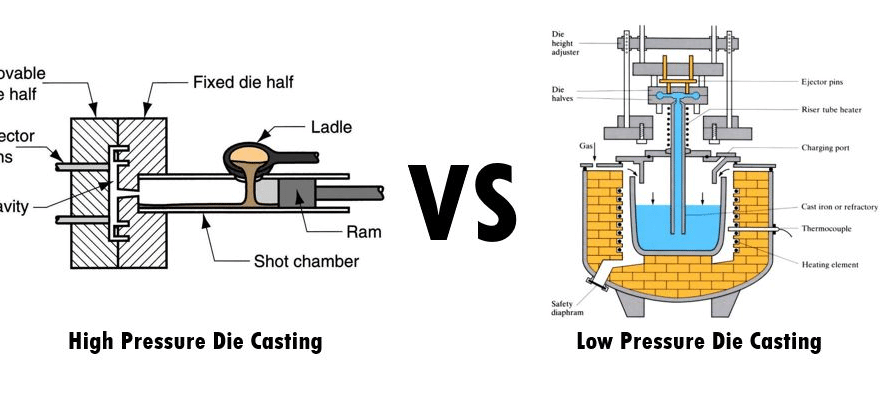
A different question comes up often enough to address directly: how does any of this compare to low pressure die casting? It's less a spectrum than a fork. LPDC pushes molten metal upward into the mold through a riser tube using gentle low-pressure gas — typically 0.01–0.2 MPa, filling at roughly 0.01–0.5 m/s — against HPDC's 10–150 MPa injection that fills a cavity in a fraction of a second. That slower, bottom-up fill is what makes LPDC the better call for parts where porosity genuinely isn't an option: aerospace brackets, medical housings, anything getting heat-treated or welded downstream where trapped gas turns into a real problem later. HPDC trades that lower-defect ceiling for cycle time and cost at volume, which is why the two rarely compete for the same part — they split the field by what the part can actually tolerate.
| Factor | High Pressure Die Casting | Low Pressure Die Casting |
|---|---|---|
| Injection pressure | 10–150 MPa | 0.01–0.2 MPa |
| Fill behavior | High-speed, can trap air if not controlled | Slow, controlled, bottom-up |
| Typical porosity risk | Higher — manageable with good process control | Inherently lower |
| Best fit | High-volume, cost-sensitive parts | Aerospace, medical, pressure-tight or heat-treated parts |
Two process variants are worth knowing even if they're not the default choice for most projects. Vacuum-assisted die casting pulls air out of the cavity before injection, which meaningfully cuts porosity for parts that need to be pressure-tight or heat-treated. Semi-solid die casting injects the alloy in a paste-like state between liquid and solid, which reduces turbulence during filling and measurably improves strength and surface finish on aluminum and magnesium parts — at the cost of a slower, more controlled shot. Ask about either one if your part has requirements standard HPDC struggles to hit.
Machine selection follows a similar logic to alloy selection: bigger isn't automatically better, it's about matching tonnage to the part. Clamping tonnage has to overcome the injection pressure acting across the part's projected area, so a larger or more complex part simply needs a bigger machine — undersize it and the die opens slightly during injection, which shows up as flash or dimensional drift. Oversize it and you're paying for capacity the part will never use, on every shot, for the life of the tooling. Ask your manufacturing partner to walk you through the tonnage calculation rather than taking a machine assignment on faith.
The Real Advantages and Disadvantages of High Pressure Die Casting
The short version: HPDC trades a high upfront tooling cost for excellent part quality and low per-part cost at volume. Almost everything else on both sides of the list below is a downstream consequence of that one trade.
| Advantages | Disadvantages |
|---|---|
| Excellent dimensional accuracy — typically IT6–IT7, with as-cast surface finish around Ra 5–8 | High tooling cost, especially for complex multi-cavity dies |
| Fast cycle times at production volume | Not economical below a certain volume threshold |
| Good as-cast surface finish, often skipping secondary finishing | Porosity risk if process parameters aren't controlled |
| Handles thin walls and complex geometry well | Limited to alloys compatible with the process |
The disadvantage that actually stops most early-stage projects isn't porosity risk or alloy limitations — it's the tooling cost, full stop. That's why the volume question deserves an honest answer before the alloy or the die design gets locked in, and it's also why we've put a whole section near the end of this guide on what to do when your volume genuinely doesn't justify a production die yet.
In our experience, that's true of almost every "disadvantage" on this list — it's really a statement about volume. Below a certain unit count, HPDC isn't a worse process. It's just solving a problem you don't have yet.
Aluminum, Zinc, or Magnesium? Choosing the Right Alloy for High-Pressure Die Casting
Aluminum, zinc, and magnesium alloys cover the overwhelming majority of HPDC parts worldwide, and the right choice comes down to weight, precision, and corrosion exposure more than anything else. Most guides stop at naming the three families — the grade within each one usually matters more than the family itself.
Aluminum High Pressure Die Casting
Take a fairly ordinary structural bracket: A380 and ADC12 both get specified for this kind of part constantly, and for good reason — they're essentially the same alloy under two different standards (A380 under North American convention, ADC12 under Japanese Industrial Standards), both offering excellent fluidity and die release at high volume. Where they start to diverge from "good enough" is corrosion exposure: neither alloy's copper content holds up particularly well outdoors, which is exactly the scenario where engineers often reach for A360 instead — better corrosion resistance and mechanical properties, at the cost of fluidity that demands tighter process control to fill properly. Specifying A360 for a bracket that lives indoors for its entire service life is money spent on a property the part will never need.
High Pressure Zinc Die Casting
Zinc alloys — Zamak 3 and Zamak 5 being the two you'll see most often — solve a different problem entirely. They cast with tighter tolerances and thinner walls than aluminum, at lower melting points that mean faster hot chamber cycles, which is why zinc dominates small precision components: connectors, gears, decorative hardware. What zinc gives up is weight and high-temperature performance, so it rarely shows up anywhere near an engine bay or a heat-generating assembly.
Magnesium High Pressure Die Casting
Magnesium sits at the extreme end of the weight conversation — meaningfully lighter than aluminum at comparable strength, which is why aerospace and high-performance automotive programs reach for it despite a real limitation: magnesium's corrosion resistance and flammability during processing demand tighter shop-floor controls than aluminum or zinc need. It's not a drop-in aluminum substitute; it's a deliberate trade of processing complexity for weight savings, and it only makes sense when the weight actually matters to the application.
| Alloy Family | Common Grades | Best Suited For |
|---|---|---|
| Aluminum | A380, ADC12, A360 | Structural housings, brackets, general-purpose parts |
| Zinc | Zamak 3, Zamak 5 | Small precision parts, connectors, gears, decorative hardware |
| Magnesium | AZ91D, AM60 | Weight-critical aerospace and automotive structural parts |
See the full range of grades on our materials page.
What Design Rules Actually Keep HPDC Parts Out of the Scrap Bin?
Four design decisions determine most of what happens to a die cast part in production: wall thickness, draft angle, fillets, and rib design. Get these right and most defects never have a chance to start. A die casting project doesn't really start on the shop floor — it starts at the CAD stage, months before anyone cuts steel.
Wall thickness. Molten metal is injected at extremely high speed, and uneven wall sections cool and solidify at different rates — that mismatch is what produces shrinkage porosity and warpage, not a mysterious process fluke. In our own production guidelines, the recommended minimum sits around 1.5mm for aluminum and can go down to 0.8mm for zinc, which fills more easily at lower viscosity. Where a wall does need to step up in thickness, keep the ratio between adjoining sections within roughly 1:3 — go beyond that and you're inviting the uneven filling this whole rule exists to prevent.
Draft angles. Without enough taper on vertical walls, the casting shrinks and grips the die cores as it cools, and ejection either damages the part or the die trying to force it free. Internal cavities generally need more draft than external walls, since the metal shrinks onto the core rather than away from it. Plenty of references quote 1–2° as a safe default; with tight process control we can usually hold draft down to about 0.5° minimum without demolding trouble, though a designer working to a generic rule of thumb should budget for the more conservative number.
Fillets and radii. Sharp corners are exactly where die casting problems concentrate — they disrupt metal flow and create stress risers in the tool steel itself, which is how a die starts cracking prematurely. Even a modest 0.5mm radius on intersecting surfaces measurably improves flow and tool life; there's rarely a good reason to leave a corner sharp.
Ribs, not thicker walls. When a part needs more rigidity, the instinctive fix is to thicken the wall — which adds material cost and porosity risk in roughly equal measure. Ribs solve the same problem more efficiently, provided the rib stays around 50–70% of the adjoining wall thickness; go thicker than that and you'll likely see a sink mark telegraph through to the cosmetic surface on the other side.
This is usually what separates a design that sails through tooling from one that comes back for a second round: every one of these four rules exists because it addresses a specific, physical failure mode — not because it's a stylistic convention.
Even with these guidelines followed to the letter, every custom part still has edge cases these general rules don't cover, and finding out a design is flawed after tooling is already cut is about the most expensive way to learn that lesson. Before cutting steel on any high pressure die casting dies, our engineering team runs a full DFM review, including mold flow simulation to flag air traps, porosity risk, and cooling issues before they become production problems.
Why Do HPDC Parts Fail — and How Do You Actually Find the Root Cause?
Most HPDC defects fall into five categories — porosity, cold shuts, shrinkage, short shots, and die soldering — and nearly all of them trace back to part design, gating, shot parameters, alloy condition, or inspection method, usually in combination rather than a single cause. Every die casting engineer has the symptom list memorized. What separates a useful defect list from a genuinely diagnostic one is whether it stops at naming the symptom or actually traces it back to where it started.
| Defect | Typical Location | Root Cause Category |
|---|---|---|
| Porosity (gas or shrinkage) | Thick sections, rib intersections, end-of-fill zones | Shot parameters, venting, wall-thickness design |
| Cold shuts | Where two flow fronts meet | Die or melt temperature, gate design, flow distance |
| Short shots | Thin walls, far from the gate | Fill speed, venting, gate sizing |
| Die soldering | Gate-impingement zones, deep cores | Local die temperature, alloy composition, release agent |
The real pattern here: an investigation works through part design, die and gating design, shot and temperature parameters, alloy condition and shop-floor handling, and inspection method — in that order — before landing on a fix, rather than adjusting the first parameter that comes to mind. We walked through this exact framework in our own aluminum die casting defect investigation guide, where the same surface flow mark turned out to trace back to four completely different root causes across different projects — die temperature, gating, release-agent residue, and part geometry — all producing what looked, on the surface, like an identical defect.
Mold flow simulation software has become standard practice for predicting these issues before a die is ever cut, modeling fill patterns, air traps, and solidification behavior against the actual part geometry rather than relying on rules of thumb alone. On the standards side, process and inspection guidelines published by industry bodies such as NADCA in North America, or their regional equivalents elsewhere, are a useful reference point for acceptance criteria regardless of where a part is actually manufactured — the physics of porosity doesn't change by region, even if the paperwork does. Formal quality certifications like ISO 9001 or AS9100 don't prevent defects on their own, but they force the kind of documented, repeatable inspection process that makes root-cause tracing possible in the first place, rather than guesswork after the fact.
In practice, the same defect on two different parts can trace back to two completely different root causes. Diagnosing from appearance alone is how teams end up "fixing" the wrong variable and watching the defect come right back on the next shot.
What Really Drives the Cost of High Pressure Die Casting?
Four factors drive most of the per-part cost in HPDC: tooling and die life, machine tonnage, material utilization, and post-processing. Tooling gets most of the attention, but it's rarely the only factor that decides whether a project pencils out.
| Process | Tooling Cost | Per-Part Cost at Volume | Best Fit |
|---|---|---|---|
| High pressure die casting | High | Low, once volume justifies tooling | Mid-to-high volume, complex geometry |
| Sand casting | Low | Higher per part | Low volume, large or simple parts |
| Investment casting | Moderate | Moderate to high | Complex geometry, lower volume, tighter as-cast tolerance |
At medium volume, this is rarely a clean win for any single process — it's a genuine trade-off between upfront tooling investment and per-part economics. The math tends to favor HPDC faster than people expect once a part is complex enough that machining it would mean extensive multi-axis setups, or when tight dimensional consistency across thousands of parts matters more than the tooling bill upfront. It tends to favor the alternatives when volume is genuinely uncertain, since a die that never gets amortized is the most expensive mistake in this entire equation.
Material recyclability deserves a mention here too, since it's increasingly a real cost lever rather than just a compliance talking point. Aluminum and zinc scrap — including runners, flash, and rejected parts — are both highly recyclable, and recycling infrastructure for both metals is mature across most industrial regions, which keeps a meaningful share of raw material cost in check even at modest volumes.
One trend worth watching, even for teams nowhere near this scale: gigacasting, where automakers use massive presses to cast entire vehicle structural sections as a single part, eliminating dozens of separate stampings and their assembly joints. It doesn't change how a mid-volume part gets designed today, but it's a useful signal of where the economics of large-scale die casting are heading.
Can You Use High Pressure Die Casting for Prototypes and Low-Volume Runs?
Yes, but not with a production-grade die. Standard HPDC tooling doesn't make sense below a few thousand units — the die cost alone won't amortize, and that's the single biggest reason smaller engineering teams write off die casting entirely before ever getting a quote.
The route around that problem is bridge tooling: a simpler, lower-cost die built to validate a design and produce a genuine batch of die-cast parts before committing to full production steel. This matters because it tests something a 3D-printed prototype physically can't — the actual alloy, the actual process, and how the part behaves under real material properties, not an approximation of them. For a team trying to validate fit, function, and manufacturability before a funding round or a customer commitment, that distinction matters more than it sounds like it should.
This is the situation we run into most often with newer product teams: a design that's promising on paper, a production volume that's still genuinely uncertain, and a real need to test the part in the material it will actually ship in. Our own die casting runs start from as few as 100 parts, with rapid tooling typically turned around in about a week — bridge tooling is how a design gets validated in die-cast aluminum or zinc without paying for a full production die on the first attempt, and it's a conversation worth having before assuming your volume is too low for die casting altogether.
If that's the position you're in right now, send us the part and your real production timeline — we'll tell you honestly whether bridge tooling makes sense or whether you're better off with a different process for now.
The Bottom Line
High pressure die casting earns its place on the shortlist because it delivers dimensional accuracy, complex geometry, and production speed that few other processes match at volume. But every advantage in this guide comes paired with a real trade-off, and the parts that run into trouble in production are almost always the ones where that trade-off got skipped over during design rather than worked through deliberately.
Alloy selection, wall thickness, draft, and gating aren't separate checkboxes — they interact, and the good outcomes come from engineers who treat them as one connected decision rather than a sequence of unrelated ones. That's true whether you're speccing a high-volume program or a bridge-tooling batch to validate a design before committing to production steel.
If there's one habit worth taking from this guide, it's sequencing: material family, then grade, then geometry, then process variant, then tooling investment — in that order, not backward from whichever machine happens to be sitting idle in the shop. Get that sequence right and most of the defect list, and most of the cost surprises, simply stop showing up.
Have a part you're evaluating for die casting?
Send us your CAD file for a free DFM review. Our engineering team will flag manufacturability risks, recommend the right alloy and process variant, and tell you honestly whether die casting — or something else — is the right call for your part and your volume.
Get Your Free DFM Review →Frequently Asked Questions
What is the difference between hot chamber and cold chamber high pressure die casting?
Hot chamber machines keep the injection mechanism submerged in molten metal, which is fast but limits them to lower-melting-point alloys like zinc. Cold chamber machines ladle metal into a separate injection chamber for each shot, which is slower but the only viable route for aluminum, magnesium, and copper alloys.
What's the difference between high pressure and low pressure die casting?
High pressure die casting injects metal at 10–150 MPa in a fraction of a second, favoring speed and cost at volume. Low pressure die casting fills the mold gently from the bottom up at 0.01–0.2 MPa, which produces inherently lower porosity — the better choice for aerospace, medical, or pressure-tight parts where defects aren't an option.
Which aluminum alloys are most commonly used in die casting and why?
A380 and ADC12 cover most general-purpose parts because of their excellent fluidity and die release at high volume. A360 gets specified instead when a part faces real corrosion exposure, trading some castability for better mechanical and corrosion performance.
How do engineers design ribs and wall thicknesses to avoid defects in HPDC parts?
Keep wall thickness as uniform as possible, typically 1.5–3.0mm for aluminum and zinc parts, and add ribs rather than thickening walls for extra rigidity — keeping rib thickness to roughly 50–70% of the adjoining wall to avoid sink marks on the opposite surface.
What are the root causes of porosity in die castings and how can they be mitigated?
Porosity typically traces back to trapped gas during high-speed filling, dissolved gas in the melt, or shrinkage in thick sections that solidify last. Mitigation depends on the type — better venting and vacuum assistance for gas porosity, wall-thickness and gating redesign for shrinkage porosity.
How does the total cost of high pressure die casting compare to sand casting or investment casting for medium-volume production?
HPDC carries a higher upfront tooling cost than sand or investment casting, but a lower per-part cost once volume climbs high enough to amortize that tooling. At true medium volume, the decision usually comes down to design confidence and available upfront investment.
Can high pressure die casting be used for prototypes or low-volume production?
Not with standard production tooling, but bridge tooling — a simpler, lower-cost die — can produce genuine die-cast parts in the real alloy for design validation before committing to a full production die.
What is gigacasting and why is it considered a breakthrough for automotive structural parts?
Gigacasting uses very large die casting presses to produce entire vehicle structural sections as a single part, replacing dozens of stamped components and their welded joints. It reduces assembly complexity and weight, though it requires massive tooling investment that only makes sense at very high production volumes.
What post-casting finishing processes (machining, coating, impregnation) are typically applied to die cast components?
Common secondary operations include CNC machining for critical tolerances and features, surface treatments like anodizing or powder coating, and vacuum impregnation to seal residual porosity on pressure-tight parts. Which ones apply depends entirely on the part's functional requirements, not a one-size-fits-all finishing spec.
Hot Articles
Hot Tags
Stay Connected!


Manufacturing on Demand
Please fill in the following information to obtain plan details (information is confidential and not disclosed publicly), we will contact you within 24 hours, please keep your phone available!
Upload a 3D/2D model to see instant pricing, lead time, and DFM feedback.