



Application and Optimization of Rapid Prototyping Technology in Manufacturing Aerospace Micro-Precision Turbine Components


1. Introduction
With the continuous upgrading of modern aerospace propulsion systems, micro-precision turbine components have become core functional parts of aero-engines, micro-turbines and aerospace power auxiliary equipment. These components feature complex curved surfaces, ultra-high dimensional tolerance requirements and extreme working environment adaptability, putting forward stringent standards for manufacturing accuracy, surface quality and structural stability. Traditional manufacturing methods including precision CNC milling and investment casting are restricted by cumbersome processing procedures, high mold opening costs and low iteration efficiency, which cannot meet the rapid development and trial production demands of high-end aerospace components.
Rapid Prototyping (RP), as an advanced digital manufacturing technology, realizes the layer-by-layer stacking forming of parts based on computer-aided design (CAD) models. It breaks through the structural limitations of traditional subtractive manufacturing, and has prominent advantages in processing complex hollow structures, thin-wall components and customized precision parts. In recent years, with the optimization of laser energy control, metal powder metallurgy and precision scanning calibration technologies, rapid prototyping has been widely applied in the batch trial production and performance verification of aerospace high-precision parts. This paper takes aerospace micro-precision turbine components as the research carrier, analyzes the technical application logic of selective laser melting (SLM) rapid prototyping process in component processing, explores the influence of key process parameters on forming quality, and summarizes the optimization strategies for precision control, so as to provide technical reference for the high-efficiency and high-quality manufacturing of similar high-precision aerospace parts.
2. Overview of Micro-Precision Turbine Components and Processing Difficulties
2.1 Structural Characteristics of Turbine Components
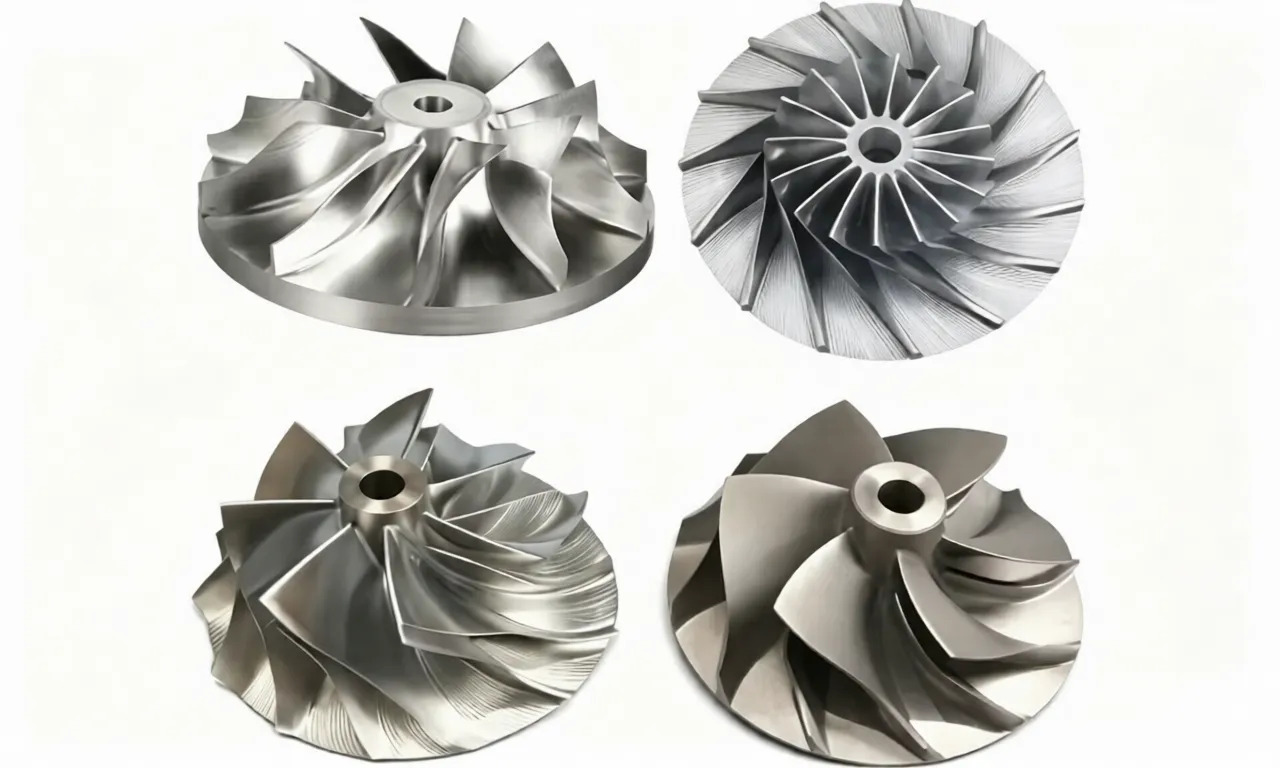
The micro-precision turbine component studied in this paper is applied to aerospace miniature power units, with an overall outer diameter of 28 mm and a wall thickness of 0.3–0.8 mm. The component is equipped with 12 asymmetric curved turbine blades, and the minimum fillet transition radius of the blade root is only 0.15 mm. In terms of performance indicators, the dimensional tolerance of key assembly positions is controlled within ±0.02 mm, and the surface roughness of the blade flow channel needs to be lower than Ra 0.8 μm. In addition, the component needs to work stably in a high-temperature and high-pressure environment for a long time, requiring the material to have excellent high-temperature oxidation resistance and mechanical fatigue resistance. The selected processing material is nickel-based superalloy powder with a particle size of 15–53 μm, which is a common high-strength alloy material for aerospace thermal-end components.
2.2 Core Processing Difficulties
Different from ordinary industrial parts, this aerospace turbine component has multiple processing pain points. Firstly, the asymmetric curved blade structure is difficult to form integrally. Traditional mechanical processing is prone to blade edge collapse and dimensional deviation, and secondary polishing will damage the structural consistency. Secondly, the thin-wall structure has high requirements for temperature field control during forming. Uneven heat accumulation will lead to thermal deformation and warping of the component, resulting in assembly failure. Thirdly, the internal flow channel of the turbine is narrow and closed, making it impossible to remove internal processing residues by traditional post-processing methods. Moreover, the aerospace service scenario puts forward ultra-high requirements for component compactness, and tiny internal pores will cause structural fatigue damage under high-speed rotation.
3. Selection and Principle of Rapid Prototyping Process
3.1 Process Selection Basis
Common rapid prototyping technologies include fused deposition modeling (FDM), stereolithography apparatus (SLA), selective laser sintering (SLS) and selective laser melting (SLM). FDM has low forming accuracy and poor material compactness, which is only suitable for low-strength plastic prototype production. SLA is limited to photosensitive resin materials and cannot meet the high-temperature resistance requirements of turbine components. SLS has low laser energy density, and the formed parts have obvious porosity with poor mechanical properties. In comparison, SLM technology uses high-energy fiber lasers to completely melt metal powder layer by layer under inert gas protection. It has the advantages of high forming precision, high material utilization rate and good structural integrity, which fully matches the processing requirements of nickel-based superalloy micro-turbine components.
3.2 SLM Rapid Prototyping Forming Principle
The SLM rapid prototyping system is mainly composed of laser emission module, powder spreading module, gas circulation purification module and numerical control scanning module. Firstly, the three-dimensional model of the turbine component is optimized and sliced by CAD software to generate layered processing path data. During the processing, the powder spreading roller uniformly lays nickel-based superalloy powder on the forming substrate with a single-layer powder thickness of 20 μm. The high-energy laser beam scans the powder layer according to the preset path, instantly melts the metal powder to form a molten pool, and realizes metallurgical bonding between adjacent powder particles. After the forming of one layer is completed, the forming cylinder descends by a single-layer height, and the powder spreading operation is repeated until the integral forming of the turbine component is completed. The whole processing process is carried out in a nitrogen-filled sealed cabin to avoid oxidation of high-temperature alloy materials.
4. Experimental Design and Parameter Optimization
4.1 Experimental Equipment and Detection Methods
The experiment adopts an industrial-grade SLM rapid prototyping equipment with a laser power range of 100–400 W and a scanning accuracy of 0.01 mm. After forming, a three-coordinate measuring instrument is used to detect the dimensional accuracy of key positions of the turbine component, a surface roughness meter is used to test the blade flow channel surface, and a metallographic microscope is used to observe the internal pore structure of the component. Combined with the high-speed rotation fatigue test bench, the service stability of the prototype under simulated working conditions is verified. In order to eliminate accidental errors, 5 groups of repeated processing tests are set for each parameter combination, and the average value is taken as the experimental data basis.
4.2 Influence of Key Process Parameters on Forming Quality
Laser power, scanning speed and powder layer thickness are the core parameters affecting the forming quality of SLM rapid prototyping. Excessively high laser power will cause excessive heat accumulation, resulting in blade warping and surface burning; while low laser power will lead to incomplete powder melting and increased internal porosity. When the scanning speed is too fast, the laser action time is short, and the molten pool cannot be fully fused; too slow scanning speed will reduce processing efficiency and cause local overheating. The experimental results show that when the laser power is 260 W, the scanning speed is 850 mm/s, and the single-layer powder thickness is 20 μm, the comprehensive forming performance of the turbine component is the best. Under this parameter combination, the internal porosity of the component is less than 0.8%, the dimensional error of the assembly position is controlled within 0.012 mm, and the surface roughness of the blade flow channel reaches Ra 0.65 μm.
4.3 Post-Processing Optimization Strategy
In order to further improve the surface finish and structural stability of the turbine component, targeted post-processing is carried out after rapid prototyping. Firstly, ultrasonic cleaning technology is used to remove residual powder in the narrow flow channel, with a cleaning time of 25 minutes and a cleaning medium of high-purity ethanol. Secondly, vacuum stress relief annealing is adopted to eliminate internal residual stress generated during layer-by-layer forming. The annealing temperature is set to 850 ℃, and the constant temperature holding time is 2 hours. Finally, micro-polishing is performed on the blade edge and flow channel surface to remove tiny melting burrs without changing the original dimensional accuracy of the component.
5. Processing Result Analysis and Performance Verification
5.1 Dimensional and Surface Quality Analysis
After processing and post-processing, the dimensional detection results of the micro-turbine component show that the overall dimensional error is less than 0.015 mm, which meets the aerospace ultra-precision assembly standard. The asymmetric curved blade has smooth transition without obvious step lines and melting defects. Compared with traditional CNC processing, the rapid prototyping process shortens the processing cycle of a single component from 18 hours to 4.5 hours, and the material utilization rate is increased from 42% to 91%, which greatly reduces the processing cost of high-value alloy materials. In terms of surface quality, the optimized post-processing effectively eliminates laser melting traces, and the surface flatness of the blade is significantly improved.
5.2 Mechanical and Working Condition Performance Test
The high-temperature tensile test and high-speed rotation fatigue test are carried out on the formed turbine components. At a high temperature of 650 ℃, the tensile strength of the component reaches 985 MPa, and the elongation is 14.2%, which is consistent with the mechanical properties of forged nickel-based superalloy. In the simulated aerospace working condition test, the component runs continuously for 500 hours at a rotation speed of 35000 r/min without blade deformation, cracking or performance attenuation. The internal metallographic structure is dense and uniform, without obvious pore defects, which proves that the rapid prototyping component has reliable service performance in extreme environments.
6. Industry Application Prospects and Technical Limitations
6.1 Engineering Application Value
This research verifies the feasibility of rapid prototyping technology in the batch trial production of aerospace micro-precision components. Compared with traditional manufacturing processes, rapid prototyping realizes integrated forming of complex thin-wall curved structures, eliminates the error accumulation caused by splicing processing, and significantly shortens the product iteration cycle. At present, the optimized SLM rapid prototyping process has been applied to the trial production of multiple miniature aerospace power components, providing a reliable technical scheme for the personalized customization and rapid verification of high-end aerospace parts. In addition, this technology can also be extended to the processing of precision parts in the fields of medical equipment and new energy vehicles, with broad industrial application prospects.
6.2 Existing Technical Limitations
Although rapid prototyping has outstanding advantages in precision component processing, there are still some technical bottlenecks. On the one hand, the equipment cost of high-precision metal rapid prototyping is high, and the processing cost of single small-batch components is still higher than that of mature mass production processes. On the other hand, the forming efficiency of large-size precision components is low, and the heat accumulation control technology for ultra-thin wall structures needs to be further optimized. In addition, the surface uniformity of complex deep-cavity structures is difficult to be comprehensively improved by conventional post-processing methods.
7. Conclusion
Taking aerospace micro-precision turbine components as the research object, this paper systematically explores the application effect of SLM rapid prototyping technology in the processing of high-precision and high-performance parts. Through the optimization of laser power, scanning speed and other core parameters, combined with vacuum annealing and micro-polishing post-processing technology, the high-quality forming of nickel-based superalloy turbine components is realized. The experimental results show that under the optimized process parameters, the component has excellent dimensional accuracy, surface quality and mechanical properties, which can meet the extreme service requirements of aerospace scenarios. Compared with traditional processing technologies, rapid prototyping has obvious advantages in processing complex structures, shortening production cycles and improving material utilization rates.
In the future, it is necessary to further develop intelligent temperature field monitoring technology and multi-beam laser synchronous scanning technology to improve the forming efficiency and structural uniformity of rapid prototyping. At the same time, combining machine learning algorithm to realize automatic optimization of process parameters can reduce manual debugging costs. With the continuous technological iteration, rapid prototyping will become one of the core manufacturing technologies for high-end precision components, and provide strong technical support for the high-quality development of aerospace, national defense and other advanced manufacturing industries.
Hot Articles
Hot Tags
Stay Connected!


Manufacturing on Demand
Please fill in the following information to obtain plan details (information is confidential and not disclosed publicly), we will contact you within 24 hours, please keep your phone available!
Upload a 3D/2D model to see instant pricing, lead time, and DFM feedback.