



A Medical PMMA Block With Hidden 3D Channels — and Why 0.1 mm Matters


When the Inside of a Part Matters More Than the Outside
How do you manufacture a solid, fully transparent block where the real engineering lives entirely inside — a three-dimensional maze of channels, chambers, and ports that must line up to within a tenth of a millimeter, seal perfectly, and still look like a single piece of crystal?
This is a medical-grade PMMA manifold that Mastars produced for a European client. At first glance, it looks like a simple rectangular block of clear acrylic. Look closer, or shine a light through it, and you see the truth: a complex internal fluidic network machined into multiple layers, then fused together so seamlessly that the bond lines disappear. The part routes liquids or gases through intersecting horizontal and vertical channels, holds them in circular chambers for mixing or observation, and connects to external medical tubing through precision-threaded ports.
Because this serves as a medical device, the assembly follows general tolerances per ISO 2768-mK, with critical internal channels held to ±0.1 mm. That number sounds small until you realize what it means in practice: if six independently machined PMMA layers shift by even a fraction of a millimeter during bonding, channels miss their connections, fluid paths dead-end, and the part becomes an expensive, leaky paperweight.
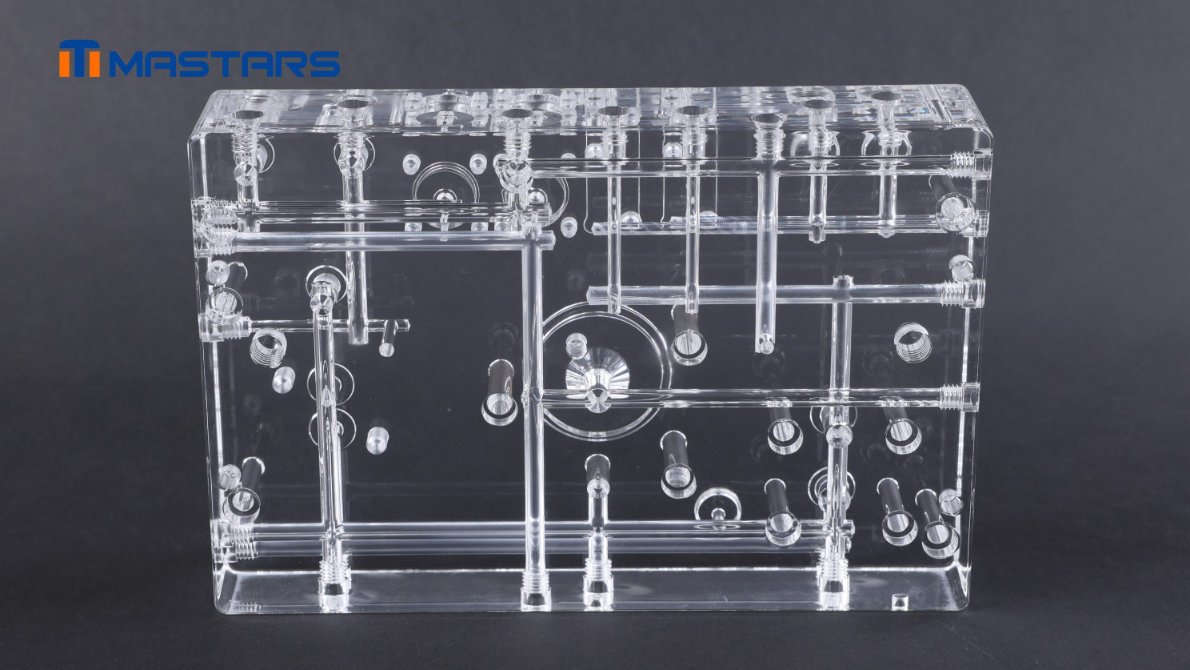
Transparent PMMA medical manifold with internal 3D channels, CNC-micromilled to 0.1 mm.
The Real Work Happens After CNC Machining
Most people see the transparency. Engineers should see the stack-up risk. This part is not carved from a single block — that would be impossible. Instead, Mastars machines individual PMMA layers on a high-precision CNC center, using single-flute polished tools at high spindle speeds with compressed-air and alcohol-mist cooling. Why not water? Because PMMA under water-based coolant surfaces, fog and micro-crack damage are permanent and ruin optical clarity forever.
Each layer is measured before bonding: channel depth, port position, and layer thickness. Anything outside the ±0.1 mm window is rejected. Then comes the step that makes or breaks the part: solvent bonding. The mating surfaces are treated with chloroform, which dissolves and re-fuses the PMMA molecules into a single continuous structure — no glue line, no foreign material, no optical defect. For a medical device that relies on visual fluid monitoring, that optical invisibility is non-negotiable.
After bonding, vapor polishing restores the internal channel surfaces. Controlled solvent vapor exposure smooths away micromilling tool marks without distorting the 0.1 mm geometry. The part then undergoes annealing to release residual stress from machining and bonding — stress that would otherwise cause crazing or cracking under thermal cycling in a clinical environment. Finally, pressure-decay leak testing and dimensional re-verification against the ±0.1 mm specification confirm that every channel is connected, every interface is sealed, and every optical path is clear.
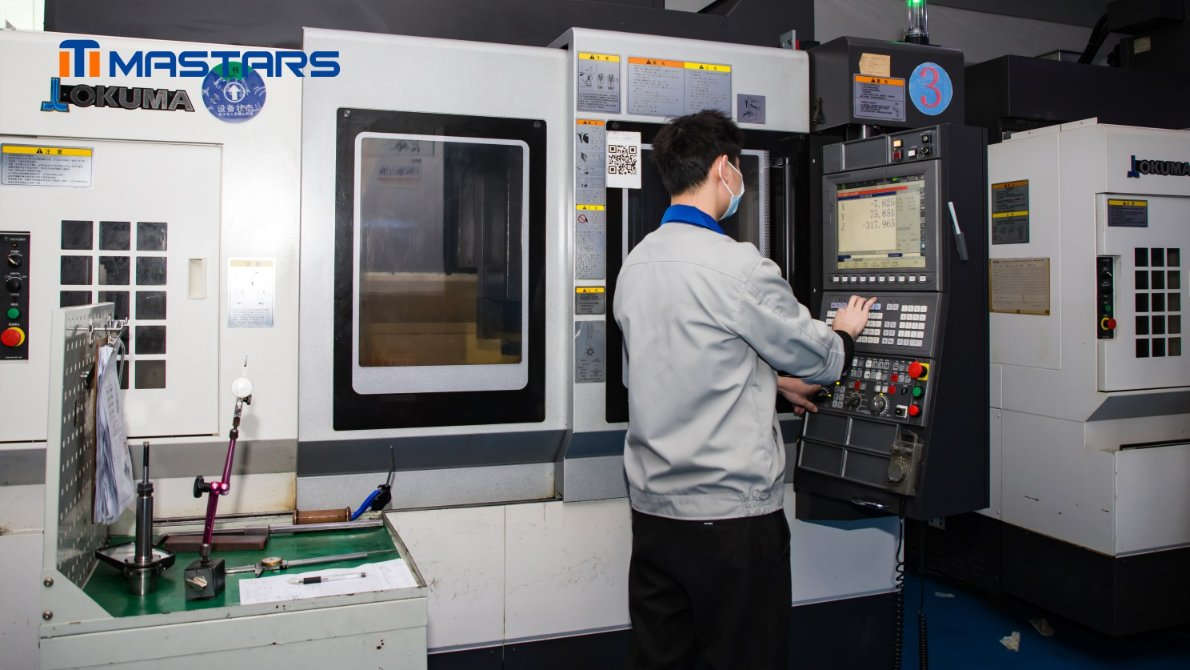
High-precision CNC micromilling on OKUMA center for medical PMMA mannifold production.
What "Medical-Grade" Actually Means Here
A European medical device manufacturer receives a PMMA manifold that meets ISO 2768-mK, passes leak testing, and maintains optical clarity for clinical fluid observation.
Here are more measurable improvements you’ll see:
✅ ±0.1 mm channel alignment across six or more bonded layers — eliminates dead volumes that previously required 15–20% extra reagent per test cycle
✅ Solvent-fused interfaces with zero visible seam lines — removes the need for secondary O-ring sealing, cutting assembly part count by roughly 30%
✅ Vapor-polished internal surfaces for unobstructed visual inspection — reduces surface roughness to <0.05 μm Ra, improving flow consistency and cutting calibration time by ~25%
✅ Annealed and pressure-tested to eliminate stress cracks and leaks — achieves <0.01 mbar·L/s leak rate under 2 bar test pressure, preventing field failures and rework
✅ Full traceability records for medical device documentation — supports ISO 13485 audit readiness from day one, shortening customer validation lead time by 2–3 weeks
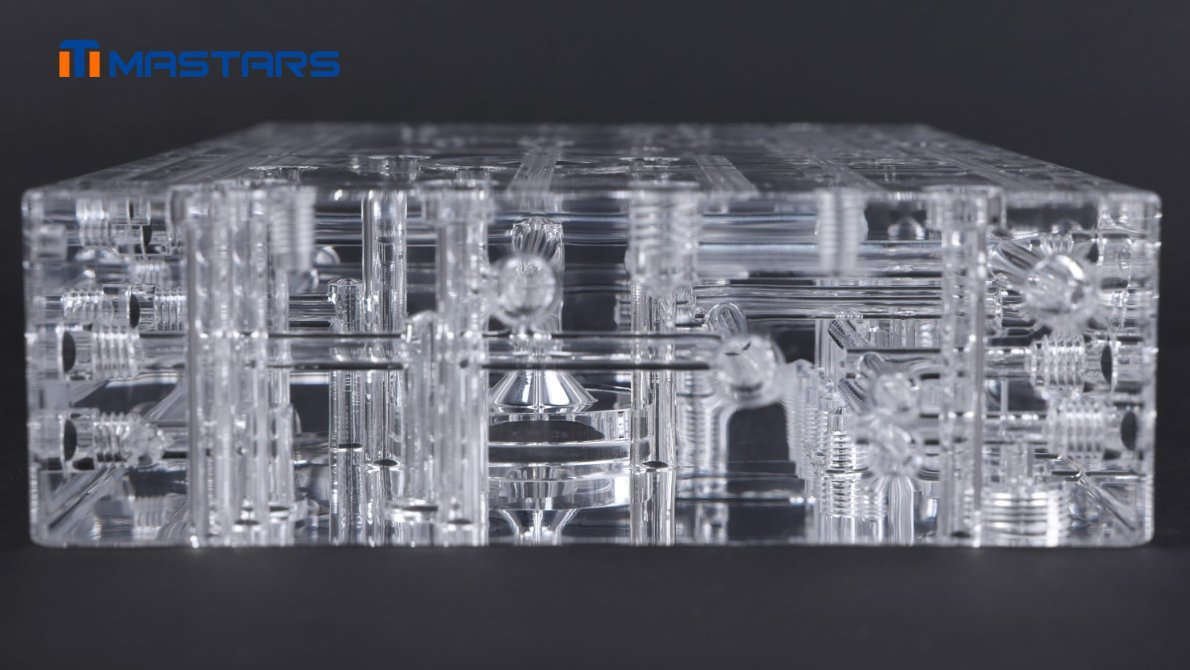
Multi-layer solvent bonding and vapor polishing create seamless optically clear fluidic paths.
This Challenge Is Bigger Than One Part
The same stack-up, bonding, and validation problem appears wherever medical or diagnostic devices need to see what is happening inside a fluid path.
It is widely applicable to various medical fluid-related scenarios:
- In-vitro diagnostics — transparent reagent manifolds and flow cells
- Surgical devices — irrigation blocks with real-time visual feedback
- Point-of-care instruments — disposable optical cassettes and microfluidic cartridges
- Pharmaceutical processing — visual mixing and reaction observation modules
- Medical R&D — transparent prototype housings for fluid dynamics validation
Does your next medical project need internal 3D geometry held to sub-0.1 mm accuracy, with full optical transparency and medical-device validation? Send your requirements to Mastars for DFM review, process definition, and manufacturing support.

Mastars, the most trusted one-stop manufacturing services provider for low-volume production worldwide!
Hot Articles



Hot Tags
Stay Connected!


Manufacturing on Demand
Please fill in the following information to obtain plan details (information is confidential and not disclosed publicly), we will contact you within 24 hours, please keep your phone available!
Upload a 3D/2D model to see instant pricing, lead time, and DFM feedback.