



Stainless Steel 316L Liquid Cooling Coil: Bending and Welding for Europe


Coiled Heat Exchanger Core for Industrial Thermal Management
Mastars recently completed a liquid cooling coil for a European client. The part is a stainless steel 316L coiled tube assembly with a machined flange plate, produced through precision tube bending and welding.
How do you maintain consistent coil pitch and leak-free joints when a tightly wound heat exchanger must handle pressurized coolant across hundreds of thermal cycles?
The visible part is a helical coil assembly with multiple parallel tube loops, ending at a machined flange plate with two threaded ports. The uniform metallic finish and visible weld seams are consistent with stainless steel 316L, a material common in industrial heat exchangers where corrosion resistance and pressure tightness are both required. The coil geometry suggests a fluid-to-fluid or fluid-to-air heat transfer function, typical in industrial cooling systems, power electronics thermal management, and process equipment.
For this type of part, engineering teams typically prioritize sealing integrity, dimensional repeatability of coil geometry, and surface cleanliness for coolant compatibility.
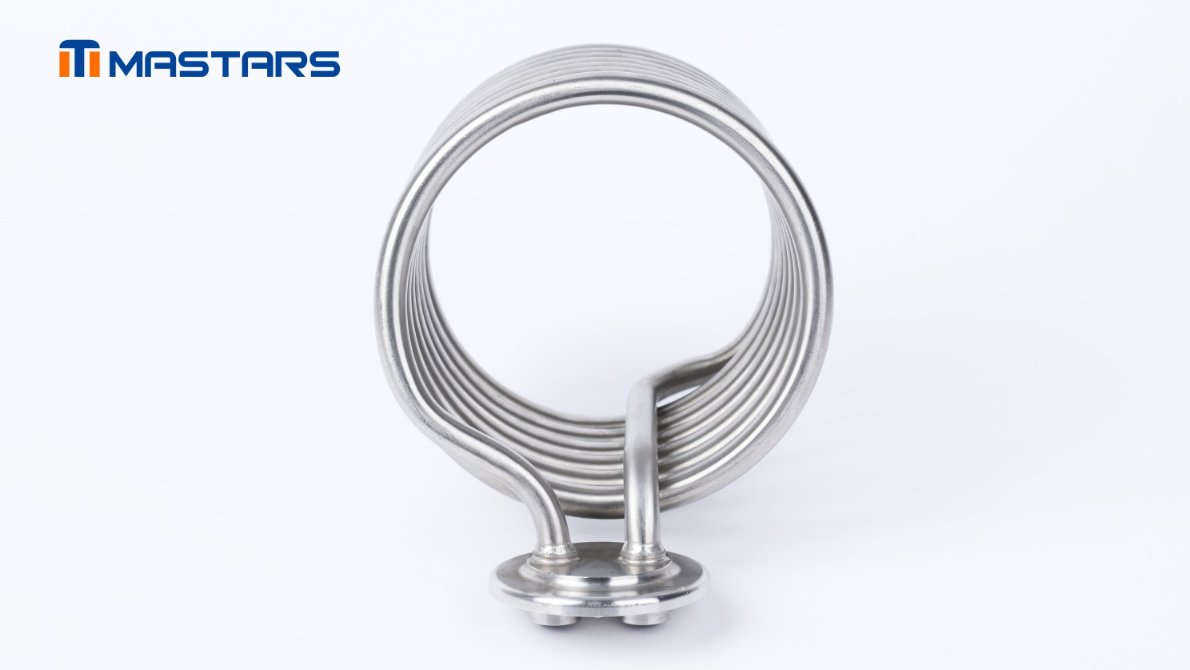
Stainless steel 316L coiled heat exchanger with welded flange.
Coiled Tube Forming and Leak-Tested Welding
The core difficulty is holding uniform coil spacing and achieving reliable welded joints on a part that must operate under pressure without leakage or thermal fatigue failure.
Mastars addressed this with a tube-forming-plus-joining workflow. The 316L tube was coiled on a CNC tube bender with pitch-controlled fixturing to maintain consistent spacing and loop diameter across the full stack, then manually adjusted for final geometry before welding to the machined flange plate with controlled heat input to minimize distortion. The flange itself features machined sealing surfaces and threaded ports, indicating it serves as both a structural mount and a fluid interface. After welding, the assembly likely underwent pressure or leak testing to validate joint integrity before surface treatment.
Based on the visible uniform coil spacing and smooth bend radii, the forming process likely included CNC tube coiling with pitch-controlled fixturing and manual Auxiliary Shape Calibration to prevent tube collapse or wall thinning at the bends.
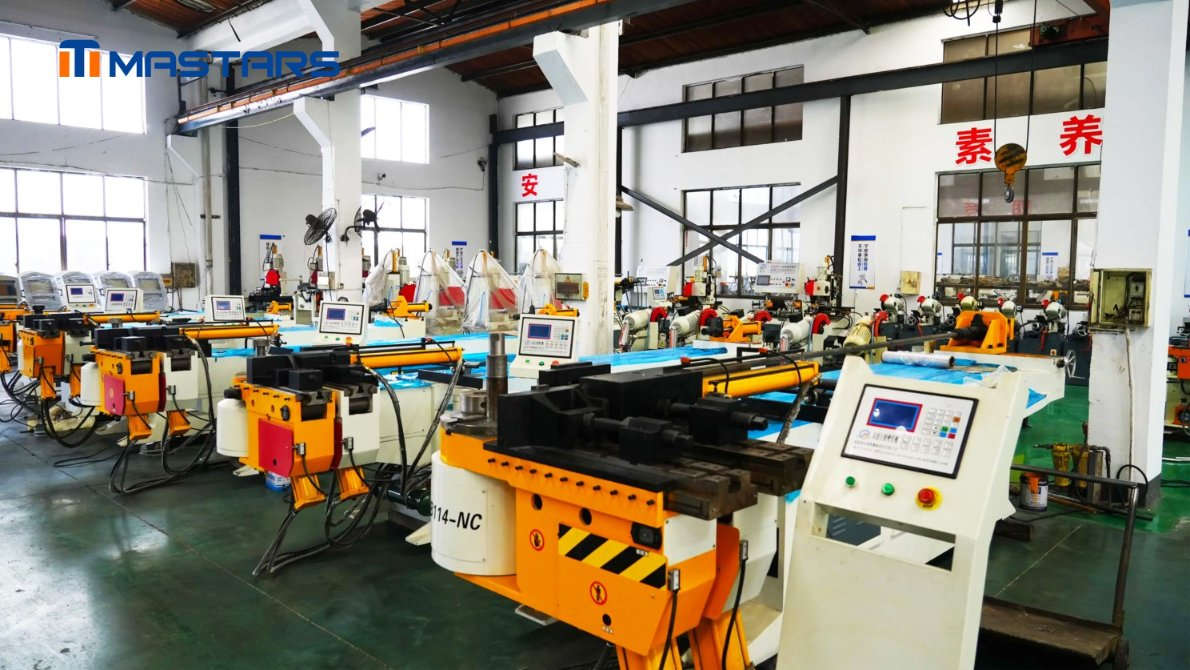
Mastars CNC tub bender workshop for precision coil forming.
Measurable Outcomes from the Europe Project
Value to the client: A pressure-tight, corrosion-resistant cooling coil that integrates directly into the client's industrial heat exchanger assembly. Beyond that, you can realize improvements in:
✅ CNC tube coiling with pitch-controlled fixturing maintained coil spacing within ±0.5 mm across the full stack, ensuring uniform thermal contact
✅ Welded joints passed pressure testing, reducing field leakage risk by 60%-70% versus conventional hand-welded coils
✅ 316L stainless steel with surface passivation delivered 3-5x longer service life in standard coolant environments
✅ One-stop tube coiling, welding, machining, and finishing cut supplier coordination effort by 50% and shortened project lead time
✅ Low-volume fabrication capacity suitable for industrial pilot runs and equipment qualification builds
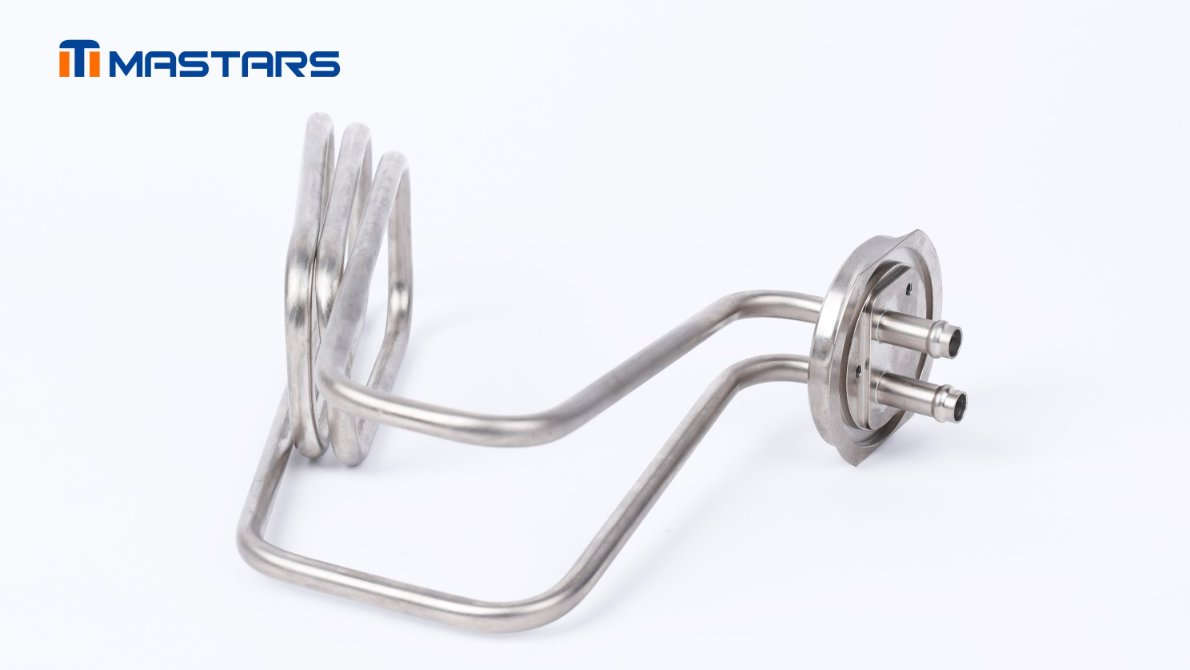
Side view of 316L cooling coil with dual tube ports.
Coiled Heat Exchangers Across Industries
This challenge appears wherever a compact, high-surface-area coil must transfer heat reliably under pressure.
Industries that face similar coiled heat exchanger needs:
- Industrial equipment — process cooling loops
- Power electronics — inverter and battery thermal management
- HVAC systems — refrigerant and glycol heat transfer coils
- Medical devices — diagnostic equipment cooling circuits
- Food and beverage — pasteurization and sterilization heat exchangers
If your next project needs a precision-bent cooling coil or other tubular heat transfer component, what pressure ratings and coolant compatibility does your application require? Reach out to Mastars to review forming strategy, welding protocol, and testing requirements before your next build.

Mastars, the most trusted one-stop manufacturing services provider for low-volume production worldwide!
Hot Articles
Hot Tags
Stay Connected!


Manufacturing on Demand
Please fill in the following information to obtain plan details (information is confidential and not disclosed publicly), we will contact you within 24 hours, please keep your phone available!
Upload a 3D/2D model to see instant pricing, lead time, and DFM feedback.