



PEEK-PTFE Semiconductor Valve Body: 5-Axis One-Shot Machining for Australia


Dual-Material Valve Body for Semiconductor Flow Control
Mastars recently completed a custom-machined semiconductor valve body for an Australian client. The part combines a beige PEEK outer shell with a white PTFE inner liner, machined as one continuous component on a Hermle 5-axis center.
How do you maintain thread engagement and sealing integrity when the rigid outer body and soft inner liner must be finished in a single clamping?
The visible geometry is a cylindrical valve body with external male threads on both ends, a central oval flange with mounting holes, and an internal bore. PEEK provides structural rigidity and chemical resistance, while PTFE delivers a low-friction, non-stick flow surface. This material pairing is common in semiconductor fluid handling, where both chemical inertness and dimensional stability are required. For this type of part, engineering teams typically prioritize fit and alignment, chemical cleanliness, and thermal stability under process temperatures.
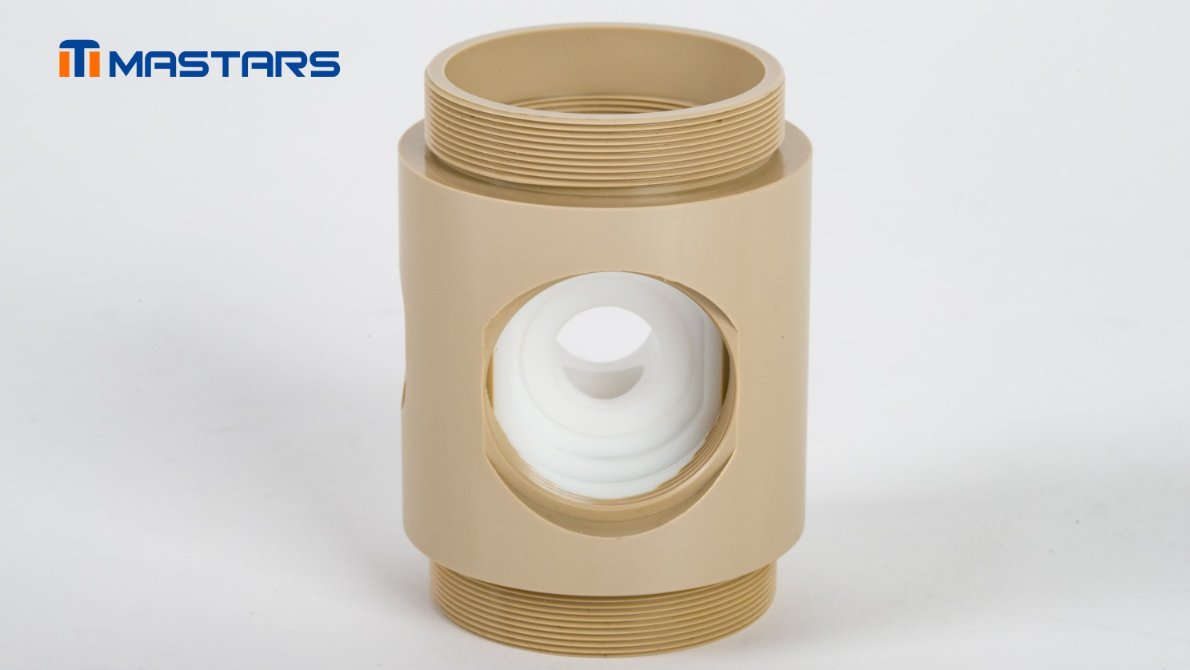
Hermle 5-axis machined PEEK-PTFE semiconductor valve body for Australia.
One-Shot 5-Axis Machining with Hermle
The core difficulty is machining two dissimilar plastics—rigid PEEK and soft PTFE—in one setup without cross-contamination, thermal distortion, or dimensional drift. The visible uniform surface finish and absence of tool chatter marks suggest the process likely included dedicated tooling for each material to prevent PTFE smearing onto PEEK surfaces.
Mastars addressed this with a one-clamping strategy on a Hermle 5-axis machining center. The entire part—external PEEK profile, internal PTFE liner geometry, both sets of threads, and flange mounting holes—was completed in a single fixturing. This eliminates re-fixture error and keeps the concentricity between outer threads and inner bore within tight limits. Tool paths were sequenced to machine PTFE zones with low cutting forces first, then finish PEEK threads with controlled spindle speeds and air-blast cooling to manage PEEK's heat sensitivity and PTFE's thermal expansion.
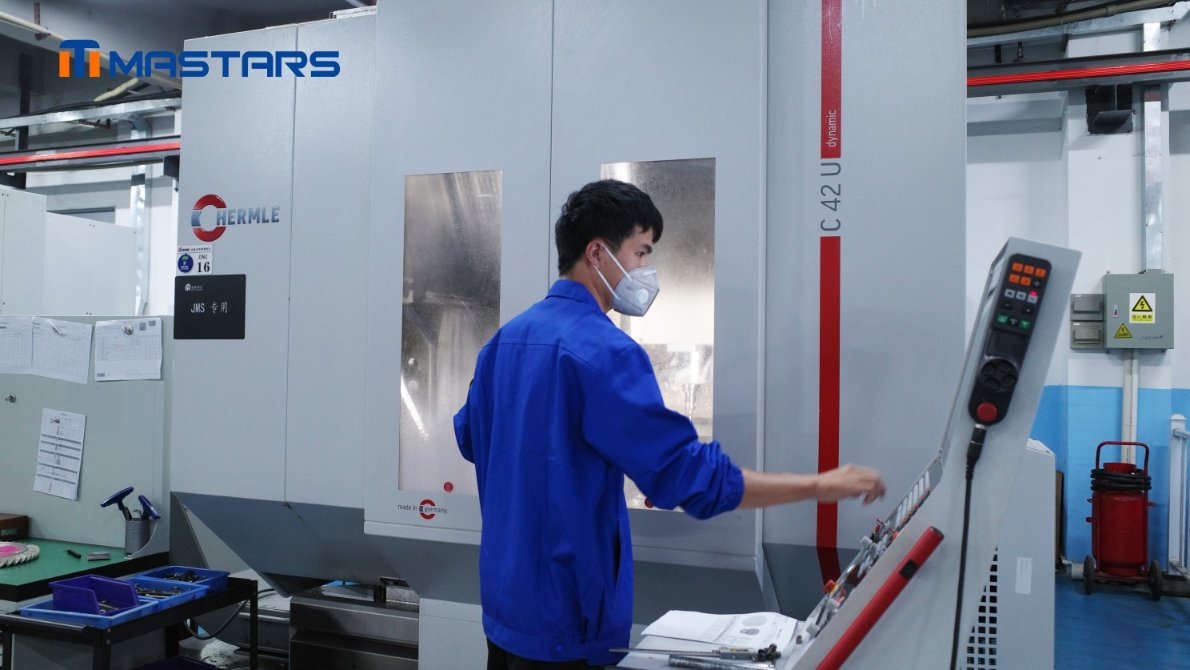
Hermle 5-axis machined PEEK-PTFE semiconductor valve body for Australia.
Measurable Outcomes from the Australia Project
Value to the client: A dual-material valve body that ships ready for cleanroom assembly without secondary bonding or liner insertion. Beyond that, you can realize improvements in:
✅ One-clamping 5-axis cycle reduced handling steps and alignment risk by 40%-50% versus multi-setup machining
✅ PEEK shell gives structural threads and chemical resistance rated for continuous semiconductor process use
✅ PTFE inner surface provides a low-friction, non-stick flow path with zero adhesive interface to eliminate outgassing
✅ Concentricity between outer threads and inner bore held within 0.02-0.03 mm through 5-axis single-fixture machining
✅ Low-volume precision production suitable for semiconductor pilot lines and qualification builds
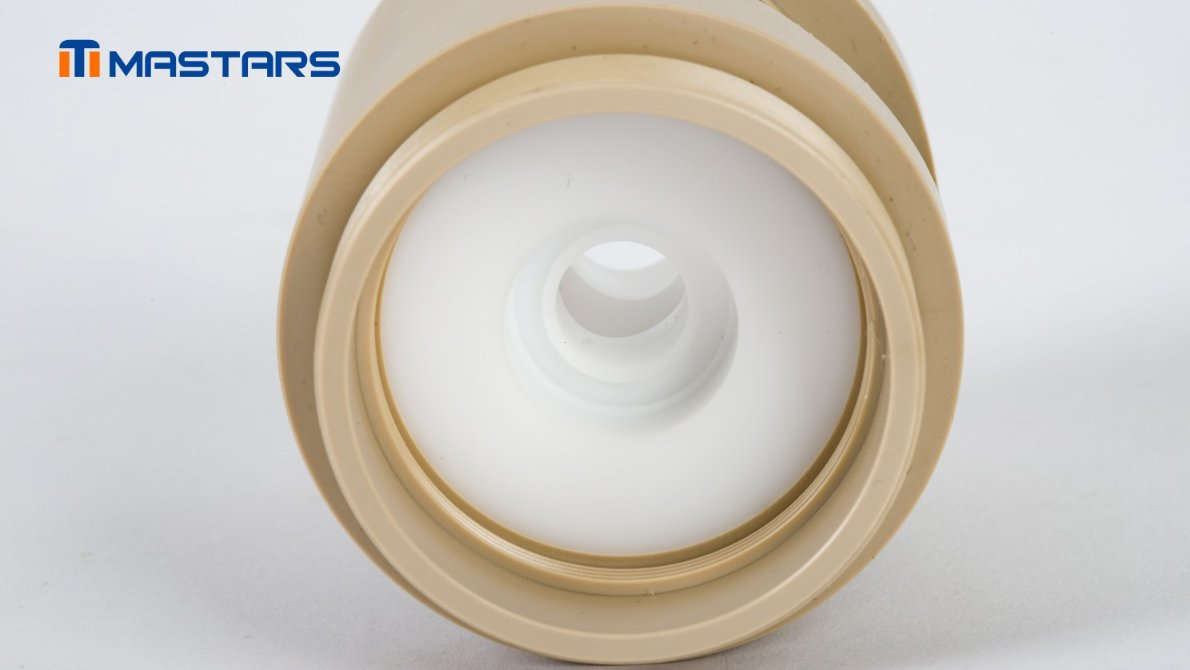
Top view shoing PEEK shell and white PTFE inner bore detail.
Precision Plastic Valve Bodies Across Industries
This challenge appears wherever a rigid housing must integrate a chemically inert sealing or flow surface.
Industries that face similar dual-material precision needs:
- Semiconductor — wafer processing manifolds
- Chemical processing — pump housings with fluoropolymer liners
- Medical devices — fluid delivery valve cartridges
- Food and pharma — high-purity filling valve bodies
- Aerospace — fuel system isolation valves
If your next project needs a PEEK-PTFE combination or other multi-material precision component, what tolerances and cleanliness levels does your application require? Reach out to Mastars to review DFM and machining strategy before your next build.

Mastars, the most trusted one-stop manufacturing services provider for low-volume production worldwide!
Hot Articles
Hot Tags
Stay Connected!


Manufacturing on Demand
Please fill in the following information to obtain plan details (information is confidential and not disclosed publicly), we will contact you within 24 hours, please keep your phone available!
Upload a 3D/2D model to see instant pricing, lead time, and DFM feedback.