



mastars|Titanium vs Aluminum,which Metal to Choose


Mastars' rapid prototyping service can provide various prototyping services according to customers' needs, verify your designed, provide fast, efficient and cost-effective services, and lay the foundation for future mass production of your products.
Titanium alloy and aluminum alloy are two different materials, which are widely used. Now let's have a look at the differences between titanium alloy and aluminum alloy.
What are the differences between titanium alloy and aluminum alloy?
1. Titanium alloy with different colors is a kind of silvery white metal and has better properties. Aluminum alloy is a non-ferrous metal with good strength and strong moldability.
2. The density of titanium alloy is 4.54 grams per cubic centimeter, which is lighter than steel and heavier than magnesium. It also has good high temperature resistance. The density of aluminum alloy will be smaller, only 1 / 3 of that of iron, and it has low melting point, high moldability and easy processing.
3. Different titanium alloys for different purposes can be used to make aircraft, which can carry more weight, and can also be used to make submarines, which are not easy to be corroded and dive deeper. Aluminum alloy is commonly used in aluminum alloy doors and windows, and has also been widely used in aerospace and machinery.
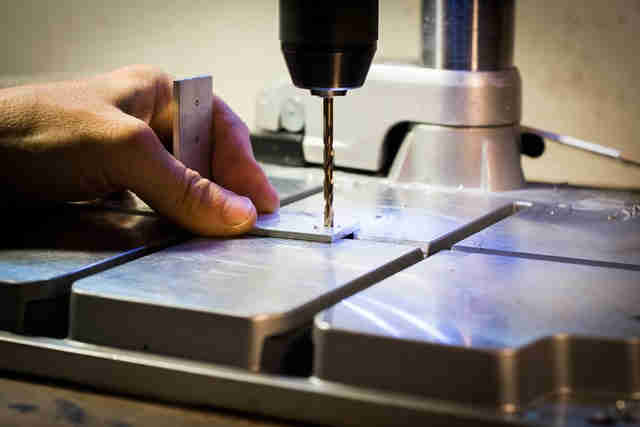
Aluminum will be the best metal for manufacturing or 3D printing because of its low cost. Although titanium is more expensive, it can provide value. Parts that are lighter in mass-save fuel in-vehicle applications and titanium elements last longer.
What are the characteristics of titanium alloy processing?
1. When cutting titanium alloy, the deformation coefficient will be less than or equal to 1, and the friction on the surface when cutting chips is relatively large, resulting in the acceleration of furniture wear.
2. The temperature of titanium alloy cutting is also relatively high. At this time, because the thermal conductivity of titanium alloy is relatively small, the heat generated during machining is not easy to spread out. In general, the heat generated by titanium alloy processing is about twice that of stainless steel.
3. The cold hardening phenomenon of titanium alloy during processing is relatively serious. Titanium alloy has great chemical activity. When it is cut at high temperature, it is easy to absorb oxygen and ammonia to produce a hard skin. In addition, when cutting, the change of plasticity will also lead to surface hardening. This will not only lead to fatigue strength of parts, but also accelerate the wear of props.
Mastars Industries CO., LTD
www.mastars.com
Email: marketing@mastars.com
Tel: +86 755-88210689
Fax: +86 755-8821 0685
Add: Building 6,Blue Sky Industrial Park, Ditang Road, Shajing Town, Shenzhen City, Guangdong, China
Hot Articles
Hot Tags
Stay Connected!


Manufacturing on Demand
Please fill in the following information to obtain plan details (information is confidential and not disclosed publicly), we will contact you within 24 hours, please keep your phone available!
Upload a 3D/2D model to see instant pricing, lead time, and DFM feedback.