



CNC Machining: Driving Precision Manufacturing of Sports Equipment Components


With the rapid development of the global sports industry and the rising demand for professional sports equipment, the requirements for product performance, safety, and durability have become increasingly stringent. As a core power transmission component of bicycles (road bikes, mountain bikes, and professional racing bikes), the crankset undertakes the key task of converting the rider’s leg power into forward driving force. It must meet strict standards for structural strength, lightweight design, dimensional accuracy, and fatigue resistance. CNC (Computer Numerical Control) machining technology, with its advantages of high precision, high efficiency, flexible production, and excellent process stability, has become the core manufacturing process for high-quality bicycle cranksets, injecting strong impetus into the upgrading of the sports equipment industry.
I. Core Demands of Bicycle Cranksets: Balancing Performance and Safety
The bicycle crankset consists of crank arms, chainrings, and bottom bracket interfaces, which are directly related to riding efficiency, comfort, and safety. Whether it is a professional racing bike pursuing extreme lightweight or a mountain bike facing harsh off-road conditions, the crankset must withstand repeated alternating loads (up to 500-800N per pedal stroke) and maintain stable performance for a long time. These application characteristics put forward comprehensive and strict requirements for the manufacturing process of cranksets, which are also the core scenarios where CNC machining exerts its technical advantages:
High structural strength and fatigue resistance: The crank arm is a typical cantilever beam structure, which is prone to bending and fatigue fracture under long-term high-intensity pedaling. The material must have high tensile strength (≥500MPa) and excellent fatigue life (more than 100,000 cycles of load tests without damage). Common materials include 6061-T6, 7075-T6 aluminum alloys, and titanium alloys, all of which rely on CNC machining to ensure structural integrity and stress distribution uniformity.
Strict dimensional accuracy and assembly compatibility: The crankset needs to be perfectly matched with the bottom bracket, chain, and other components. The parallelism of the two crank arms must be controlled within ±0.1mm, the positional accuracy of the chainring mounting holes is ±0.05mm, and the surface roughness of the bottom bracket interface is Ra ≤ 0.8μm. Any dimensional deviation will lead to abnormal noise, power loss, or even safety hazards during riding.
Lightweight design and aerodynamic performance: For professional sports bikes, every gram of weight reduction can improve riding efficiency. The crankset usually adopts a hollow structure and optimized profile design, with the wall thickness of the crank arm controlled at 2-4mm. CNC machining can accurately shape complex hollow structures and aerodynamic profiles that are difficult to achieve with traditional processes.
Excellent surface quality and corrosion resistance: Sports equipment often faces harsh use environments such as outdoor wind, rain, and sweat erosion. The crankset surface must be smooth, free of burrs, cracks, or defects, and needs to undergo anti-corrosion treatment (such as anodizing, powder coating) to resist oxidation and salt spray corrosion, ensuring a long service life and aesthetic appearance.
Traditional manufacturing processes such as forging + manual machining or stamping are difficult to balance the above requirements. CNC machining, with its precise numerical control system and flexible processing capabilities, has become the irreplaceable core technology for high-end bicycle crankset production.
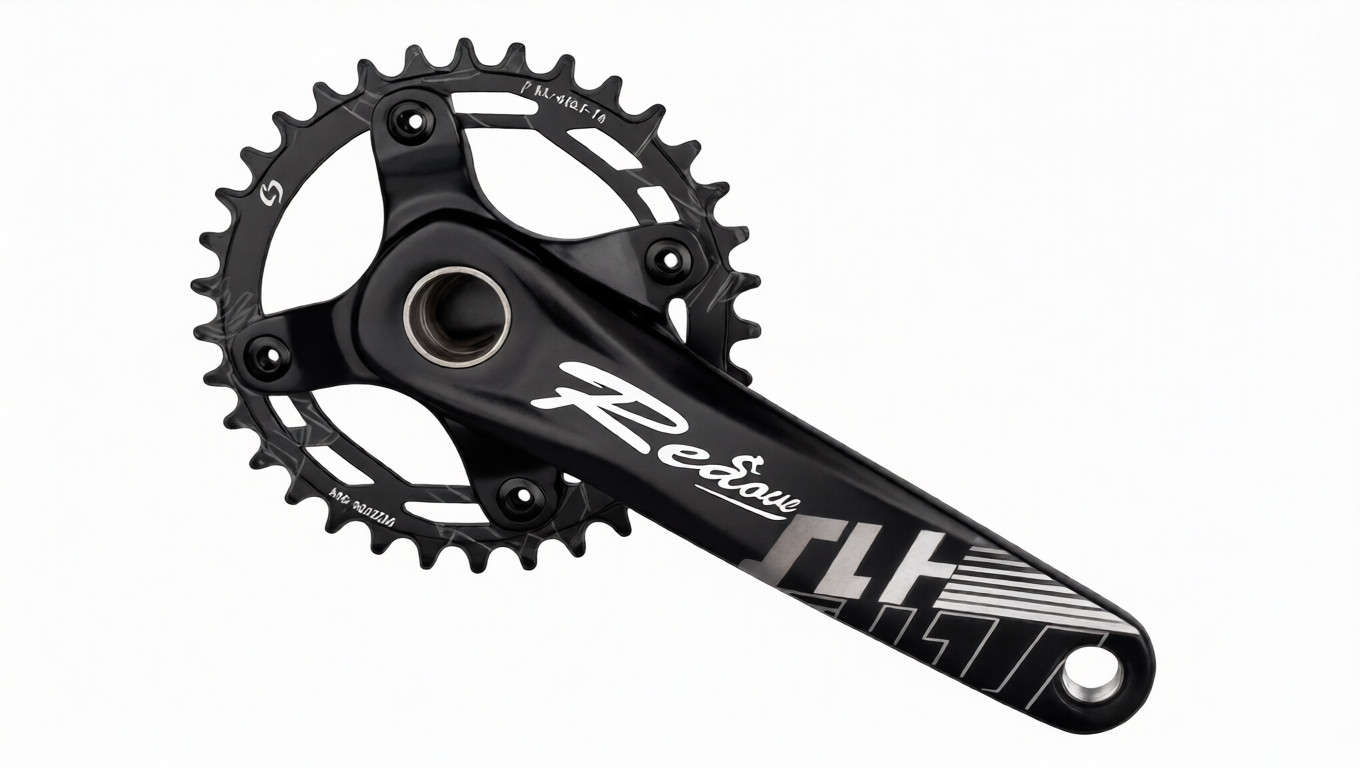
II. Core Applications of CNC Machining in Bicycle Crankset Manufacturing
CNC machining technology covers the entire production process of bicycle cranksets, from blank processing to finished product inspection, and can adapt to different materials, structural designs, and production scales. Its core applications are concentrated in material processing, process optimization, and precision control, forming a complete set of mature manufacturing solutions.
(I) Material Adaptation: Matching Different Sports Scenarios
Different types of bicycles have different requirements for crankset materials, and CNC machining can achieve precise processing of various materials to maximize their performance advantages:
1. Aluminum alloy cranksets: The most widely used type in the market (accounting for more than 70% of the market share), mainly using 6061-T6 and 7075-T6 aluminum alloys. 6061-T6 has good machinability and cost-effectiveness, suitable for civilian and entry-level sports bikes; 7075-T6 has higher strength (tensile strength ≥540MPa) and better fatigue resistance, suitable for professional racing bikes and mountain bikes. CNC machining can realize high-speed cutting of aluminum alloys (spindle speed 10,000-15,000rpm) and accurately shape hollow crank arms and complex profiles, while avoiding material deformation and burr generation.
2. Titanium alloy cranksets: High-end products for professional athletes, featuring high strength, low density, and excellent corrosion resistance. However, titanium alloy has high hardness (HRC 30-35) and poor machinability, which is a major challenge for manufacturing. CNC machining solves this problem through optimized tool selection (carbide or diamond-coated tools) and precise parameter control (low feed rate, high cutting speed, and sufficient cooling), ensuring processing efficiency and surface quality.
3. Carbon fiber composite cranksets: The mainstream of high-end racing bikes, with ultra-lightweight (weight reduction of 20-30% compared to aluminum alloys) and excellent shock absorption performance. CNC machining is mainly used for the precision trimming, drilling, and surface finishing of carbon fiber blanks, avoiding delamination and fiber breakage caused by improper processing, and ensuring the structural strength and safety of the product.
(II) Key Processing Processes: From Blank to Finished Product
The CNC machining process of bicycle cranksets is highly systematic, involving multiple processing links and equipment, and each link is closely related to the final product quality:
1. Blank preparation: The crankset blank is usually obtained through forging (aluminum alloy and titanium alloy) or molding (carbon fiber composite). Forged blanks have dense internal structures and high strength, and CNC machining can further optimize the material structure and remove excess material to form the initial shape of the crank arm.
2. CNC milling and turning: The core processing link, usually completed by vertical machining centers, horizontal machining centers, or five-axis machining centers. For the crank arm, CNC milling is used to process the profile, hollow cavity, and chainring mounting holes; for the bottom bracket interface, CNC turning is used to ensure dimensional accuracy and surface smoothness. Five-axis machining centers are widely used in high-end crankset production, which can realize multi-angle and multi-surface integrated processing in one clamping, avoiding errors caused by multiple clamping and improving processing accuracy and efficiency.
3. Precision drilling and tapping: The chainring mounting holes and bottom bracket fixing holes require high positional accuracy and thread quality. CNC drilling and tapping centers are used to complete these processes, with the drilling accuracy controlled within ±0.02mm and the thread tolerance meeting ISO 6H standards, ensuring reliable assembly and power transmission.
4. Deburring and surface finishing: After machining, the crankset surface will have burrs and tool marks, which need to be removed through CNC deburring or manual polishing. For aluminum alloy cranksets, anodizing treatment is usually performed after deburring to improve corrosion resistance and aesthetic appearance; for titanium alloy cranksets, passivation treatment is adopted to enhance surface hardness and corrosion resistance.
(III) Technical Advantages: Solving Key Manufacturing Challenges
CNC machining has unique technical advantages in solving the core challenges of bicycle crankset manufacturing, which are mainly reflected in the following aspects:
1. High precision and consistency: The CNC system can accurately execute processing programs with a positioning accuracy of ±0.005mm and a repeated positioning accuracy of ±0.01mm, ensuring that each crankset has consistent dimensional accuracy and assembly performance in mass production. This is particularly important for sports equipment that requires batch supply and interchangeable parts.
2. Flexible production and rapid customization: By modifying the processing program, CNC machining can quickly switch between different types, specifications, and designs of cranksets without replacing large-scale molds or fixtures. This is conducive to meeting the personalized customization needs of professional athletes and the multi-variety, small-batch production needs of sports equipment manufacturers.
3. Optimized structural design and performance improvement: CNC machining can realize complex structural designs such as hollow crank arms, aerodynamic profiles, and weight-reducing grooves that are difficult to achieve with traditional processes. These designs not only reduce the weight of the crankset but also optimize the stress distribution, improve fatigue resistance and riding efficiency.
4. High efficiency and cost control: With the development of high-speed cutting technology and intelligent CNC equipment, the processing cycle of bicycle cranksets has been significantly shortened. For example, the processing time of a single aluminum alloy crank arm can be controlled within 15-20 minutes. At the same time, CNC machining reduces material waste and manual intervention, effectively controlling manufacturing costs while ensuring product quality.
III. Application Cases: CNC Machining Empowers the Upgrade of Sports Equipment
In the global sports equipment industry, CNC machining has become the standard manufacturing process for high-end bicycle cranksets, and many professional sports equipment brands and manufacturers rely on this technology to improve product performance and market competitiveness.
For example, in the production of professional road bike cranksets, a well-known global sports equipment brand adopts five-axis CNC machining centers to process 7075-T6 aluminum alloy blanks. Through optimized tool paths and cutting parameters, the crank arm is designed as a hollow structure with a wall thickness of 2.5mm, reducing the weight by 18% compared to traditional solid cranksets. At the same time, the positional accuracy of the chainring mounting holes is controlled within ±0.03mm, ensuring smooth power transmission and reducing riding noise. The product has passed 200,000 cycles of fatigue tests and has been widely used in international cycling competitions.
In the field of mountain bikes, a domestic sports equipment manufacturer uses CNC machining technology to produce titanium alloy cranksets. By selecting high-quality carbide tools and optimizing the cooling system, it solves the problem of poor machinability of titanium alloy, and the surface roughness of the crank arm reaches Ra 0.4μm. After passivation treatment, the product can withstand 500-hour salt spray tests, meeting the corrosion resistance requirements of harsh off-road environments. The product has been well received by mountain bike enthusiasts for its high strength, durability, and lightweight characteristics.
IV. Future Trends: CNC Machining Drives the Intelligent Upgrade of Sports Equipment
With the continuous development of the sports equipment industry towards intelligence, personalization, and high performance, the application of CNC machining technology in bicycle crankset manufacturing will usher in new development trends, and its technical content and application scope will be further expanded.
1. Intelligent processing and digital twin technology: The integration of CNC machining with digital twin technology will realize real-time simulation, monitoring, and optimization of the entire processing process. By building a virtual processing model, manufacturers can predict and avoid processing defects in advance, adjust processing parameters in real time, and improve production efficiency and product yield. At the same time, intelligent CNC equipment equipped with industrial cameras and sensors will realize online detection and quality control of cranksets, ensuring zero defective products entering the market.
2. Application of new materials and new processes: With the emergence of new materials such as high-strength magnesium alloys, ceramic matrix composites, and graphene-reinforced composites, CNC machining will face new challenges and opportunities. The research and development of targeted processing tools, parameters, and processes will promote the application of new materials in bicycle cranksets, further improving product performance and reducing weight. In addition, the combination of CNC machining with 3D printing technology will realize the rapid prototyping and small-batch production of personalized cranksets, meeting the diverse needs of professional athletes and consumers.
3. Green and low-carbon processing: In response to the global "dual-carbon" strategy, CNC machining will develop towards green and low-carbon production. The promotion of energy-saving CNC equipment, environmentally friendly cutting fluids, and material recycling technology will reduce energy consumption and environmental pollution in the production process. At the same time, the optimization of processing paths and the reduction of material waste will further improve the utilization rate of resources, promoting the green development of the sports equipment industry.
Conclusion
As a core component of bicycles, the crankset's manufacturing quality directly determines the performance, safety, and comfort of sports equipment. CNC machining technology, with its high precision, high efficiency, flexibility, and stability, has become the backbone of high-quality bicycle crankset production, and has played an important role in promoting the upgrading and development of the sports equipment industry.
From material processing to structural optimization, from precision control to intelligent production, CNC machining is constantly breaking through technical bottlenecks and meeting the increasingly stringent requirements of the sports equipment industry. In the future, with the deep integration of intelligent technology, new materials, and new processes, CNC machining will continue to play a core role in the field of sports equipment manufacturing, helping to create more high-performance, personalized, and environmentally friendly sports equipment, and contributing to the development of global sports undertakings.
Hot Articles
Hot Tags
Stay Connected!


Manufacturing on Demand
Please fill in the following information to obtain plan details (information is confidential and not disclosed publicly), we will contact you within 24 hours, please keep your phone available!
Upload a 3D/2D model to see instant pricing, lead time, and DFM feedback.