



Metal Injection Molding (MIM): Professional Terminology


Metal Injection Molding (MIM): Professional Terminology
Category 1: Core Process & Overview
Term | Definition & Context |
Metal Injection Molding (MIM) | A manufacturing process that combines the design flexibility of plastic injection molding with the material performance of wrought metals to produce small, complex, high-strength parts. |
Powder Injection Molding (PIM) | A broader term that includes MIM and Ceramic Injection Molding (CIM). |
Feedstock | The homogeneous mixture of fine metal powder and a multi-component binder that is the raw material for the MIM process. |
Debinding | The critical process of removing the binder from the "green" part after molding. |
Sintering | The high-temperature process where the "brown" part is densified to near-theoretical density. |
Category 2: Materials: Powder & Binder
Term | Definition & Context |
Metal Powder | Fine, spherical powder, typically 5-20 µm in diameter, made from alloys like 316L stainless steel, 17-4PH, or Ti-6Al-4V. |
Binder | A multi-component system (typically polymers and waxes) that temporarily binds the metal powder particles together to allow for molding. |
Feedstock | The final, pelletized form of the uniform mixture of metal powder and binder. |
Powder Loading | The critical volume fraction of metal powder in the feedstock. It determines the final part density and shrinkage, typically around 60% by volume. |
Rheology | The study of the flow and deformation of the feedstock. Proper rheology is essential for successful molding. |
Category 3: The Molding Stage
Term | Definition & Context |
Green Part | The part as it is ejected from the mold. It has the precise shape but is very fragile, as its strength comes entirely from the binder. |
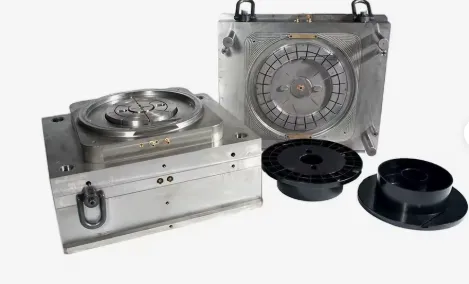
Mold (Tool) | The precision tool, typically made of tool steel, that shapes the feedstock. Similar to plastic injection molds. |
Gate | The small entrance point through which the feedstock enters the mold cavity. |
Runner | The channel that delivers the feedstock from the machine nozzle to the mold cavity. |
Shot | A single cycle of the molding machine, or the volume of material injected. |
Mold Release Agent | A lubricant sprayed into the mold to aid in the ejection of the green part. |
Category 4: The Debinding Stage
Term | Definition & Context |
Debinding | The process of removing the binder from the green part. This is often a multi-step process. |
Solvent Debinding | The primary debinding step where a major binder component (often a wax) is dissolved away by immersing the part in a solvent (e.g., Heptane). This creates open channels for the next stage. |
Thermal Debinding | The secondary debinding step where the remaining binder is removed by thermal decomposition in a controlled atmosphere furnace. This is often the start of the sintering cycle. |
Catalytic Debinding | A highly controlled primary debinding process, often used for certain binder systems (e.g., BASF's Catamold), where a catalyst (e.g., Nitric Acid vapor) decomposes the binder. |
Brown Part | The part after the debinding process. It is a porous, fragile metal skeleton that holds its shape but has very low strength. |
Category 5: The Sintering Stage
Term | Definition & Context |
Sintering | The high-temperature process where the brown part is heated to just below its melting point, causing the powder particles to fuse (densify) through atomic diffusion. |
Sintering Furnace | A high-temperature, controlled-atmosphere furnace (e.g., vacuum, hydrogen) used for sintering. |
Densification | The increase in density that occurs during sintering as pores between powder particles are eliminated. |
Shrinkage | The uniform, predictable reduction in the part's dimensions that occurs during sintering. It is typically 15-25% linearly and must be precisely accounted for in the mold design. |
Final Density | The density of the sintered part, usually expressed as a percentage of theoretical density. MIM parts typically achieve 96% - 99.5% density. |
Carbon Control | The critical process of maintaining the correct carbon content in the atmosphere during sintering, especially for steels, to achieve desired mechanical properties. |
Category 6: Part Properties & Defects
Term | Definition & Context |
Theoretical Density | The density of a perfectly solid, pore-free piece of a material. |
Mechanical Properties | The material properties of the sintered part (e.g., tensile strength, yield strength, elongation). MIM parts have properties close to wrought materials. |
Isotropic Shrinkage | The property of shrinking equally in all directions, which is a key characteristic and advantage of the MIM process. |
Sintering Distortion | Warping or bending of a part during sintering, often caused by non-uniform density in the green part or improper support during the sintering cycle. |
Cracking | A defect that can occur during debinding or sintering if the process is too rapid, creating internal stresses. |
Blistering | A surface defect where gases trapped inside the part cause bubbles or blisters on the surface during sintering. |
Black Core | A defect where carbonaceous binder residue is trapped inside the part, affecting its chemistry and properties. |
Category 7: Quality Control & Secondary Operations
Term | Definition & Context |
Metalography | The microscopic examination of a part's cross-section to evaluate density, pore structure, and microstructure. |
Sintering Setter | A ceramic plate or fixture used to support the brown parts during sintering to prevent distortion. |
Coining / Sizing | A secondary operation where the sintered part is pressed in a die to calibrate a critical dimension to a very tight tolerance. |
Heat Treatment | A post-sintering process (e.g., hardening, aging) used to enhance the mechanical properties of the sintered part. |
HIP (Hot Isostatic Pressing) | A post-sintering process that uses high temperature and isostatic gas pressure to eliminate internal porosity and improve fatigue life. |
Hot Articles
Hot Tags
Stay Connected!


Manufacturing on Demand
Please fill in the following information to obtain plan details (information is confidential and not disclosed publicly), we will contact you within 24 hours, please keep your phone available!
Upload a 3D/2D model to see instant pricing, lead time, and DFM feedback.