



Gravity Die Casting vs Pressure Die Casting: Key Differences


Two suppliers can look at the same casting drawing and recommend different processes. One may suggest gravity die casting because the tooling investment is lower. Another may recommend high-pressure die casting (HPDC) because the part has thin walls and the annual volume justifies faster production.
More importantly, gravity die casting and pressure die casting are not completely separate manufacturing families. Gravity casting relies on the weight of the molten metal to fill a reusable die, while pressure die casting—typically high-pressure die casting (HPDC)—uses a plunger to inject metal into the die at high speed and pressure. That difference affects wall thickness, porosity, heat treatment, tooling cost, cycle time, dimensional repeatability, and downstream machining.
| Factor | Gravity Die Casting | High-Pressure Die Casting |
|---|---|---|
| Filling | Gravity | High-pressure injection |
| Tooling | Lower initial investment | Higher initial investment |
| Cycle time | Longer | Shorter |
| Thin sections | More limited | Better suited |
| Typical production volume | Low to medium | Medium to high |
| Gas entrapment | Lower risk | Higher risk |
| Heat treatment | Generally more compatible | Alloy/process dependent |
| Dimensional repeatability | Good | Very good |
| Surface finish | Good | Very good |
A low quoted unit price can be misleading. Tooling, annual volume, machining, scrap, and inspection can change the economics considerably.
The sections below focus on the factors that usually drive the process decision: wall thickness, porosity, heat treatment, tooling cost, production volume, and the machining and inspection required after casting.
How Do Gravity Die Casting and Pressure Die Casting Work Differently?
Gravity die casting and HPDC both use reusable metal tooling, but the filling conditions are very different. Gravity casting uses the metal’s own weight to fill the cavity, while HPDC forces molten metal into the die with a plunger. The difference affects how engineers approach gating, venting, cooling, wall thickness, and solidification.
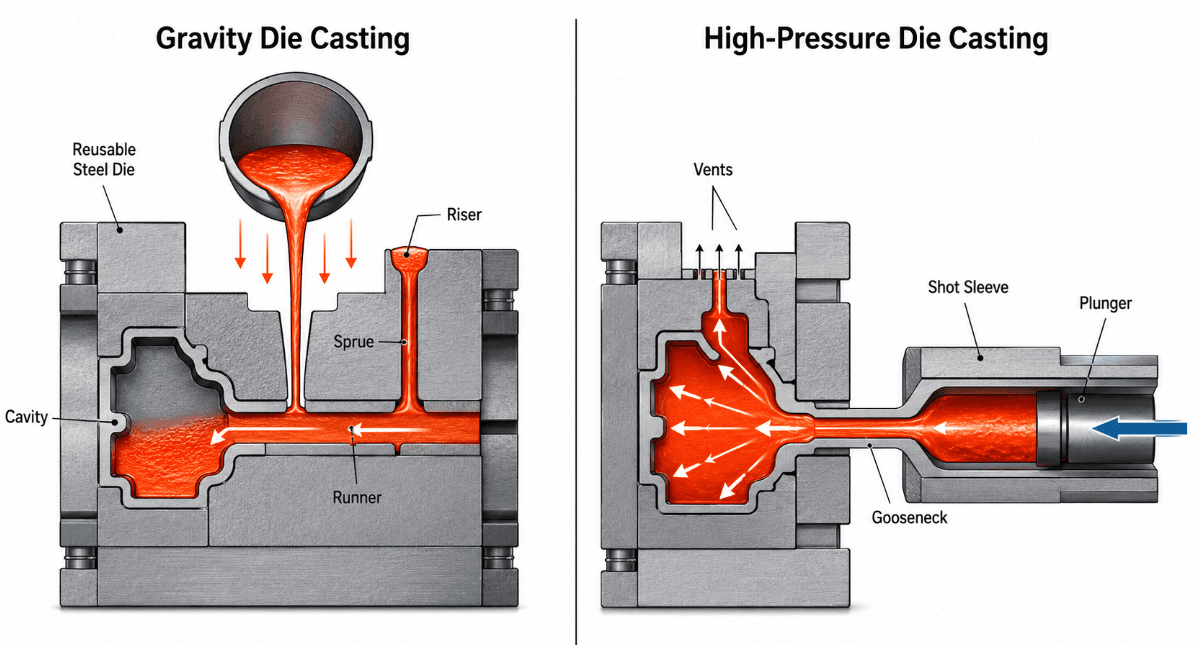
Gravity die casting vs HPDC filling process comparison
Gravity Die Casting
In gravity die casting, molten metal is poured into a preheated permanent metal mold. Gravity drives the metal through the gating system and into the cavity. The mold can be tilted or designed with specific gates, risers, and feeders to control filling and compensate for shrinkage during solidification.
The process requires less expensive tooling than HPDC in many applications and gives the foundry more time to control filling and solidification. That can be useful when casting integrity or subsequent heat treatment is important.
Production speed is the main trade-off. Thin sections, deep cavities, and intricate details are harder to fill consistently because the metal is not being injected at high speed. Wall thickness, die temperature, gating design, and feeding need to be considered during DFM.
High-Pressure Die Casting
HPDC uses a shot sleeve and plunger to inject molten metal into the die at high speed and pressure. For aluminum parts, cold-chamber machines are commonly used. After filling, the metal solidifies under pressure before the casting is ejected and trimmed.
This makes HPDC well suited to complex housings, ribs, bosses, thin walls, and high-volume production. Fast filling also helps the metal reach narrow sections before premature solidification.
A transmission housing project provides a useful example. The documented HPDC process used injection speeds of approximately 1–5 m/s and pressures of 100–1,500 bar, with parameters adjusted according to section thickness and geometry. Thin areas needed sufficient injection speed to reduce cold-shut risk, while thicker areas required control of turbulence and air entrapment.
Injection pressure is only one part of the process window. Die temperature, venting, cooling, alloy behavior, and injection speed all affect the finished casting.
Wall Thickness, Porosity, and Heat Treatment
HPDC is usually the stronger option for thin walls, complex details, and short production cycles. Gravity die casting becomes more attractive when lower tooling investment, controlled filling, lower gas-entrapment potential, or heat treatment carry more weight. Mechanical performance depends on the alloy, geometry, solidification, porosity, and subsequent treatment as much as on the casting method itself.
Wall Thickness and Geometry
HPDC can produce thinner sections because molten metal enters the cavity quickly, reducing the time available for premature solidification. For suitable aluminum designs, sections around 0.8–1.5 mm can be achievable. Gravity die casting commonly works better with thicker sections, often around 2.5–5 mm, depending on alloy, geometry, tooling, and required quality.
These are design reference ranges rather than universal minimums. Flow length, part size, alloy fluidity, die temperature, gating, and the required casting quality can all change the practical limit.
A transmission housing shows why nominal wall thickness alone is not enough. In the same transmission housing project, the housing had an average wall thickness of approximately 5–6 mm, with local sections reaching around 20 mm. The thinner areas required controlled filling to avoid cold shuts, while the thicker sections required attention to cooling, feeding, porosity, and shrinkage.
For designers, smooth transitions between sections are important. Ribs, fillets, draft, and local thick areas should be considered together with how the metal will fill and solidify.
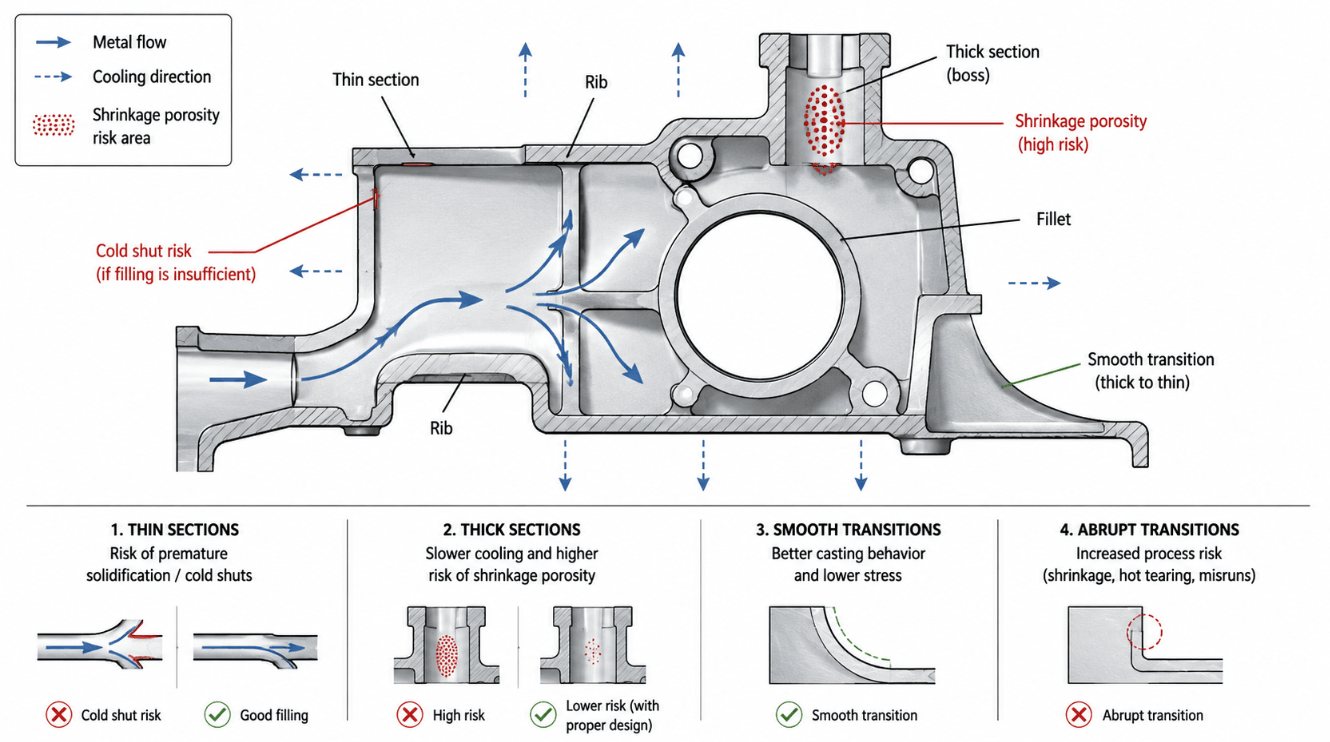
Die casting wall thickness and porosity risk in thin and thick sections
Porosity Is Often the Bigger HPDC Concern
HPDC has a greater risk of gas entrapment because molten metal enters the cavity at high speed. If air cannot escape through the venting system, it can become trapped inside the casting. Turbulent flow and dissolved gas can add to the problem.
Gravity casting has a lower filling velocity, which can reduce some air-entrapment risks. Shrinkage porosity remains possible, particularly in thick sections where solidification takes longer.
In the same transmission housing project, defect control included molten-aluminum degassing, optimized gating and venting, controlled cooling, and inspection after casting. CMM measurement, non-destructive testing, and leak testing were used to check the finished housing.
Acceptance criteria should be tied to the defect location and the function of the casting. A cosmetic cover and a pressure-tight housing can have very different defect limits.
Heat Treatment Changes the Process Choice
Conventional HPDC can contain entrapped gas and internal porosity that make some heat-treatment conditions difficult. During heating, trapped gas can expand and cause blistering or dimensional problems.
Gravity die casting is generally more compatible with conventional heat-treatment routes because the slower filling process can reduce gas entrapment when the process is properly controlled. LPDC is another option when structural integrity and heat treatment are important.
Alloy selection also narrows the choice. A356 is commonly associated with gravity and low-pressure casting where strength and heat treatment are important. A380 and ADC12 are widely used in HPDC because of their casting and production characteristics, although their suitability for a specific heat-treatment condition needs to be checked against the application.
Tooling Cost vs. Part Cost: Why Production Volume Changes the Answer
HPDC usually requires more expensive tooling, while gravity die casting has a lower initial tooling commitment but a slower production cycle. The expected quantity determines how much that tooling investment contributes to the finished part cost.
A useful first calculation is:
Tooling cost per part = Tooling cost ÷ Expected production quantity
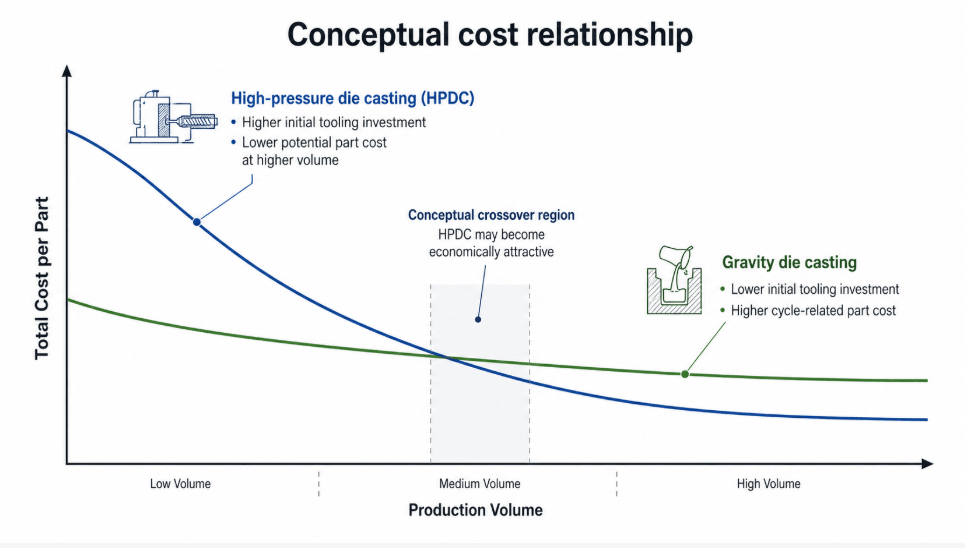
Gravity die casting and HPDC tooling cost versus production volume
For a few thousand parts, lower-cost gravity tooling may be attractive even if each casting takes longer to produce. At higher volumes, HPDC can spread its tooling investment across more parts while benefiting from shorter cycles and greater automation.
Some industry references use roughly 500–10,000 parts as a planning range for gravity casting and 50,000+ parts per year as a point where HPDC can become particularly attractive. These figures are useful for early planning rather than fixed break-even thresholds. Part size, die complexity, machine requirements, scrap, machining, and tool life can move the economics substantially.
Mastars’ manufacturing materials also document die-casting production for quantities above 10,000 pieces, supported by automated production lines.
For a real quotation, compare the complete production cost over the expected program volume. Tooling and unit price alone do not tell the whole story.
Gravity Casting, LPDC, and Sand Casting Solve Different Problems
Gravity die casting is only one alternative when HPDC does not fit the part. Low-pressure die casting and sand casting can make more sense when the geometry, volume, or casting-integrity requirements fall outside the practical range of HPDC.
| Process | Strongest Use Case | Main Trade-Off |
|---|---|---|
| Gravity Die Casting | Moderate-volume, durable castings | Slower filling and thicker sections |
| Low-Pressure Die Casting | High-integrity aluminum structural parts | More equipment and process control |
| HPDC | Thin-wall, complex, high-volume parts | Higher tooling and porosity considerations |
| Sand Casting | Large or low-volume parts | Lower dimensional consistency and finish |
Gravity Die Casting vs. Low-Pressure Die Casting
Low-pressure die casting uses relatively low gas pressure to push molten metal upward through a riser tube into the die. The bottom-up filling pattern provides stable, relatively low-turbulence metal flow and is widely used for aluminum wheels and structural components.
Compared with gravity casting, LPDC offers greater control over filling but requires more specialized equipment and process control. It is worth considering when a part needs good structural integrity or heat-treatment potential while still benefiting from a reusable metal die.
Gravity Casting vs. Sand Casting
The mold is the main difference. Gravity die casting uses a reusable metal mold, while sand casting uses a disposable sand mold for each part.
Gravity casting generally provides better surface finish, dimensional consistency, and repeatability. Sand casting is more flexible for large parts, low-volume production, and designs that need complex internal sand cores. Its tooling commitment is also lower.
For a large industrial housing needed in relatively small quantities, sand casting may avoid the investment required for a permanent die. For a repeat-production aluminum component where surface quality and dimensional consistency matter, gravity casting can be a better fit.
Material and Design Choices Can Change the Process Decision
The alloy needs to be considered alongside the casting process. A356, A380, and ADC12 offer different combinations of castability, mechanical properties, machinability, pressure-tightness, and heat-treatment compatibility.
| Alloy | Common Engineering Consideration |
|---|---|
| A356 | Strength, ductility, heat treatment, gravity/LPDC suitability |
| A380 | Castability, strength, pressure-tightness, common HPDC use |
| ADC12 | Castability, machinability, common HPDC use |
A transmission housing project evaluated ADC12, A380, and A383 against different requirements. ADC12 offered good castability and machinability; A380 provided a useful balance of strength, fluidity, and pressure-tightness; A383 provided higher fluidity for complex sections.
Alloy selection should start with the required strength, sealing performance, machining plan, casting geometry, and production process rather than a standard alloy list alone.
DFM Before Tooling
Before committing to a die, review the features that can create problems later:
- Minimum and nominal wall thickness
- Draft angle
- Fillets and section transitions
- Parting-line location
- Core requirements
- Machining allowance
- Critical dimensions and GD&T
- Mating surfaces
- Surface-finish requirements
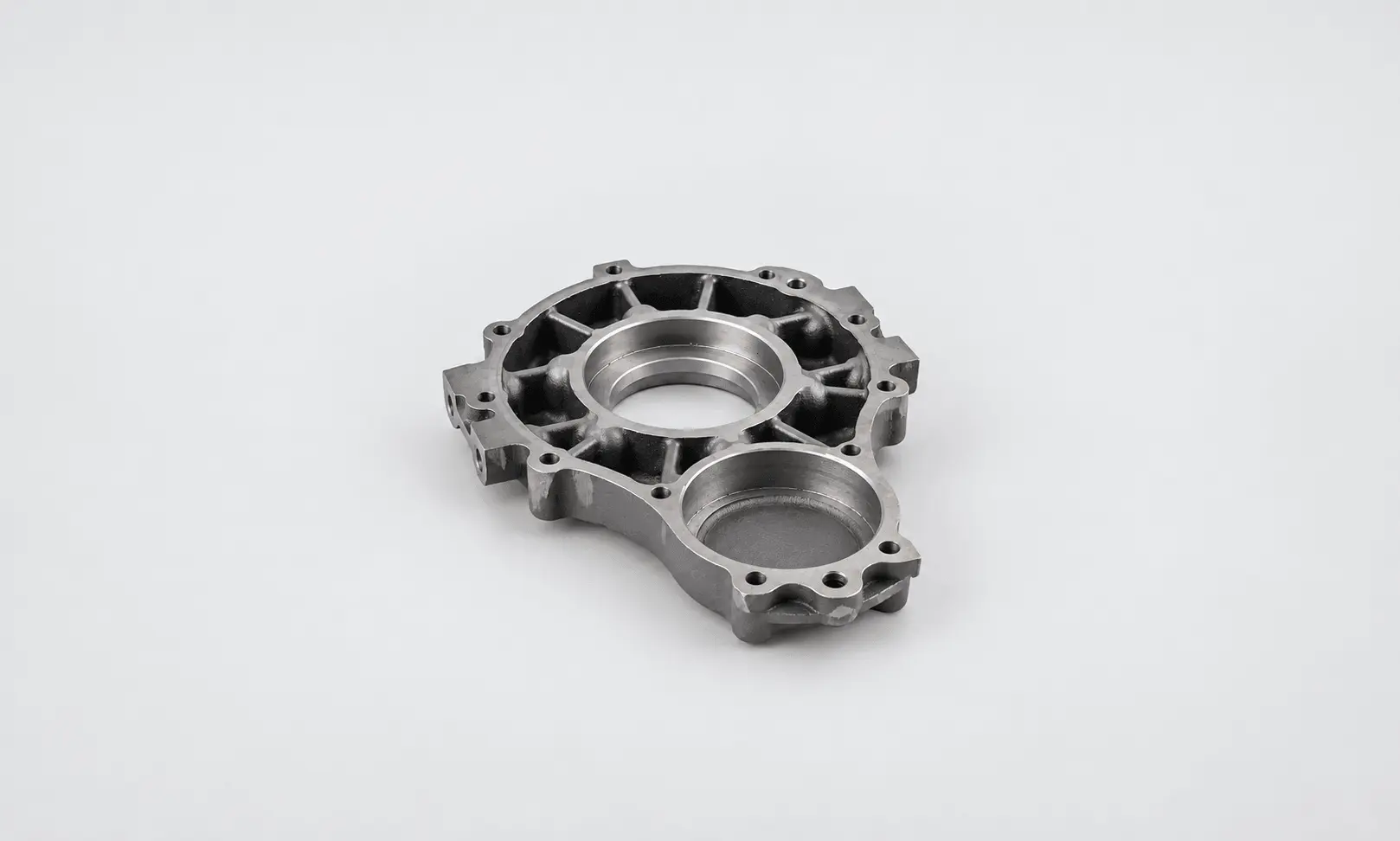
A custom die-cast magnesium motor housing manufactured by Mastars for an Australian client is a useful example. The casting combined ribs, side openings, datum faces, bosses, and mounting features in a compact housing. The manufacturing challenge was keeping these features in a controlled relationship through casting, machining, and final assembly.
The project included fixture planning, critical-dimension checks, surface inspection, functional checks of openings and mounting areas, and traceable inspection records.
The DFM review should also cover machining, fixturing, sealing, and assembly. A geometry that casts easily can still create problems later in the manufacturing process.
Casting Tolerances Do Not Replace Machining
Casting establishes the basic geometry, but critical fits and interfaces often require machining. The finished-feature tolerance is more important than quoting one tolerance value for the entire casting.
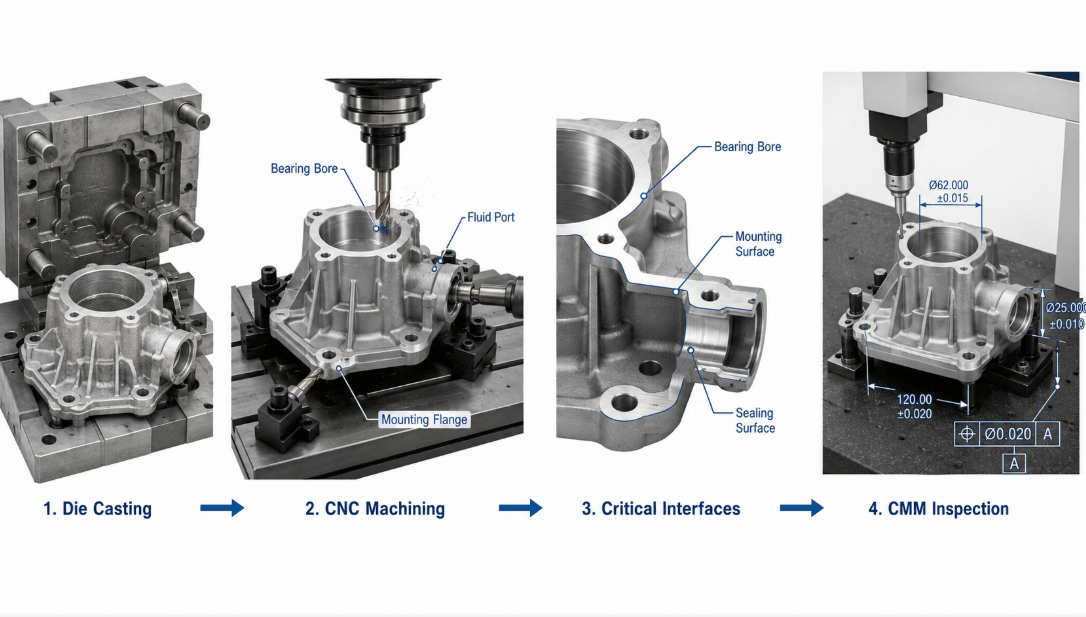
Die casting to CNC machining and inspection workflow for critical features
As-cast variation can come from alloy shrinkage, die temperature, tool wear, geometry, and process stability. Critical interfaces should be identified separately, with enough machining allowance built into the casting.
In the documented transmission housing project, mounting flanges, bearing bores, and fluid ports were machined after casting. Critical machined features were controlled to approximately ±0.05 mm, with CMM inspection used to verify dimensional accuracy.
For cast housings, this approach is common: use casting for the bulk geometry, then machine the surfaces that control fit, alignment, sealing, or assembly. When tighter finished dimensions are required, Mastars also provides CNC machining services for secondary machining.
Quality Control Should Follow the Part’s Actual Risks
Inspection requirements should reflect how the part can fail. Dimensional requirements may call for CMM inspection, internal porosity may require X-ray or another NDT method, and pressure-tight housings may need leak testing.
For the transmission housing project, final inspection included CMM dimensional measurement, NDT for internal defects, and leak testing for fluid containment. Visual inspection was also used to identify cracks, cold shuts, burrs, and surface defects before later operations.
Mastars’ documented quality workflow includes FAI, IPQC, FQC, CMM inspection, and material verification, covering both first-article approval and production-stage control.
The inspection plan should be established around the drawing and application requirements before production starts.
A Practical Framework for Choosing the Casting Process
Start with five questions:
- How many parts will you need each year?
- What are the minimum and maximum wall thicknesses?
- Which alloy and heat-treatment condition are required?
- How sensitive is the part to porosity or leakage?
- Which dimensions and interfaces actually control function?
As an initial screening:
| Part Requirement | Process to Consider |
|---|---|
| High volume + thin walls + complex details | HPDC |
| Moderate volume + thicker sections + heat treatment | Gravity die casting |
| Structural aluminum + controlled filling | LPDC |
| Large part + low volume + complex cores | Sand casting |
| Small complex parts with fine detail | Investment casting |
Then check tooling cost, machining requirements, surface finish, inspection method, and expected production stability. A part that sits between two process windows deserves a cost-and-risk comparison before tooling is ordered.
Conclusion: Choose the Process Around the Part
Gravity die casting generally suits moderate-volume parts where tooling investment, controlled filling, thicker sections, or heat treatment are important. HPDC is usually the better fit for thin walls, complex geometry, fast cycles, and higher production volumes. LPDC provides another route for structural aluminum parts, while sand casting remains useful for large or low-volume designs.
The process decision should follow the part’s actual requirements: geometry, alloy, volume, porosity limits, machining, tooling, and inspection. Getting that decision right before tooling can prevent expensive changes after the first casting.
Send your CAD model, material or alloy, annual quantity, target wall thickness, critical dimensions, surface requirements, and any heat-treatment, leak-testing, machining, or inspection requirements.
Mastars can review the casting route and identify tooling, dimensional, and production risks before you commit to a process. Get a Quote →
FAQ
What is the difference between gravity die casting and pressure die casting?
Gravity die casting fills a reusable metal die primarily through gravity. Pressure die casting uses external pressure to force molten metal into the cavity; in most manufacturing discussions, this means high-pressure die casting (HPDC). HPDC is generally faster and better suited to thin walls and high volumes, while gravity casting requires less tooling investment.
Is gravity die casting the same as die casting?
Not exactly. Gravity die casting is one type of permanent-mold casting that uses a die. “Die casting” can refer to several processes, including high-pressure die casting. When people search for “gravity casting vs. die casting,” they are usually comparing gravity die casting with HPDC.
Which is cheaper: gravity casting or pressure die casting?
It depends mainly on volume and tooling. Gravity casting usually requires less expensive tooling, making it attractive for lower or moderate quantities. HPDC costs more to tool but can reduce the part cost at higher volumes because of faster cycles and greater automation. Machining, scrap, inspection, and tooling life should also be included in the comparison.
Can HPDC parts be heat treated?
Sometimes. Conventional HPDC can contain entrapped gas and porosity that limit some heat-treatment conditions. Gravity casting and LPDC are generally easier choices when conventional heat treatment is a major requirement. The alloy, casting quality, required properties, and use of vacuum-assisted HPDC should be evaluated before specifying a treatment such as T6.
What information should I provide when asking for a casting process recommendation?
A CAD model is the best starting point, but rough information is enough for an initial discussion. Provide the material or alloy, annual quantity, approximate part weight, minimum wall thickness, critical dimensions, surface requirements, heat-treatment requirements, leak or pressure requirements, machining needs, and inspection requirements. These details allow the casting process and tooling strategy to be evaluated together.
Hot Articles

Hot Tags
Stay Connected!


Manufacturing on Demand
Please fill in the following information to obtain plan details (information is confidential and not disclosed publicly), we will contact you within 24 hours, please keep your phone available!
Upload a 3D/2D model to see instant pricing, lead time, and DFM feedback.