



Types of Iron: Properties, Differences, and How to Choose the Right Material


Gray cast iron, ductile iron, and steel solve different engineering problems. Gray iron is useful for vibration-sensitive machine bases; ductile iron offers greater tensile ductility for many load-bearing castings; and steel provides a wide range of strength, toughness, and fabrication options. The right choice also affects machining, finishing, and production cost.
The main categories commonly discussed as types of iron are pig iron, cast iron, wrought iron, and steel. They are not interchangeable: pig iron is primarily a feedstock for further processing, while cast iron and steel are widely used in finished components. Traditional wrought iron is now uncommon in modern industrial manufacturing.
Understanding their differences helps narrow the material options before finalizing the part design and manufacturing route.
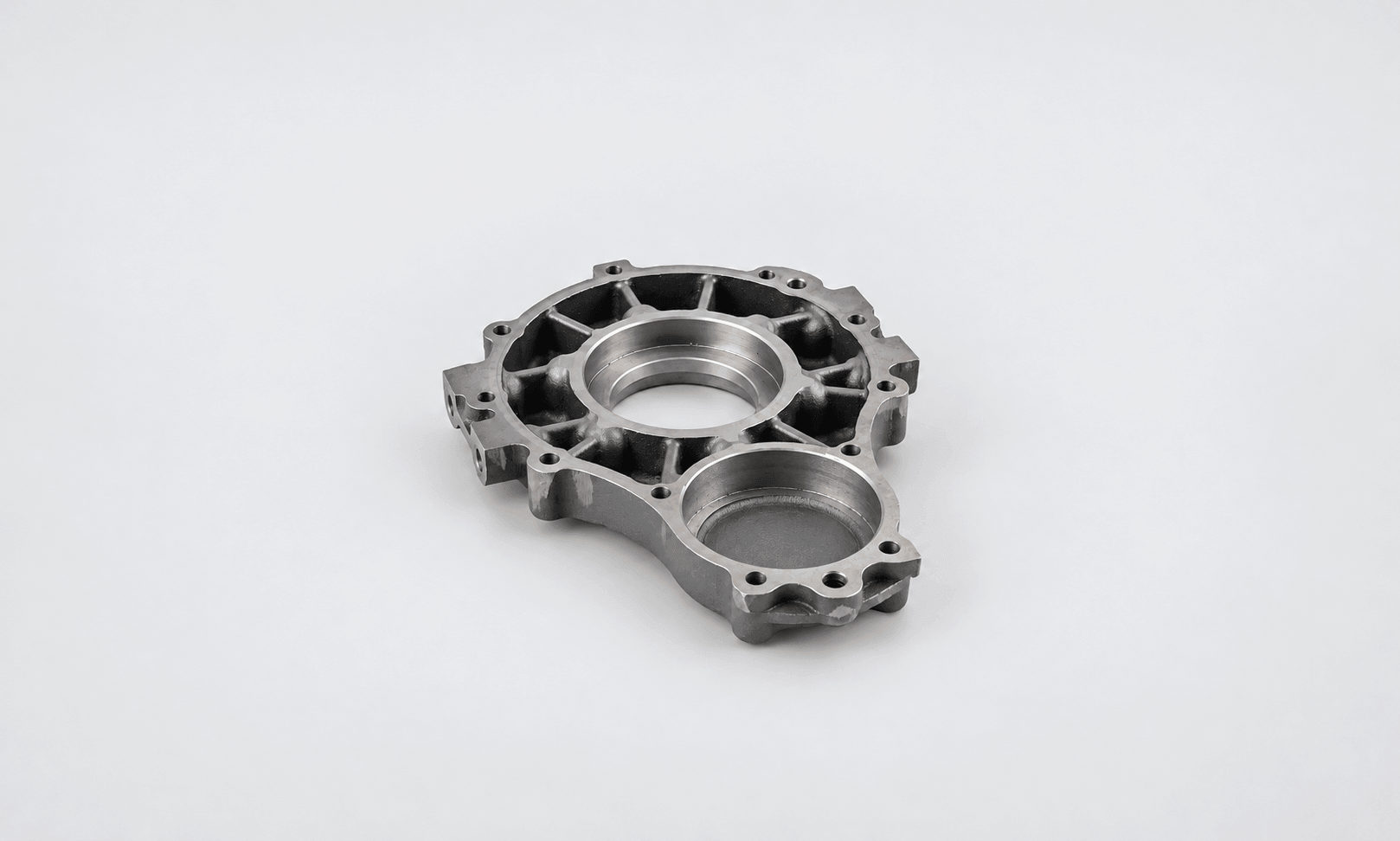
What Are the Main Types of Iron?
Iron-based materials are commonly classified by carbon content, microstructure, and production method. Pig iron is an intermediate product from ironmaking. Cast iron and steel are common engineering materials, while traditional wrought iron is a low-carbon material known for its characteristic slag inclusions.
| Material | Key characteristics | Typical role |
|---|---|---|
| Pure iron | Very low carbon content; soft and ductile | Specialized electrical and magnetic applications |
| Pig iron | High carbon content and other impurities | Feedstock for steelmaking and cast iron production |
| Cast iron | Generally above about 2% carbon; good castability | Machine bases, housings, pipes, and wear components |
| Wrought iron | Very low carbon content with characteristic slag inclusions | Historic structures, restoration, and decorative metalwork |
| Steel | Generally below about 2% carbon; properties vary widely by grade | Shafts, brackets, frames, fasteners, and structural parts |
These carbon ranges are broad classification guidelines, not a reliable way to predict performance on their own. Alloying elements, heat treatment, and microstructure also affect mechanical properties.
One terminology issue matters when purchasing parts: decorative gates and railings marketed as “wrought iron” are often fabricated from mild steel. If material identity affects structural performance or restoration requirements, confirm the actual specification.
What Are the Different Types of Cast Iron?
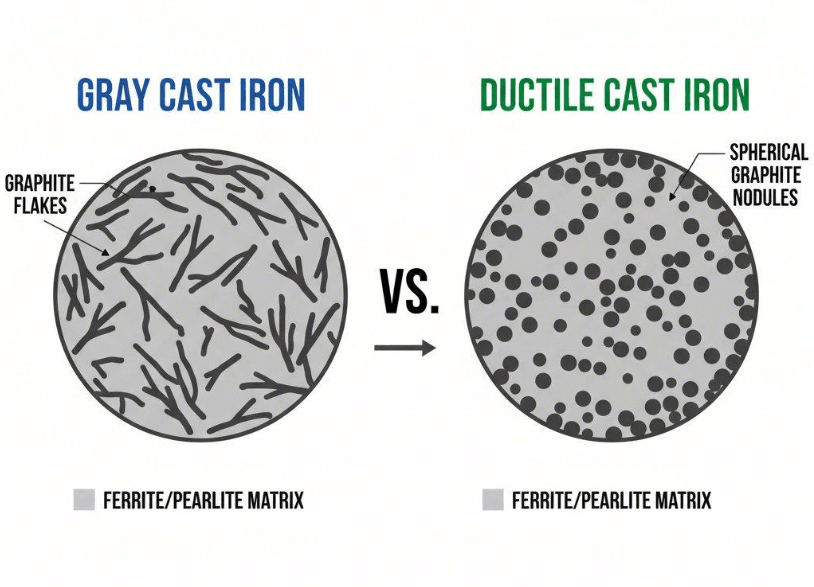
The main types of cast iron differ in how carbon appears in the microstructure. Gray iron contains graphite flakes, ductile iron contains rounded graphite nodules, and white iron contains carbon mainly in carbide form. These differences influence tensile behavior, ductility, hardness, vibration damping, and wear resistance.
| Type | Microstructure | Main characteristics | Typical applications |
|---|---|---|---|
| Gray cast iron | Flake graphite | Good damping and machinability; limited tensile ductility | Machine bases, engine blocks, housings |
| Ductile cast iron | Spheroidal graphite | Greater tensile strength and elongation than typical gray iron | Pipes, crankshafts, load-bearing castings |
| White cast iron | Carbon mainly in carbides | High hardness and abrasion resistance; brittle | Wear plates, liners, grinding components |
| Malleable cast iron | Temper-carbon aggregates formed by heat treatment | Improved ductility compared with white iron | Fittings and selected hardware |
| Compacted graphite iron (CGI) | Vermicular or compacted graphite | A distinct balance of thermal and mechanical properties | Engine blocks and selected thermally loaded components |
Gray iron or ductile iron?
Gray iron is common in machine bases and rigid housings where vibration damping and machinability matter. Its graphite flakes help dissipate vibration, but they also act as stress concentrators. Ductile iron's rounded graphite nodules generally allow greater tensile strength and elongation.
This distinction becomes important around loaded mounting points, thin sections, and features exposed to repeated forces. A machine base that mainly supports static loads may suit gray iron; a component that must tolerate tensile loading or deformation before fracture may call for ductile iron. The specified grade still needs to meet the design requirements.
When are white, malleable, and compacted graphite iron used?
White cast iron is used for severe abrasion because its carbide-rich structure provides high hardness, although it is brittle and difficult to machine. Malleable iron is produced by heat-treating white iron to improve ductility. Compacted graphite iron is used in applications such as selected engine components where thermal and mechanical behavior must be balanced.
These materials address more specialized requirements than gray and ductile iron. Their production routes are important because the resulting microstructure is central to performance.
How Do Cast Iron, Wrought Iron, Pig Iron, and Steel Differ?
Cast iron is suited to many complex cast shapes, steel offers a broad range of mechanical properties and fabrication methods, and pig iron is mainly a production input. Traditional wrought iron is now associated largely with historic metalwork and restoration. Their different roles matter as much as their composition when choosing a material for a component.
| Comparison | Cast iron | Steel | Traditional wrought iron | Pig iron |
|---|---|---|---|---|
| Main role | Finished cast components | Finished products and structural components | Historic and decorative metalwork | Feedstock for further processing |
| Tensile behavior | Varies by type; gray iron has limited ductility | Varies by grade and heat treatment | Generally workable, with properties affected by slag structure | Not normally selected for finished engineering parts |
| Manufacturing routes | Casting, often followed by machining | Casting, forging, rolling, and machining | Traditionally forged and worked | Further processing into other materials |
| Machining and joining | Machinability varies; welding can be challenging | Depends on grade, hardness, and joining procedure | Depends on material condition and fabrication method | Usually processed before becoming a finished part |
Is cast iron stronger than steel?
Neither material family is universally stronger. Some ductile iron grades reach tensile strengths comparable to certain carbon steels, while gray iron generally has lower tensile ductility. Steel properties also vary substantially with composition and heat treatment.
Compare the properties relevant to the part. A shaft subject to repeated bending needs a different assessment from a machine base designed mainly to support static loads and damp vibration. Tensile strength alone does not establish fatigue life, impact resistance, or suitability for a specific geometry.
Which Material Properties and Grades Should You Compare?
Strength, ductility, hardness, fatigue behavior, wear resistance, corrosion resistance, and machinability are useful comparison points, but their importance depends on the failure mode the design must avoid. A bearing seat, for example, may need controlled hardness and dimensional stability, while a cast housing may be governed more by stiffness, damping, and the loads around its mounting features.
| Property | When it matters | What to check |
|---|---|---|
| Tensile and yield strength | Pulling loads and permanent deformation | Specified grade and material condition |
| Elongation and impact behavior | Sudden loads or deformation before fracture | Required ductility and service temperature |
| Hardness and wear resistance | Abrasion and repeated surface contact | Hardness range and contact conditions |
| Fatigue strength | Repeated or fluctuating loads | Load cycles, stress concentrations, and surface condition |
| Corrosion resistance | Moisture or chemical exposure | Service environment and protective finish |
| Machinability | Cutting time, tooling, and surface finish | Grade, hardness, and part geometry |
Which material standards and grades are commonly used?
Material standards turn broad material names into more specific purchasing and inspection requirements. ASTM A48/A48M covers gray iron castings, ASTM A536 covers ductile iron castings, and ASTM A36/A36M covers carbon structural steel shapes, plates, and bars for structural and general-purpose applications. These specifications serve different purposes and should not be treated as interchangeable material grades. See the official descriptions for ASTM A48/A48M, ASTM A536, and ASTM A36/A36M.
For a more concrete comparison, ASTM A536 includes ductile iron grades such as 65-45-12 and 80-55-06. The grade designations indicate different minimum tensile-strength, yield-strength, and elongation requirements. The higher-strength grade does not offer the same elongation requirement as the more ductile grade, illustrating why selecting on tensile strength alone can be misleading. Always confirm the applicable standard edition and grade requirements before specifying a material.
Test results also need context. ASTM A536 notes that the properties measured at different locations in a casting cannot be related precisely to one another or to a test specimen cast from the same iron. A material certificate is important, but it does not remove the need to consider casting geometry and the properties required in the finished component.
If the design is still at the concept stage, compare candidate materials against the loads, environment, and manufacturing process before locking in the specification. The material selection considerations are especially relevant when the prototype material may differ from the intended production material.
Which Types of Iron Are Used for Different Applications?
Typical applications provide a useful starting point, not a universal material prescription. Gray iron is common in vibration-sensitive structures, ductile iron in load-bearing castings, white iron in abrasive environments, and steel in components that need a broad choice of strength and fabrication methods.
| Component or application | Common candidate | Main reason to consider it |
|---|---|---|
| Machine base or rigid housing | Gray cast iron | Vibration damping and castability |
| Pressure pipe | Ductile cast iron | Strength and ductility in a cast product |
| Abrasion-resistant liner | White cast iron | High hardness and wear resistance |
| Load-bearing casting | Ductile cast iron or steel | Different combinations of strength, ductility, and manufacturing options |
| Structural frame or bracket | Structural steel | Established fabrication methods and broad availability |
| Precision shaft | Suitable steel grade | Wide choice of strength, hardness, and machinability |
| Historic railing or restoration part | Traditional wrought iron or specified steel alternative | Authenticity and restoration requirements |
Consider a machine base with a broad footprint and mounting points. Gray iron may be a practical candidate because damping matters and the shape can be cast. A slender shaft exposed to repeated bending presents a different problem; a suitable steel grade may be preferable because tensile and fatigue performance are central to the design.
How Does Manufacturing Affect Cost, Tolerances, and Part Quality?
The manufacturing route changes how much material must be removed, which features need finishing, and where dimensional variation can affect assembly. Casting can establish complex geometry efficiently, while machining provides accurate bores, threads, and mating surfaces. For many parts, the practical question is whether to cast or form the main body and then machine selected features—or to machine the component from solid stock.
When should a part be cast and then CNC machined?
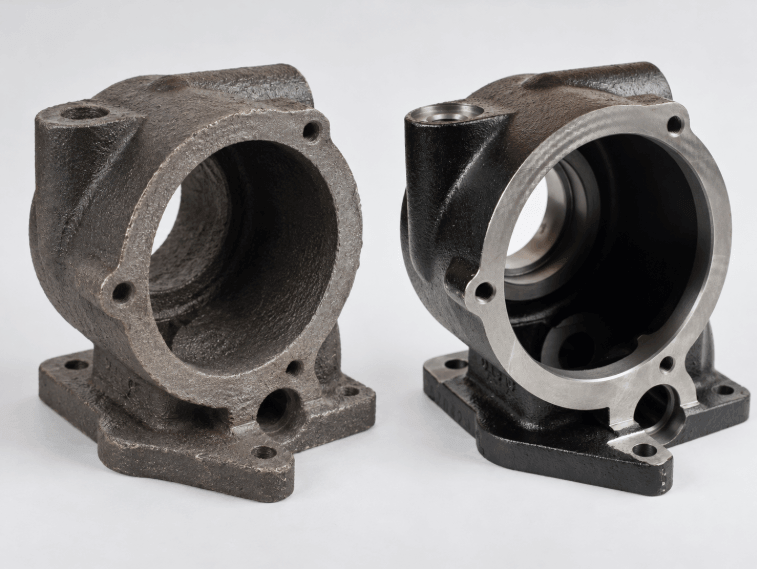
A cast-and-machined route is worth considering when a component has a complex body but only a limited set of precision interfaces. Casting establishes the near-net shape; machining then focuses on features such as bores, mounting faces, threads, and mating surfaces. This avoids applying the same machining effort to every surface.
Mastars' stage-light Pan Shaft manufacturing case illustrates this approach. The published process includes die casting, gate and overflow removal, CNC machining and threading, and dimensional verification. The part has a flange, raised bosses, mounting holes, and a rear cylindrical feature. The four threaded bosses must be positioned consistently with the mating assembly, so their locations should be verified against the relevant datums.
The case demonstrates how machining can be concentrated on functional interfaces while the die-cast body retains its near-net geometry. It does not establish that the same route is automatically best for iron castings: the documented component is die-cast, and the page does not publish comparative costs, cycle times, or achieved tolerances.
For an iron or steel component, the same decision needs to account for geometry, quantity, material waste, tooling, and required tolerances. A complex housing with deep cavities may benefit from a cast blank that reduces material removal. A one-off component with no suitable tooling may be more practical to machine from solid stock.
What makes complex parts difficult to machine?
Deep cavities, thin walls, and closely related mounting features create different machining risks. Long-reach tools can deflect or vibrate inside deep pockets. Thin walls can lose rigidity as material is removed, while multiple setups can introduce positional errors between holes, bores, and mating surfaces.
These issues affect the machining sequence. Roughing and finishing may need to be separated so that critical surfaces are not completed before later material removal changes the part's rigidity. Workholding and datum selection also matter: a dimensionally accurate bore is of limited value if its position relative to the mounting face is wrong.
Which dimensions should be toleranced tightly?
Tight tolerances belong on features that control function or assembly, such as bearing seats, sealing faces, locating holes, and mounting interfaces. Non-critical external surfaces usually do not need the same level of control. Applying tight tolerances everywhere can increase machining and inspection costs without improving performance.
Drawings should identify critical dimensions and use geometric dimensioning and tolerancing (GD&T) where relationships between features matter. Before production, define the material specification, surface finish, and any required inspection records. A prototype that fits correctly does not by itself prove that the same process will deliver repeatable dimensions at production quantities.
Conclusion: Choose the Material and Process Together
The useful starting point is the component's function: the loads it carries, the environment it operates in, and the features that control fit or movement. Compare candidate grades against those requirements, then evaluate whether casting, forming, or machining offers the most practical route.
For complex parts, near-net shaping followed by selective CNC machining can reduce unnecessary material removal while preserving precision at critical interfaces. The Pan Shaft case shows how that division of work can be planned around assembly requirements, although the best route for a different material and geometry still needs its own assessment.
Share your drawing or 3D CAD model, target material or grade, quantity, and critical dimensions. If the material is not finalized, include the operating conditions and the features that matter most to fit or function.
Get a Quote →Frequently Asked Questions
What are the four main types of iron?
The four commonly discussed categories are pig iron, cast iron, wrought iron, and steel. Pig iron is mainly a feedstock for further processing, while cast iron and steel are widely used in finished engineering components. Traditional wrought iron is now uncommon in modern manufacturing.
Which type of cast iron is strongest?
There is no single strongest type for every property. Ductile iron generally offers greater tensile strength and elongation than typical gray iron, while white iron is harder and more abrasion-resistant but brittle. Compare the specified grade's mechanical requirements with the component's loading and wear conditions.
Can cast iron be welded or machined?
Cast iron can be machined, although cutting behavior varies by type and hardness. Welding is possible in some situations, but cracking and heat-affected-zone problems can make it more difficult than welding many common steels. The joining or repair method should be selected for the specific grade and component.
What information is needed to choose an iron-based material for a custom part?
A drawing or 3D CAD model, quantity, operating environment, load conditions, and any required material grade are a good starting point. Include critical dimensions, surface requirements, and inspection criteria if available. If the grade is undecided, preliminary information is enough to begin comparing viable options.
Hot Articles

Hot Tags
Stay Connected!


Manufacturing on Demand
Please fill in the following information to obtain plan details (information is confidential and not disclosed publicly), we will contact you within 24 hours, please keep your phone available!
Upload a 3D/2D model to see instant pricing, lead time, and DFM feedback.