



Brass vs Stainless Steel: Properties, Machining Costs, and Material Selection


Brass is often a practical choice for conductive components, fittings, and complex CNC-machined parts. Stainless steel is usually the stronger candidate for load-bearing hardware and components exposed to demanding environments. When comparing brass vs stainless steel, the right choice depends on the specific grades, the part's function, and the cost of producing the finished component.
For precision-machined parts, three details can change the decision: whether the component carries a structural load, what the surrounding environment can do to the material, and how much machining its geometry requires. C36000 free-machining brass, 304 stainless steel, and 316 stainless steel illustrate these differences, but they are not interchangeable grades.
A useful comparison starts with what the part must do, then works backward to material properties, manufacturing requirements, and total cost.
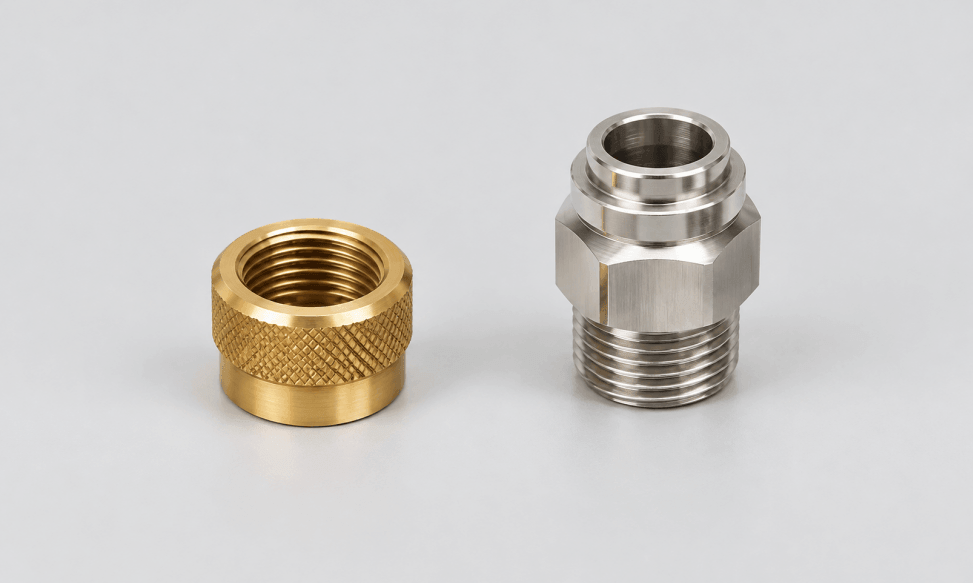
Brass vs Stainless Steel: What Are the Main Differences?
Brass generally offers better electrical conductivity and easier machining than common stainless steel grades. Stainless steel usually provides higher strength and better resistance to many corrosive environments. Brass is also denser than 304 or 316 stainless steel, so an equal-volume brass part will typically weigh more.
| Property | C36000 Brass | 304 Stainless Steel | 316 Stainless Steel |
|---|---|---|---|
| Main advantage | Excellent machinability and good conductivity | General-purpose strength and corrosion resistance | Improved resistance to many chloride-related corrosion conditions compared with 304 |
| Density | About 8.5 g/cm³ | About 8.0 g/cm³ | About 8.0 g/cm³ |
| Electrical conductivity | About 26% IACS | Low; grade and condition affect the value | Low; grade and condition affect the value |
| CNC machining | Free-machining grade suited to turned features and threaded components | Work hardening makes cutting conditions important | Similar work-hardening considerations; machining strategy matters |
| Corrosion concerns | Some environments can cause dezincification or other forms of attack | Susceptible to pitting and crevice corrosion in some chloride environments | Better resistance to many chloride-related pitting conditions, but not immune |
| Common applications | Connectors, fittings, bushings, machined valve components | Brackets, housings, hardware, general industrial components | Components exposed to more demanding chloride-bearing environments |
| Important limitation | C36000 contains lead and is not automatically suitable for potable-water use | Not suitable for every chemical or chloride-rich environment | Higher alloy cost than many 304 applications; suitability still requires assessment |
Reference sources: Copper Development Association — C36000, AZoM — 304 Stainless Steel, and AZoM — 316 Stainless Steel.
The table is intended for initial selection, not final design approval. Strength values, hardness, and machining behavior vary with grade, product form, and material condition. C36000 is a specific free-machining brass, not a representative of every brass alloy.
Is Brass Stronger Than Stainless Steel?
For common comparisons involving C36000 brass and 304 or 316 stainless steel, stainless steel generally has the advantage in tensile and yield strength. That does not automatically make it the better material for every part. A low-load connector may benefit more from brass's machinability and conductivity than from the additional strength of stainless steel.
AZoM lists minimum tensile strength of 515 MPa and minimum yield strength of 205 MPa for specified 304 stainless steel flat-rolled products under ASTM A240/A240M. These are specification values for the stated product form, not universal values for all 304 components. A valid design comparison must use mechanical data for the actual grades and delivery conditions being considered.
Strength is only one part of the decision:
- Load-bearing brackets: Yield strength and stiffness help determine whether the component will deform under load.
- Threaded fittings: Thread engagement, wall thickness, tightening torque, and repeated assembly may matter more than bulk tensile strength alone.
- Bushings and sliding components: Wear behavior, friction, lubrication, and the mating material need attention.
- Thin-walled parts: Geometry and workholding can affect dimensional stability during machining.
If a brass component is failing under load, switching to stainless steel may help, but it is worth identifying the failure mode first. A stripped thread, a bent section, and a worn bearing surface are different problems. They may require different changes to the material, geometry, or assembly design.
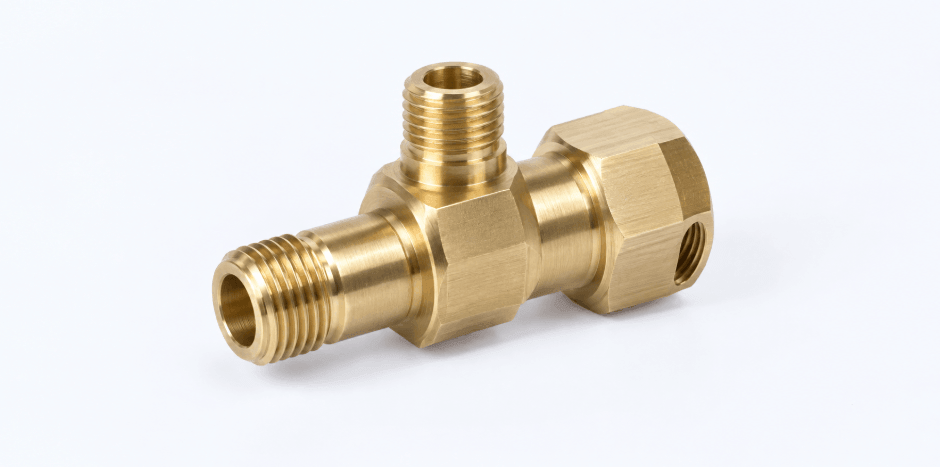
Which Material Resists Corrosion Better?
Brass and stainless steel fail in different ways, so a single corrosion-resistance ranking is misleading. Stainless steel 304 and 316 can develop pitting or crevice corrosion in chloride-bearing environments. Some brass alloys can suffer dezincification, in which zinc is selectively removed from the alloy, weakening the affected material.
The type of exposure helps narrow the choice:
| Environment | What to consider |
|---|---|
| Indoor, dry service | Strength, appearance, wear, and cost may dominate |
| Fresh water or plumbing | Water chemistry, alloy suitability, and applicable product requirements |
| Saltwater or chloride exposure | Stainless grade, crevices, deposits, temperature, and brass alloy composition |
| Chemical processing | Chemical identity, concentration, temperature, and exposure time |
| Dissimilar-metal assembly | Galvanic corrosion, moisture retention, contact area, and electrical isolation |
316 stainless steel contains molybdenum, which improves resistance to many chloride-related pitting and crevice-corrosion conditions compared with 304. It is not immune to attack in every marine or chemical environment. The Nickel Institute's guidance on galvanic corrosion explains why the surrounding environment and contact between dissimilar metals matter.
Consider a brass fitting installed against a stainless steel housing. The material pairing alone does not tell you whether galvanic corrosion will become a problem. Moisture, electrical contact, the exposed area of each metal, and the geometry of the joint all influence the risk. If the assembly stays wet or contains trapped fluid, evaluate the joint as a system rather than selecting each material independently.
How Do Conductivity and Weight Affect Material Selection?
Brass is generally much more electrically conductive than 304 or 316 stainless steel, while stainless steel is slightly less dense. These differences can make brass attractive for electrical contacts and connectors, but conductivity requirements, mechanical loading, and the component's dimensions still determine whether it is suitable.
The Copper Development Association lists C36000 at approximately 26% IACS electrical conductivity. IACS is a reference scale for electrical conductivity, so the figure should not be confused with a percentage of material strength or machining efficiency. Stainless steel has much lower electrical conductivity, making it less suitable where the metal itself must carry current efficiently.
Weight needs a separate calculation. Brass at approximately 8.5 g/cm³ is denser than stainless steel at approximately 8.0 g/cm³. For components with identical external volume, brass will weigh more. In practice, a lighter finished part may still be possible if the design changes wall thickness or geometry, but those changes must preserve the required strength and stiffness.
Choose brass when conductivity is a functional requirement and its mechanical properties are sufficient. Choose stainless steel when its strength or corrosion performance matters more than electrical conductivity. If both requirements are critical, compare the full design rather than relying on a material-property table alone.
What Changes When You CNC Machine Brass Instead of Stainless Steel?
C36000 brass is designed for free machining, which can make it particularly suitable for turned parts with multiple diameters, grooves, and threads. Stainless steel grades such as 304 and 316 generally need more careful control of cutting conditions because they can work-harden. The difference becomes more relevant when the drawing contains many machined features or tight dimensional requirements.
Consider a turned connector with several diameter changes, external threads, and cross-holes. In brass, the free-machining grade can support efficient chip formation and productive cutting conditions. In stainless steel, the process may need closer attention to tool selection, feeds and speeds, chip evacuation, and avoiding unnecessary rubbing or dwell.
That does not mean every brass part will be cheaper or every stainless steel part will be difficult to machine. A simple stainless steel spacer may require little machining, while a complex brass part can still involve expensive setups, small tools, or demanding inspection.
For either material, the drawing should identify the features that control function:
- Threads: Specify the thread standard, fit, engagement length, and any sealing requirement.
- Critical diameters and bores: Identify fits and dimensions that affect alignment, rotation, or assembly.
- Thin walls: Consider clamping deformation and the risk of dimensional changes after release from the fixture.
- Cross-holes and intersecting features: Check tool access, burr removal, and whether the remaining wall is sufficient.
- Surface finish: Call out roughness on functional surfaces where it affects sealing, sliding, contact, or appearance.
Mastars can work to tolerances as tight as ±0.005 mm on suitable CNC-machined parts. This is not a blanket guarantee for every material, feature, or geometry. The achievable tolerance depends on the part design, material, machining approach, and inspection requirements, so critical dimensions should be reviewed against the drawing before production.
For precision parts, dimensional inspection can include CMM measurement, optical inspection, and first-article checks. These methods are useful when critical bores, mating diameters, or positional relationships determine whether the part assembles correctly.
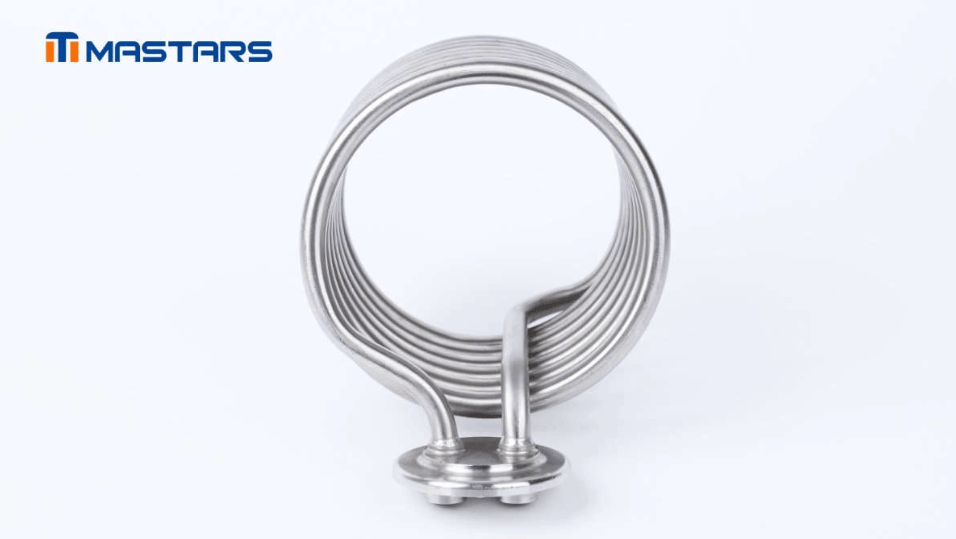
Does Brass or Stainless Steel Cost Less as a Finished Part?
The cheaper raw material does not always produce the cheaper component. For CNC-machined parts, the quote includes stock cost, machining time, tooling, finishing, inspection, and material utilization. A free-machining brass grade can reduce cutting effort on a feature-rich component, while a simple stainless steel part may have so little machining that the raw material price has greater influence.
The distinction is easiest to see in two common situations:
A multi-feature turned fitting: If the part requires several diameter changes, threads, grooves, and drilled features, machining efficiency can have a meaningful effect on total cost. C36000 may be worth quoting because of its free-machining characteristics, provided its composition and service performance meet the requirements.
A simple spacer or bracket: If the geometry requires only a few operations, the difference in machining time may be less important. Material price, stock size, finishing, and quantity can have a greater influence on the finished-part quote.
A useful cost model is:
Cpart = Cmaterial + Cmachining + Ctooling + Cfinishing + Cinspection − Vscrap
Here, Vscrap represents any recoverable scrap value that is actually credited in the costing method. It should not be assumed to reduce every quote.
Brass can be faster to machine than stainless steel in some applications, but there is no reliable percentage that applies to every part. The actual difference depends on part geometry, machine and tooling choices, batch size, inspection scope, and pricing conditions. A same-part quote comparison is the most useful way to estimate the cost difference.
For a useful comparison, request quotes for both materials using the same drawing revision, quantity, surface requirements, and inspection scope. The difference between the quotes will then reflect the actual manufacturing choices more closely.
Which Material Fits Your Application?
The right starting point is the requirement that matters most to the component's function. Brass is worth evaluating for conductive components, fittings, connectors, and machined parts that benefit from free-machining behavior. Stainless steel is a common starting point for structural hardware and components that need strength or corrosion resistance in a suitable environment.
| Application | Material to evaluate first | Main consideration |
|---|---|---|
| Precision-turned fittings and connectors | C36000 brass, where permitted | Thread design, fluid compatibility, and lead restrictions |
| Electrical contacts or conductive components | Brass or another suitable copper alloy | Required conductivity, contact resistance, temperature, and mechanical load |
| General-purpose brackets and housings | 304 stainless steel | Load, stiffness, corrosion exposure, and geometry |
| Chloride-exposed hardware | 316 stainless steel or another suitable alloy | Actual exposure conditions, crevices, and temperature |
| Potable-water components | A compliant, certified material and product | Lead content, leaching requirements, and applicable local regulations |
| Components with repeated assembly | Either material, depending on design | Thread wear, galling, tightening torque, and service life |
For drinking-water applications in the United States, C36000 should not be assumed suitable simply because it is easy to machine. The grade contains lead, and product approval depends on applicable requirements and certification. The U.S. EPA's guide to identifying lead-free certified drinking-water products explains the role of relevant lead-content and leaching standards, including NSF/ANSI/CAN 372 and NSF/ANSI/CAN 61.
The same principle applies to material substitutions in an existing design. If a prototype was made in brass and the production version will use stainless steel, revisit the machining process and the dimensions that control fit. The change can affect cutting conditions, burr formation, finishing, and assembly. Prototype approval alone does not establish that the production process is ready.
What Should You Include in a CNC Machining RFQ?
A useful RFQ identifies the part, its required material or performance, and the dimensions that control function. If you are undecided between brass and stainless steel, say so. The manufacturer can make a more meaningful comparison when both options are evaluated against the same drawing and acceptance criteria.
Include the following information where available:
- CAD model and 2D drawing: STEP or IGES files are useful for 3D geometry; the drawing should define critical dimensions, tolerances, and thread specifications.
- Material grade: State C36000, 304, or 316 if already selected. Otherwise, describe the functional requirements and operating environment.
- Quantity: Include the prototype quantity and expected production volume if known.
- Critical dimensions: Mark mating diameters, bores, sealing surfaces, thread features, and any GD&T requirements that affect assembly.
- Surface requirements: Specify roughness, cosmetic expectations, coatings, or other finishing operations where they matter.
- Service conditions: Identify loads, temperature, chemical or fluid exposure, and regulatory requirements.
- Inspection needs: State whether first-article results, dimensional reports, or other documentation are required.
Rough information is enough to start a discussion. The most important details are the features that affect function, the intended operating environment, and any requirements that would rule out a material before machining begins.
Conclusion: Choosing Between Brass and Stainless Steel
Brass is often a strong candidate for conductive components, fittings, and complex machined parts where free-machining behavior can help. Stainless steel is usually worth evaluating first for higher-strength components and applications where its corrosion performance fits the environment. The best choice comes from matching the grade to the part's function and comparing the cost of the finished component.
If you are comparing both materials for a custom part, start with the drawing, the critical dimensions, and the operating conditions. Those details provide a much more useful basis for material selection than a general claim that one metal is stronger, more durable, or cheaper.
Send Mastars your CAD model, drawing, target quantity, and material requirements. If the material is not finalized, include the critical dimensions, surface requirements, and operating conditions so the options can be assessed against the same part requirements.
Get a Quote →Frequently Asked Questions
Is brass heavier than stainless steel?
Yes, by density. C36000 brass is approximately 8.5 g/cm³, compared with about 8.0 g/cm³ for 304 and 316 stainless steel. For parts with the same volume, the brass component will generally weigh more. The finished part's actual weight still depends on its dimensions and geometry.
Is stainless steel always non-magnetic?
No. Austenitic grades such as annealed 304 and 316 are generally non-magnetic or only weakly magnetic, but cold working can introduce measurable magnetic response. If magnetic behavior is a functional requirement, specify the grade and condition and verify the finished component rather than relying on the label “stainless steel.”
Is nickel-plated brass equivalent to stainless steel?
No. Nickel plating can change brass's surface appearance and provide a barrier against certain forms of surface attack, but it does not turn the underlying brass into stainless steel. Coating thickness, coverage at edges and threads, wear, and damage during assembly all affect performance. Select the coating based on the actual environment and required service life.
If I change a prototype from brass to stainless steel, can I keep the same tolerances?
Not automatically. The nominal dimensions may remain the same, but machining behavior, burr formation, workholding, and finishing can change. Recheck critical bores, mating diameters, threads, and thin-wall features during the material change. If the component relies on a close fit or sealing interface, validate those features before releasing production.
Can I specify a general material name such as “brass” or “stainless steel” on my drawing?
For a critical component, a specific grade is preferable. “Brass” covers alloys with different compositions, strengths, machinability, and corrosion behavior. “Stainless steel” also includes grades with different properties. If you have not selected a grade, state the functional requirements and service conditions so the material can be chosen before the drawing is finalized.
Hot Articles

Hot Tags
Stay Connected!


Manufacturing on Demand
Please fill in the following information to obtain plan details (information is confidential and not disclosed publicly), we will contact you within 24 hours, please keep your phone available!
Upload a 3D/2D model to see instant pricing, lead time, and DFM feedback.