



Urethane Casting vs Injection Molding: Cost, Volume, and Production Fit


A finished CAD model does not always make the manufacturing route obvious. A project may need 20 parts for functional testing, 100 parts for market validation, or several hundred parts while the design is still being refined. At that point, the choice between urethane casting and injection molding comes down to more than the quoted price per part.
Urethane casting (Vacuum Casting) is generally suited to limited quantities, ongoing design changes, and prototypes that need realistic physical parts without a large tooling commitment. Injection molding becomes more attractive when the design is stable, the production thermoplastic needs to be validated, dimensional repeatability matters, or recurring volume can justify the mold.
Quantity alone does not determine the right process. Tooling complexity, material requirements, critical dimensions, finishing, expected production life, and the type of validation still needed can all change the calculation.
The sections below focus on the cost, material, tooling, tolerance, and production factors that usually determine which route makes sense.
Urethane Casting vs Injection Molding: How the Processes Differ
Urethane casting uses a master pattern and silicone mold to produce polyurethane parts, while injection molding uses rigid metal tooling to form molten material under pressure. The tooling difference affects material selection, dimensional behavior, design changes, part cost, and production volume.
Urethane Casting
The process normally begins with a master pattern produced by 3D printing or CNC machining. Silicone is formed around the pattern to create a flexible mold. Liquid polyurethane resin is then mixed, degassed, poured into the mold, cured, removed, trimmed, and finished.
The relatively simple tooling route makes urethane casting useful during product development. If the design changes, another silicone mold can generally be produced without modifying a production steel mold.
Silicone tooling has a finite service life, and the cast polyurethane is not automatically equivalent to the thermoplastic that may eventually be used in production.
Injection Molding
Injection molding starts with the CAD model and a DFM review. A production mold is then manufactured from aluminum or steel according to the part geometry, quantity, expected tool life, and production requirements.
Thermoplastic pellets are melted and injected into the cavity. The material fills the mold, cools, and is ejected before the next cycle. The mold determines much more than the external shape. Gate location, runner design, cooling, parting lines, slides, lifters, and ejection all influence the molded part.
That additional engineering raises the initial investment, but the same tool can produce a large number of repeatable parts.
| Factor | Urethane Casting | Injection Molding |
|---|---|---|
| Tooling | Silicone mold | Aluminum or steel mold |
| Starting point | Master pattern | CAD + DFM |
| Material | Polyurethane resin | Production thermoplastic or specified molding material |
| Upfront tooling cost | Lower | Higher |
| Design changes | Generally easier before production is locked | More expensive after tooling |
| Typical use | Prototypes and low-volume parts | Production and recurring volume |
| Material behavior | Resin-dependent | Based on actual molding material |
| Repeatability | Limited by mold and casting variables | Generally higher once process is stable |
| Tool life | Limited | Much longer |
| Complex features | Flexible silicone can help with some undercuts | Slides, lifters, inserts, and ejection may be required |
Cost and Break-Even Considerations
Urethane casting usually requires less money upfront because the tooling is simpler. Injection molding puts more cost into the beginning of the project, while its recurring unit cost can become attractive as quantity increases.
For urethane casting, the project cost may include:
- Master pattern
- Silicone mold
- Polyurethane resin
- Casting and finishing
- Inspection
- Additional molds for repeated production or design revisions
Injection molding shifts more of the investment toward tooling:
- Mold design
- Tool manufacture
- Machining and EDM
- Mold trials
- Tool corrections
- Production molding
- Secondary operations and inspection
A simple cost model is:
Total Cost = Tooling Cost + (Unit Cost × Quantity) + Secondary Costs
For a basic comparison, the break-even quantity can be estimated as:
Break-Even Quantity = (Injection Tooling Cost − Casting Tooling Cost) ÷ (Casting Unit Cost − Injection Unit Cost)
A simple two-cavity enclosure has a very different cost structure from a large housing with slides, lifters, complex cooling, or demanding cosmetic surfaces.
Design maturity also affects the calculation. If the geometry is still moving, avoiding a large tooling commitment may be more valuable than reaching the lowest theoretical unit price.
For procurement, ask suppliers to separate:
- Tooling cost
- Unit manufacturing cost
- Finishing and secondary operations
- Inspection requirements
- Expected tool life
- Tooling revision assumptions
- Production quantity assumptions
This makes quotations with different cost structures easier to compare.
Material Selection and Prototype Validation
Urethane casting uses polyurethane resin, while injection molding uses the thermoplastic or other molding material specified for production. A cast resin can simulate selected characteristics of ABS, PC, PP, or rubber-like materials, but it should not automatically be treated as the final production material.
Typical urethane casting materials include rigid, flexible, and elastomeric polyurethane systems. Different formulations can be selected for hardness, appearance, impact behavior, flexibility, or other prototype requirements.
Injection molding provides access to a wider range of production-intent materials, including engineering thermoplastics such as:
- ABS
- PC
- PC/ABS
- PA
- POM
- PP
- PE
- TPU and TPE
- PEEK and other high-performance polymers
The material difference matters for snap-fits, repeated assembly, elevated temperatures, chemical exposure, impact loading, fatigue, creep, flame-retardant requirements, and electrical applications.
An enclosure may look correct and assemble correctly using a cast resin while behaving differently from the final PC/ABS or PC material under heat or repeated loading. A snap-fit that works during a short prototype test may also have a different service life in the production resin.
| Validation Requirement | Urethane Casting | Injection Molding |
|---|---|---|
| Overall geometry | Suitable | Suitable |
| Appearance review | Suitable | Suitable |
| Fit and assembly | Suitable | Suitable |
| Multiple low-volume samples | Suitable | Possible, but tooling investment is higher |
| Final production resin | No | Yes |
| Production molding behavior | No | Yes |
| Long-term material validation | Limited by resin | Better suited to final material |
| Injection-specific shrinkage and warpage | Cannot fully reproduce | Directly evaluated |
Tolerance, Surface Finish, and Repeatability
Dimensional accuracy depends on different variables in each process. Urethane casting is influenced by the master pattern, silicone flexibility, resin shrinkage, mold condition, and demolding. Injection molding adds melt flow, cooling, gate location, ejection, and polymer shrinkage.
A blanket tolerance for the entire part is less useful than identifying the dimensions that control the assembly.
For many parts, the most important features are:
- Connector openings
- Mounting holes
- Bearing or mating surfaces
- Snap-fits
- Screw bosses
- Threads and inserts
- Sealing interfaces
- Assembly datums
- Critical wall sections
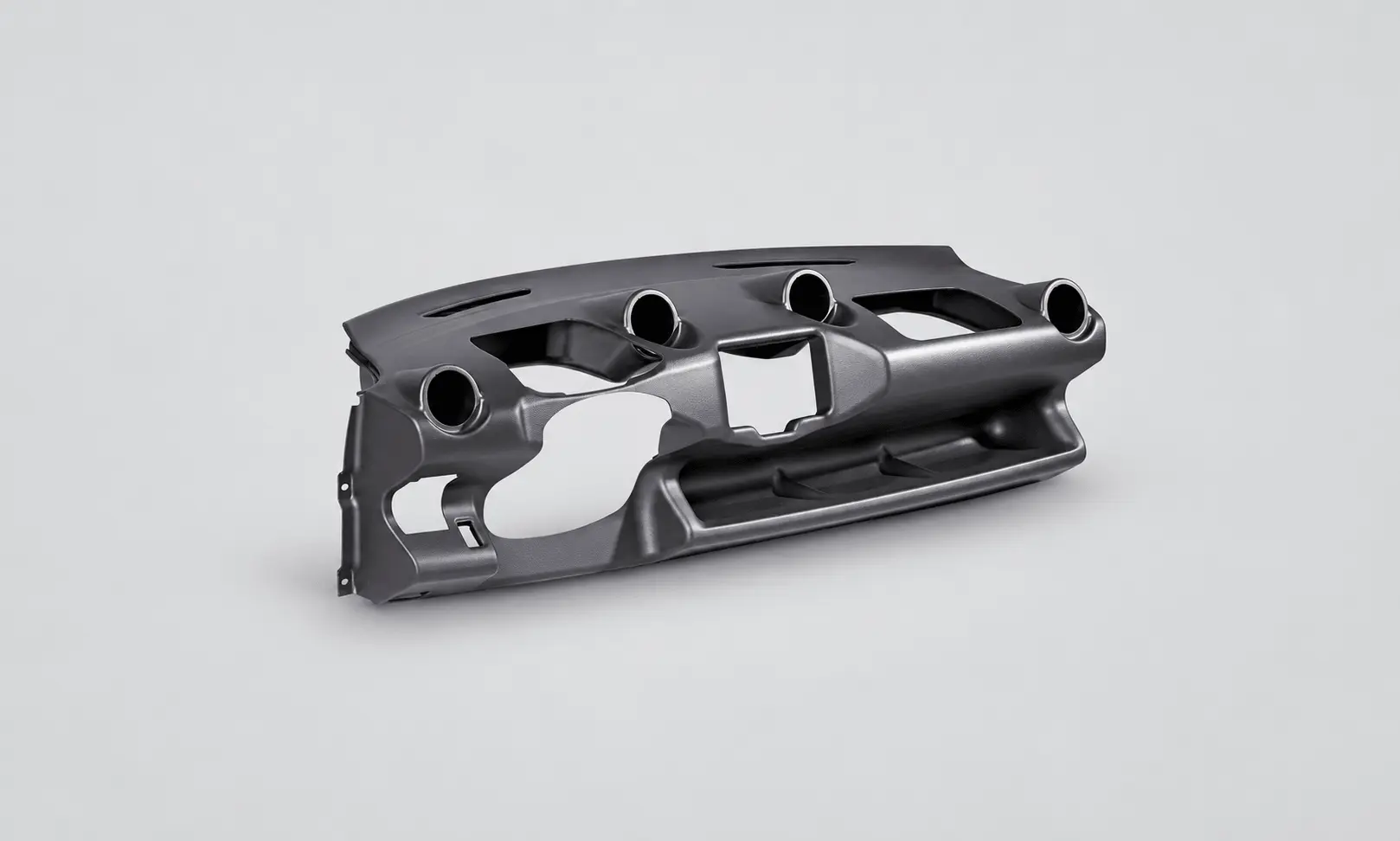
The Mastars PC+ABS trim-substrate project illustrates this approach. Key holes, screw bosses, and fixing points were checked against specified tolerances ranging from ±0.10 to ±0.20 mm, while openings, ribs, and wall transitions received 100% visual and dimensional inspection.
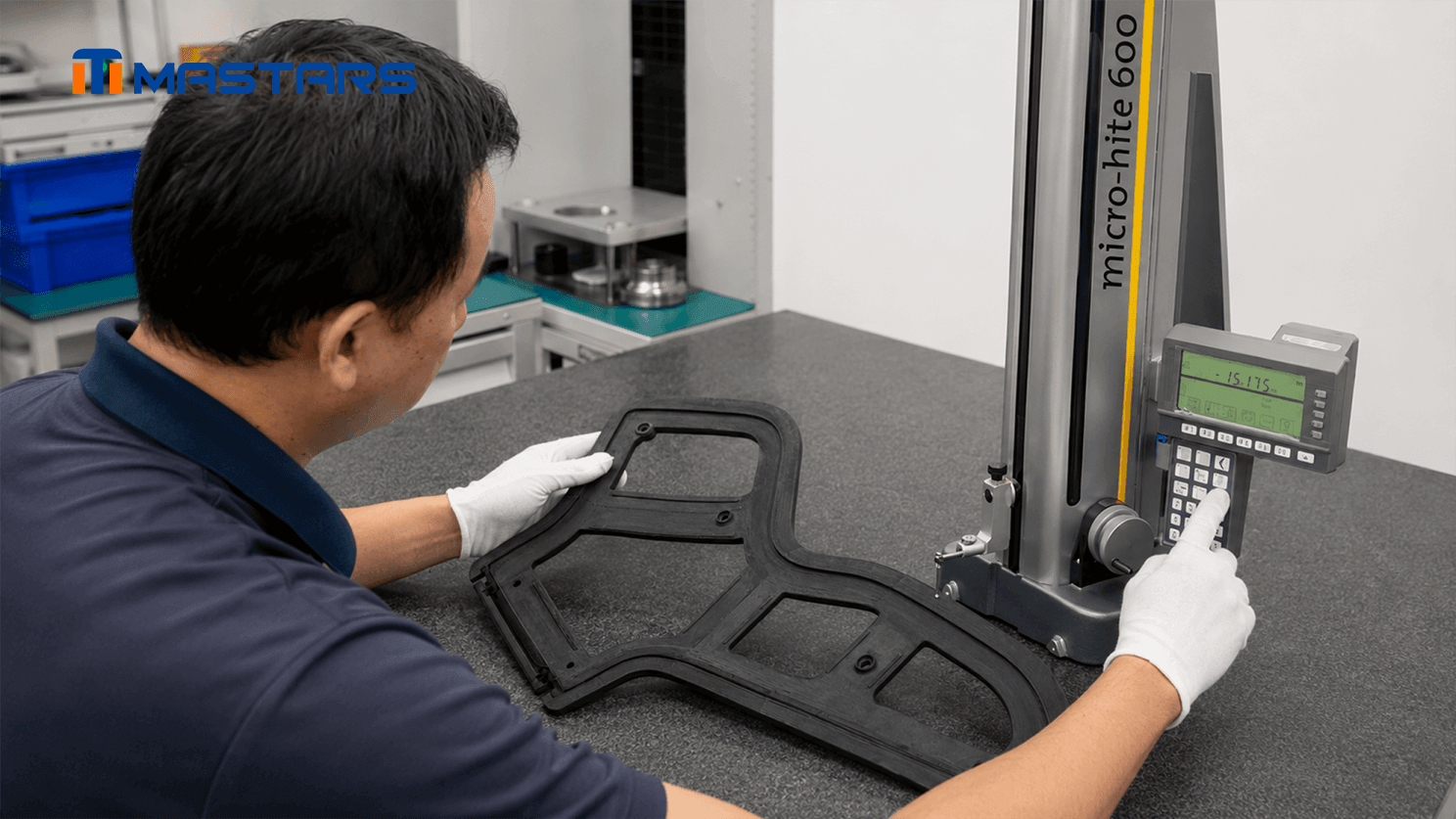
Mastars’ engineer checks keyhole positions and edge features
Injection Molding Adds More Process Variables
Injection molding introduces variables that a cast prototype cannot fully reproduce. Melt flow and polymer orientation can contribute to residual stress, while temperature differences during cooling affect shrinkage and warpage.
The tooling itself becomes part of dimensional control. Gate position, runner design, cooling channels, ejection, and cavity balance can all influence the result.
For critical molded parts, DFM review, mold-flow analysis where appropriate, cooling design, and trial molding help identify these risks before stable production begins.
Surface Finish Depends on the Process
Urethane casting can reproduce the surface of the master pattern closely, making the master pattern’s finish an important part of the final appearance.
Injection molding introduces additional features and potential defects, including:
- Sink marks
- Weld lines
- Flow marks
- Flash
- Gate vestiges
- Ejector marks
- Burn marks
- Texture variation
- Gloss differences
- Stress whitening
The location of a feature matters. A gate vestige on an internal surface may be acceptable, while the same feature on a customer-facing surface may require a different tooling or cosmetic strategy.
For both processes, visible surfaces, mating surfaces, and critical interfaces should be defined separately rather than applying one finish requirement to the entire part.
What Urethane Casting Can Validate Before Tooling
Urethane casting can validate physical geometry, appearance, fit, assembly, and selected functional requirements before production tooling is built. It does not reproduce every behavior of an injection-molded production part.
Urethane casting can help answer:
- Does the housing have the right overall geometry?
- Do the components fit together?
- Are the interfaces positioned correctly?
- Does the product look right?
- Can several physical samples be produced for evaluation?
- Does the general assembly work?
- Does the part meet the required appearance for early validation?
Injection-specific questions remain:
- Will the final production thermoplastic behave the same way?
- Will the injection mold produce the required shrinkage and warpage?
- Are the gate and ejection locations suitable?
- Will a multi-cavity mold remain consistent?
- Will injection-specific defects appear on cosmetic surfaces?
- Is the production process stable over repeated molding cycles?
A Mastars multi-port USB charger enclosure project shows how these validation stages differ. The prototype samples were used to evaluate product geometry, connector positioning, PCB accommodation, enclosure fit, fastening, and assembly relationships. Before tooling, the engineering review moved to wall sections, ribs, bosses, draft, parting strategy, gates, ejection, shrinkage, warpage, and cosmetic surfaces.
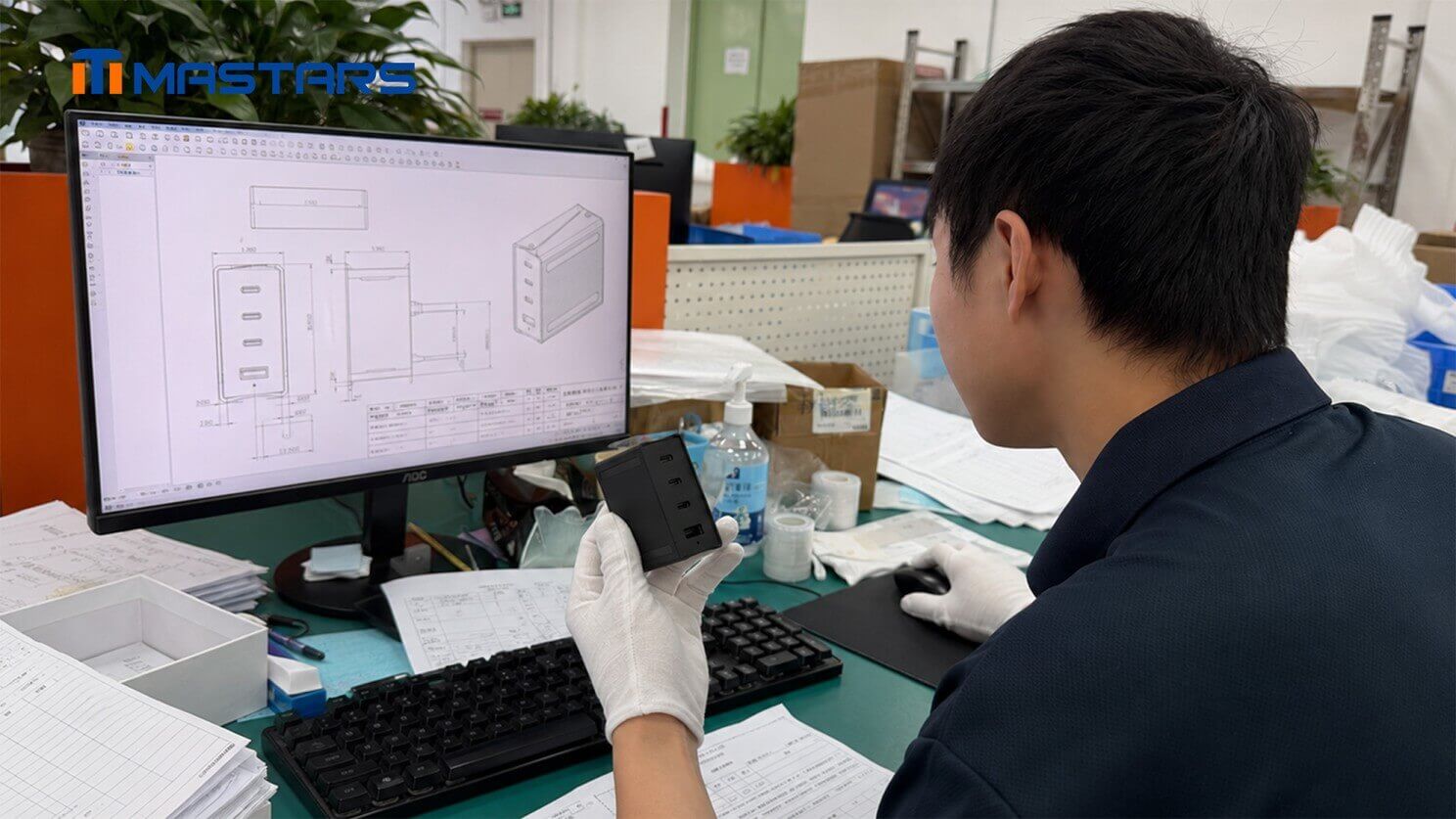
Quality inspection compares the enclosure against its 2D drawing.
When to Move From Urethane Casting to Injection Molding
The decision usually becomes clearer after four factors are established: design maturity, production quantity, final material requirements, and the level of repeatability or injection-specific behavior that must be validated.
1. Design maturity
If the geometry is still changing, flexible tooling can reduce the cost of another design iteration. Once the major dimensions, interfaces, and cosmetic requirements are stable, production tooling becomes easier to justify.
2. Quantity and production life
A short validation run and recurring production have different economics. Consider the total number of parts expected over the product’s life, not only the first batch.
3. Final material requirements
If the production thermoplastic has important mechanical, thermal, chemical, electrical, or compliance requirements, injection molding with the intended material provides more representative validation.
4. Repeatability and molding risk
If critical dimensions must remain consistent over repeated cycles, or if shrinkage, warpage, gate location, cooling, ejection, and other injection-specific factors affect the design, those risks need to be addressed through injection molding.
| Project Situation | Route to Consider |
|---|---|
| Geometry is still changing | Urethane casting or another flexible prototype process |
| Need multiple low-volume samples for validation | Urethane casting may be practical |
| Appearance and assembly need review | Urethane casting can be useful |
| Final production resin must be tested | Injection molding |
| Tight, repeatable production interfaces | Injection molding |
| Recurring production volume | Injection molding |
| Complex injection-specific risks need validation | Injection molding |
| Quantity is uncertain and design maturity is low | Validate first, then compare tooling economics |
These factors should be evaluated together rather than against a fixed volume threshold. A simple part with inexpensive tooling can justify injection molding at a different quantity from a complex housing with expensive tooling.
What Changes When a Prototype Becomes a Production Part?
Production adds variation that a small prototype run may not expose. The process needs to remain stable across molding cycles, cavities, material lots, tooling conditions, inspection points, and assembly operations.
Production review typically covers:
- Process stability
- Material and cavity-to-cavity variation
- Dimensional and cosmetic inspection
- Mold wear and maintenance
- Assembly consistency
- Traceability
For a multi-cavity mold, one acceptable sample does not establish consistency across all cavities. Critical-to-quality features should be measured against the drawing and assembly requirements.
Cosmetic acceptance also needs defined criteria. Sink marks, weld lines, gate vestiges, ejector marks, texture, gloss, and color variation should be evaluated according to their location and visibility.
A Mastars PC+ABS housing project for a pet GPS tracker illustrates the production side. The compact housing is less than 60 mm long and weighs 30 g, with an integrated paw detail on the front housing. The project combines PC+ABS injection molding with DFM, mold planning, critical-feature control, and traceable inspection.
For this type of product, production requires consistent molding and assembly rather than simply producing one housing that fits.
A Practical Path From Prototype to Production
A practical development route is to use each manufacturing process for the question it is best suited to answer, then move into injection molding once the product requirements are stable.
CAD / Concept
↓
Geometry and Fit Validation
↓
Functional or Appearance Prototype
↓
Low-Volume Validation if Needed
↓
Injection DFM and Tooling Review
↓
Tool Trial and Process Validation
↓
Production
Different prototype processes can occupy different points in this path:
- 3D printing: rapid geometry and appearance iteration
- CNC machining: engineering plastics, tighter features, connector positioning, fastening, and repeated assembly
- Urethane casting: multiple realistic physical parts while the design is still flexible
- Injection molding: final material, production repeatability, and recurring volume
Before a production mold is built, the DFM review should address wall thickness, draft, ribs, bosses, parting lines, gates, runners, cooling, ejection, shrinkage, warpage, and cosmetic surfaces.
The prototype process answers early product questions. The injection DFM and tooling stages address how that design will behave in a repeatable manufacturing process.
Conclusion
Urethane casting and injection molding solve different manufacturing problems. The choice depends on how much design flexibility is still needed, whether the final material must be validated, how many parts are required, and how much injection-specific behavior needs to be tested before production.
Share your CAD files, estimated quantity, material requirements, and any critical dimensions or surface requirements that could affect the build.
If the manufacturing route is still uncertain, include the validation goal and expected production volume. That gives the engineering team enough context to compare urethane casting, injection molding, or another suitable process.
Frequently Asked Questions
Is urethane casting cheaper than injection molding?
Usually for small quantities, because silicone tooling requires less upfront investment. Injection molding can become more economical as quantity increases because the mold cost is distributed across more parts. The actual break-even point depends on tooling complexity, unit cost, finishing, inspection, and expected production volume.
How many parts can I make with urethane casting?
There is no universal mold-life number for every silicone mold. Part geometry, resin, mold design, demolding method, and handling all affect service life. Urethane casting is generally used for prototypes and limited production rather than long production runs requiring a durable production mold.
Can I use urethane casting to test ABS or PC parts?
Yes, if the purpose is to evaluate geometry, appearance, fit, or general assembly. A cast polyurethane resin is not the same material as injection-molded ABS or PC, even when the resin is marketed as ABS-like or PC-like. Material-specific performance should be validated with the intended production grade when it matters.
When should I switch from urethane casting to injection molding?
Consider the switch when the design has stabilized, production quantity is recurring, the final thermoplastic needs validation, or repeatability has become a key requirement. If several of these conditions occur together, compare the full tooling and production economics.
Can urethane casting produce tight tolerances?
It can produce accurate parts, but the achievable result depends on the master pattern, silicone mold, resin shrinkage, geometry, demolding, and inspection method. Critical assembly dimensions should be identified individually rather than assuming one tolerance applies uniformly across the entire part.
Does injection molding always require a steel mold?
No. Aluminum tooling can be appropriate for some lower-volume or faster-turnaround applications, while steel is often selected when longer tool life, higher production volume, or demanding tooling conditions justify the additional investment.
What should I send when asking for a urethane casting or injection molding quote?
A CAD file and estimated quantity are enough to start. If available, also include the intended material, critical dimensions, surface finish requirements, assembly requirements, and whether the parts are for appearance, functional testing, market validation, or production.
Rough information is fine at the beginning. The clearer the validation goal and expected quantity, the easier it is to compare the two processes on the same basis.
Hot Articles
Hot Tags
Stay Connected!


Manufacturing on Demand
Please fill in the following information to obtain plan details (information is confidential and not disclosed publicly), we will contact you within 24 hours, please keep your phone available!
Upload a 3D/2D model to see instant pricing, lead time, and DFM feedback.