



Mill vs Lathe: Which CNC Machine Is Right for Your Part?


A cylindrical part does not always belong on a lathe. A shaft may need milling for a keyway and radial holes, while a housing may need turning for a critical bore. Once a part combines different feature types, choosing the machining process becomes less obvious.
A CNC lathe is generally suited to rotationally symmetric parts, while a CNC mill handles prismatic, multi-face, and complex 3D features more naturally. Parts that combine both may require live tooling, mill-turn machining, or separate turning and milling operations.
The right choice starts with the features that matter most: how they are oriented, how they will be held, how many setups are required, and what tolerances the drawing calls for.
Mill vs Lathe at a Glance
A CNC lathe rotates the workpiece against a cutting tool, making it well suited to cylindrical and rotational features. A CNC mill rotates the cutting tool while positioning the workpiece, making it better suited to pockets, slots, holes, angled surfaces, and complex profiles.
| Factor | CNC Lathe / Turning | CNC Mill / Milling |
|---|---|---|
| Primary motion | Workpiece rotates | Cutting tool rotates |
| Best suited geometry | Cylindrical / rotational | Prismatic / multi-face / 3D |
| Typical features | OD, ID, threads, tapers | Holes, pockets, slots, profiles |
| Workholding | Chuck, collet, centers | Vise, fixture, clamps |
| Typical parts | Shafts, bushings, spacers | Housings, brackets, fixtures |
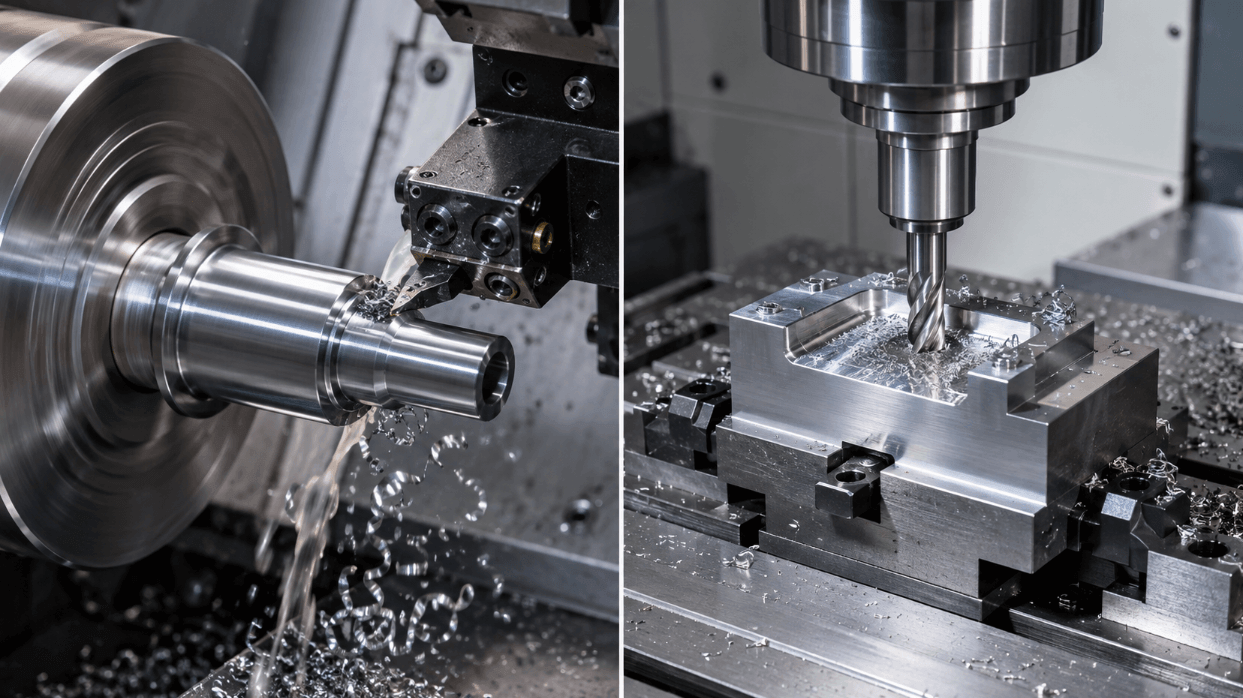
For a simple rotational component, turning is usually the most direct route. For a part with several flat faces, pockets, angled features, or complex surfaces, milling is generally more practical.
Choosing by Part Geometry and Machining Features
Part geometry narrows the choice quickly, but the outside shape is only part of the decision. The features that carry the functional requirements usually matter more.
When CNC Turning Is the Natural Choice
Turning works well when the important features share a common rotational axis. Typical examples include shafts, pins, bushings, spacers, rollers, and threaded cylindrical components.
Common turning operations include:
- Facing
- OD turning
- ID boring
- Threading
- Grooving
- Parting
When a drawing is dominated by diameters, axial lengths, threads, or concentric bores, a CNC lathe generally provides a straightforward setup and machining sequence.
When CNC Milling Fits Better
Milling is better suited to parts whose important features do not revolve around one axis. Housings, brackets, fixtures, plates, and mold components commonly require milling for pockets, slots, holes, flats, angled faces, and contoured surfaces.
Three-axis milling is sufficient for many accessible features. Four- and five-axis machines become useful when multiple faces or complex surfaces make conventional setups difficult. The additional axes provide more options for tool approach and can reduce repositioning on suitable parts.
When a Round Part Still Needs Milling
A cylindrical outside profile does not rule out milling. Radial holes, keyways, flats, and off-axis features can require a secondary milling operation even when turning remains the best choice for the main diameter.
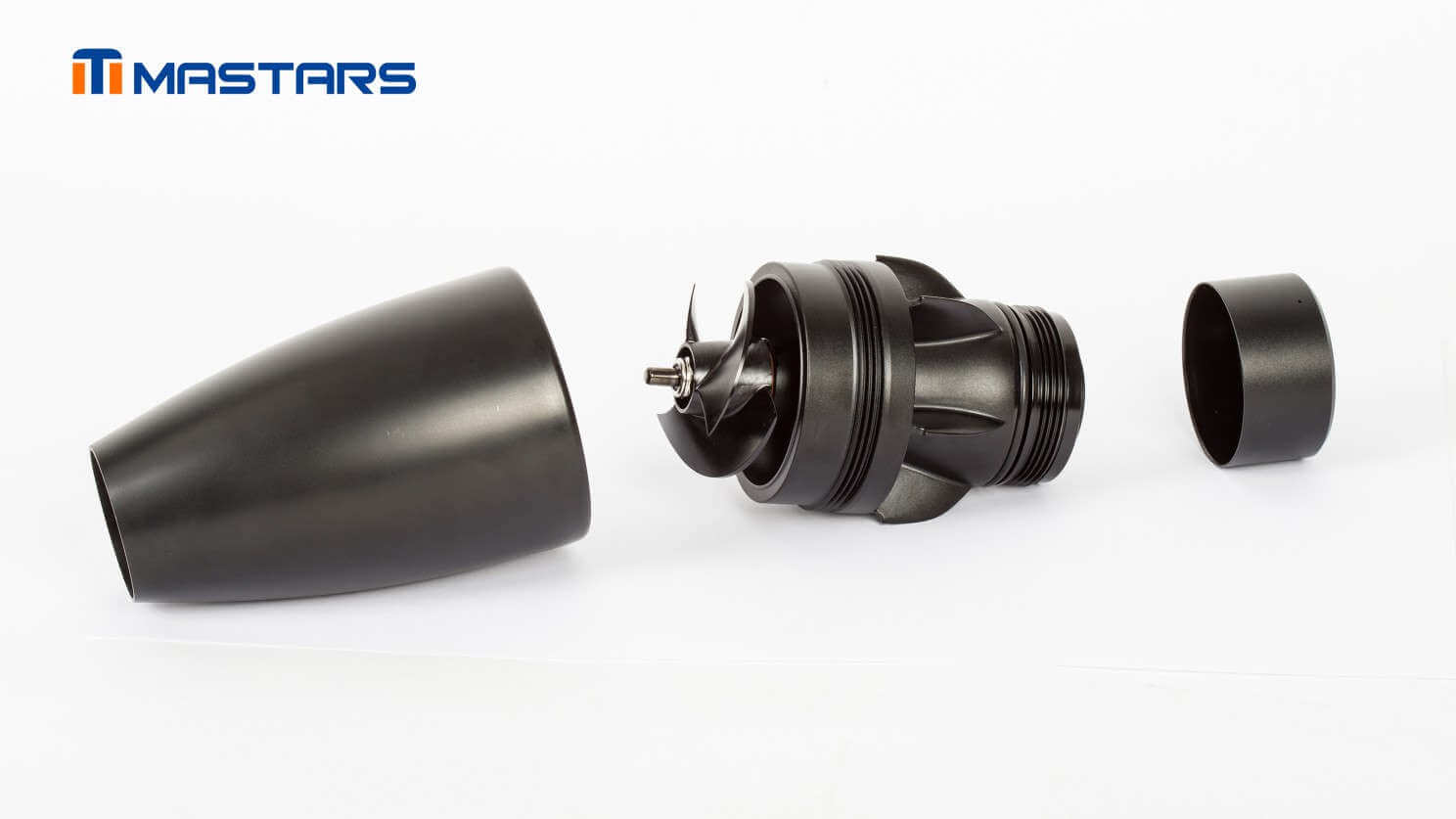
The machining strategy for a Mastars surfboard thruster impeller shows why the distinction matters. Its rotational hub was combined with curved blades and an internal spline, creating alignment concerns when machining was divided across multiple 3-axis setups. The final strategy used 5-axis machining to maintain the relationship between these critical features in one clamping.
Milling vs Turning: Operations, Setup, and Tolerance
Turning and milling are suited to different feature types, so tolerance decisions should be made feature by feature. Machine capability, workholding, tooling, material behavior, and setup strategy also affect the result.
Machining Operations and Feature Access
Turning commonly handles:
- Outside and inside diameters
- Facing
- Boring
- Threading
- Grooving
Milling commonly handles:
- Pockets
- Slots
- Drilling and tapping
- Contours
- Angled features
- 3D surfaces
There is some overlap. Both processes can drill holes, for example, but the better choice depends on the hole's location, datum relationship, surrounding geometry, and other operations.
Material can also influence the machining approach. Aluminum generally allows higher cutting speeds and efficient material removal, while stainless steel and titanium place greater demands on tooling and heat control. Engineering plastics introduce different concerns, including thermal deformation and chip evacuation. The same geometry may therefore require different tooling or cutting strategies depending on the material grade.
Workholding and Number of Setups
A lathe typically locates the workpiece with a chuck, collet, or centers. A mill may use a vise, fixture, clamps, or dedicated workholding to establish the required datums.
Every additional setup creates another opportunity for positioning variation. This matters when critical features must maintain a close positional relationship, particularly for concentricity, perpendicularity, or true position.
At the same time, fewer setups are not automatically better. A setup still needs adequate support and tool access. In the impeller project above, the move to 5-axis machining was useful because it addressed the relationship between the hub, spline, and blades rather than simply reducing the setup count. See the full impeller machining case
Accuracy and Surface Finish
Turning has an obvious advantage when the requirement centers on diameter, roundness, or concentricity. Milling becomes more useful when the tolerance concerns hole position, flatness, or the relationship between several machined faces.
There is no universal “more accurate” machine. The useful comparison is between the required feature and the process used to produce it. Tight tolerances also need to be considered alongside the material, workholding, geometry, and inspection method.
For production parts, the process choice should also match the inspection plan. Mastars supports CNC projects with CMM dimensional inspection and first article, in-process, and final inspection, with ISO 9001 and ISO 13485 quality systems supporting projects where documented quality control is required.
CNC Lathe vs CNC Mill for Production
For repeatable rotational parts, CNC turning is often efficient. Milling provides more flexibility when a part has multiple faces or complex features. Production quantity also changes how setup time, tooling, fixtures, and secondary operations affect the finished part.
Production Volume and Process Efficiency
High-volume rotational parts can benefit from efficient turning setups, repeatable tooling, and automated material handling. Low- or medium-volume parts with several faces may be better suited to milling because the process can accommodate a wider range of geometries without extensive dedicated tooling.
For parts that require both processes, live tooling or mill-turn machining may reduce handling. Separate turning and milling can still be preferable when each operation is substantially better suited to a different machine.
What Affects Machining Cost?
Part cost depends on more than machine time. Important factors include:
- Setup and fixture requirements
- Tooling
- Material utilization
- Number of operations
- Secondary machining
- Production quantity
- Tolerance and inspection requirements
A simple shaft and a complex housing should not be compared using the same cost logic. Process selection should follow the actual machining work required.
When One Part Needs Both Turning and Milling
Some components combine rotational and non-rotational features closely enough that both processes make sense. A shaft may need turning for its diameters and threads, then milling for a keyway and radial holes. A cylindrical housing may need a turned bore followed by milled pockets or mounting features.
Live Tooling and Mill-Turn
A CNC lathe equipped with live tooling can perform certain milling operations without transferring the part to a separate mill. C-axis control provides angular spindle positioning, while Y-axis capability allows additional off-center machining access.
This approach can work well for radial holes, flats, slots, and other features on rotational components. It has limits, however. Deep pockets, complex 3D surfaces, difficult tool access, and extensive multi-face machining may still favor a dedicated CNC mill or 5-axis machine.
Combining Processes in a Real Manufacturing Route
A Mastars aerospace turbine blisk demonstrates how the two processes can serve different stages of the same part. The forged Ti-6Al-4V blank was first pre-machined on a CNC lathe to establish the hub locating surface and outer-diameter datum. It then moved to 5-axis milling for the twisted, thin-walled blade geometry.
The process was divided according to the features being produced: turning established the rotational reference surfaces, while 5-axis milling provided the access needed for the blade geometry.
How to Choose the Right CNC Process for Your Part
Start with the features that drive function and tolerance. Then check how those features can be accessed, held, and machined with a reasonable number of setups.
A Practical Decision Framework
Primarily rotational part?
→ If the critical features are mainly concentric, start with CNC turning.
→ If it also needs radial holes, keyways, flats, or other off-axis features, consider live tooling or mill-turn.
Primarily prismatic or multi-face part?
→ Start with CNC milling.
→ If the geometry includes complex 3D surfaces or difficult tool access, consider 4-axis or 5-axis milling.
During a DFM review, the practical checks go beyond whether the geometry can technically be machined. Critical features should have a workable tool approach, the part should be held from stable datums, and unnecessarily tight tolerances should not force avoidable secondary operations.
Before finalizing the process, review:
- Critical dimensions
- Datum structure
- Tool access
- Workholding
- Number of setups
- Tolerances
- Surface finish
- Quantity
What Should You Provide for a CNC Machining Quote?
A useful quote requires more than a 3D model. The material, quantity, critical dimensions, tolerances, surface requirements, and inspection needs can all affect process selection and cost.
For a meaningful review, provide:
- 3D CAD model
- 2D drawing
- Material and grade
- Quantity
- Critical dimensions and tolerances
- Surface finish requirements
- Inspection requirements
If the machining process is still uncertain, rough information is enough to start. The geometry and drawing usually provide the information needed to narrow the options.
FAQs
What is the main difference between a mill and a lathe?
A lathe rotates the workpiece and is primarily suited to rotational features. A mill rotates the cutting tool and is better suited to pockets, slots, holes, flat surfaces, multi-face features, and complex profiles.
Is a lathe always better for cylindrical parts?
Usually, but not always. A cylindrical part with concentric diameters and bores is a natural turning application. Radial holes, keyways, flats, or other off-axis features may require milling or mill-turn machining.
Can a CNC lathe perform milling operations?
Yes, when it has live tooling and the required axis capability. A live-tooling turning center can produce features such as radial holes, slots, and flats. A conventional lathe without driven tooling is primarily intended for turning.
When should mill-turn machining be considered?
Mill-turn is worth considering when a rotational part also requires substantial milling, particularly when several features can be completed without removing the part. This can reduce handling and help maintain relationships between critical features.
Which process is better for tight tolerances?
It depends on the feature. Turning is naturally suited to diameter, roundness, and concentricity, while milling is often better for flatness, hole position, pockets, and multi-face relationships. The tolerance should be evaluated against the actual feature and datum scheme.
Can the same part require both milling and turning?
Yes. A shaft with diameters and threads may also require a keyway and radial holes. Turning can handle the rotational features while milling produces the off-axis ones. Depending on the geometry and quantity, these operations may be separate or combined in mill-turn machining.
Can the machining process be changed after a prototype?
Yes, and it sometimes should be. A prototype process may prioritize speed and flexibility, while production may require fewer setups, more stable workholding, dedicated tooling, or a different machine strategy. A validated prototype does not automatically mean the design is production-ready.
Hot Articles
Hot Tags
Stay Connected!


Manufacturing on Demand
Please fill in the following information to obtain plan details (information is confidential and not disclosed publicly), we will contact you within 24 hours, please keep your phone available!
Upload a 3D/2D model to see instant pricing, lead time, and DFM feedback.