



Is a 3D Printer a CNC Machine? The Engineering Answer Explained


"Can we just 3D print this instead of machining it?"
This is a question manufacturing engineers hear frequently during early product development. A 3D printer moves along X, Y, and Z axes. It follows digital instructions. Many systems even use G-code. So at first glance, it seems reasonable to ask:
Is a 3D printer actually a CNC machine?
The short answer is:technically yes, but practically no.
A 3D printer uses computer-controlled motion principles that are similar to CNC systems. However, the manufacturing logic behind the two technologies is fundamentally different. CNC machining creates parts by removing material from a solid workpiece, while 3D printing creates parts by adding material layer by layer.
For engineers, this difference is more important than the terminology itself. It affects material selection, prototype reliability, dimensional expectations, testing results, and the transition from prototype to production.
The better question is not:
"Is a 3D printer a CNC machine?"
The better engineering question is:
"Which manufacturing process gives me the right information about my part before moving forward?"
The Quick Answer: Is a 3D Printer a CNC Machine?
A 3D printer can be considered a CNC-controlled machine because it uses computer numerical control to guide movement. However, in manufacturing discussions, a "CNC machine" usually refers specifically to subtractive machining equipment such as CNC mills, machining centers, and lathes.
| Question | Engineering Answer |
|---|---|
| Does a 3D printer use CNC principles? | Yes. It uses computer-controlled movement based on digital instructions. |
| Is a 3D printer considered CNC machining? | No. It is generally classified as additive manufacturing. |
| Why are they considered different? | Because one adds material while the other removes material. |
The controller does not define the manufacturing process. The way material becomes a finished part does.
Why Do Engineers Confuse 3D Printers With CNC Machines?
The confusion is understandable because both technologies share the same digital manufacturing foundation.
- Both start from CAD models — engineers create a digital design before manufacturing begins.
- Both rely on programmed movement — machine paths are generated and executed automatically.
- Both can operate with multiple axes — movement accuracy determines how the machine follows the intended geometry.
- Both convert digital information into physical parts — the workflow begins with data rather than manual fabrication.
From the outside, a CNC machine cutting aluminum and a 3D printer depositing polymer may look similar: both follow coordinates, both move according to instructions, and both create complex geometries from digital files.
The difference appears at the manufacturing point itself.
| 3D Printing | CNC Machining | |
|---|---|---|
| Manufacturing approach | Additive manufacturing | Subtractive manufacturing |
| How the part is created | Material is deposited or cured layer by layer | Material is removed using cutting tools |
| Starting material | Filament, resin, powder, or metal powder | Solid block, plate, bar, or billet |
| Main engineering advantage | Design freedom and rapid iteration | Production-like material behavior and precision features |
The Real Difference: Additive Manufacturing vs Subtractive Manufacturing
Many discussions about 3D printing and CNC machining focus on machine specifications. Experienced engineers usually look at something more fundamental:
How does the manufacturing process influence the information we get from the prototype?
A prototype is not only a physical object. It is a tool for reducing uncertainty.
Different manufacturing approaches answer different engineering questions.
| If you need to validate... | The process may be better suited for... |
|---|---|
| Overall shape and design concept | 3D printing for fast design iteration |
| Complex internal geometry | 3D printing where traditional manufacturing may be limited |
| Final material behavior | CNC machining using engineering-grade materials |
| Critical interfaces and assembly features | CNC machining for controlled dimensions |
| Production transition planning | A process selected based on the final manufacturing route |
This is why experienced engineers do not select a manufacturing method simply because it is faster. They select the process that provides the most valuable information at the current development stage.
A Manufacturing Engineer's Decision Framework: What Should You Validate First?
The biggest mistake during prototype development is choosing a manufacturing process before defining what the prototype actually needs to prove.
A prototype is not successful because it was produced quickly. It is successful because it provides reliable information for the next engineering decision.
Before selecting 3D printing or CNC machining, experienced engineers usually ask three questions.
Question 1: What uncertainty do we need to remove?
Different development stages have different uncertainties. The manufacturing process should match the question you are trying to answer.
| Engineering Goal | Typical Manufacturing Choice | Why |
|---|---|---|
| Validate appearance, shape, and design direction | 3D Printing | Fast iteration allows teams to review physical geometry before committing to more expensive processes. |
| Verify complex geometry or internal structures | 3D Printing | Additive manufacturing can create geometries that are difficult or impossible to produce through traditional machining. |
| Test functional performance | CNC Machining | Machining can use production-like materials and provide more realistic feedback for mechanical testing. |
| Validate critical assembly features | CNC Machining | Controlled dimensions, machined surfaces, and precise interfaces provide more reliable assembly validation. |
Question 2: Does the prototype need to behave like the final product?
This question often determines whether additive manufacturing is enough or whether a production-representative process is required.
For example, a prototype housing may look correct but still fail during testing because:
- The material does not respond the same way as the final product.
- The surface finish changes user perception.
- Critical interfaces do not represent final assembly conditions.
- Mechanical loads are different from the production material.
When functional validation matters, engineers often choose a process closer to the final manufacturing route.
The best prototype is not always the fastest one. It is the one that removes the most important risk before the next development stage.
Question 3: What happens after prototype validation?
A prototype rarely exists alone. It is usually one step in a larger manufacturing journey:
| Development Stage | Possible Manufacturing Approach | Main Objective |
|---|---|---|
| Concept validation | 3D Printing | Confirm design direction quickly |
| Functional prototype | CNC Machining / Advanced Prototyping | Validate performance and assembly |
| Low-volume production | CNC, Vacuum Casting, Soft Tooling | Bridge development and market testing |
| Mass production | Injection Molding, Die Casting, Production Processes | Achieve repeatable manufacturing |
Real Engineering Examples: How Mastars Uses Different Processes for Different Risks
The question is not whether 3D printing or CNC machining is better. In real projects, engineers often use both technologies because they solve different problems.
Case 1: Using 3D Printing to Validate Complex Geometry
Challenge: Complex structures often become difficult to evaluate using traditional manufacturing methods during early development.
For highly complex geometries, the first priority is often not production strength, but understanding whether the design concept itself works.
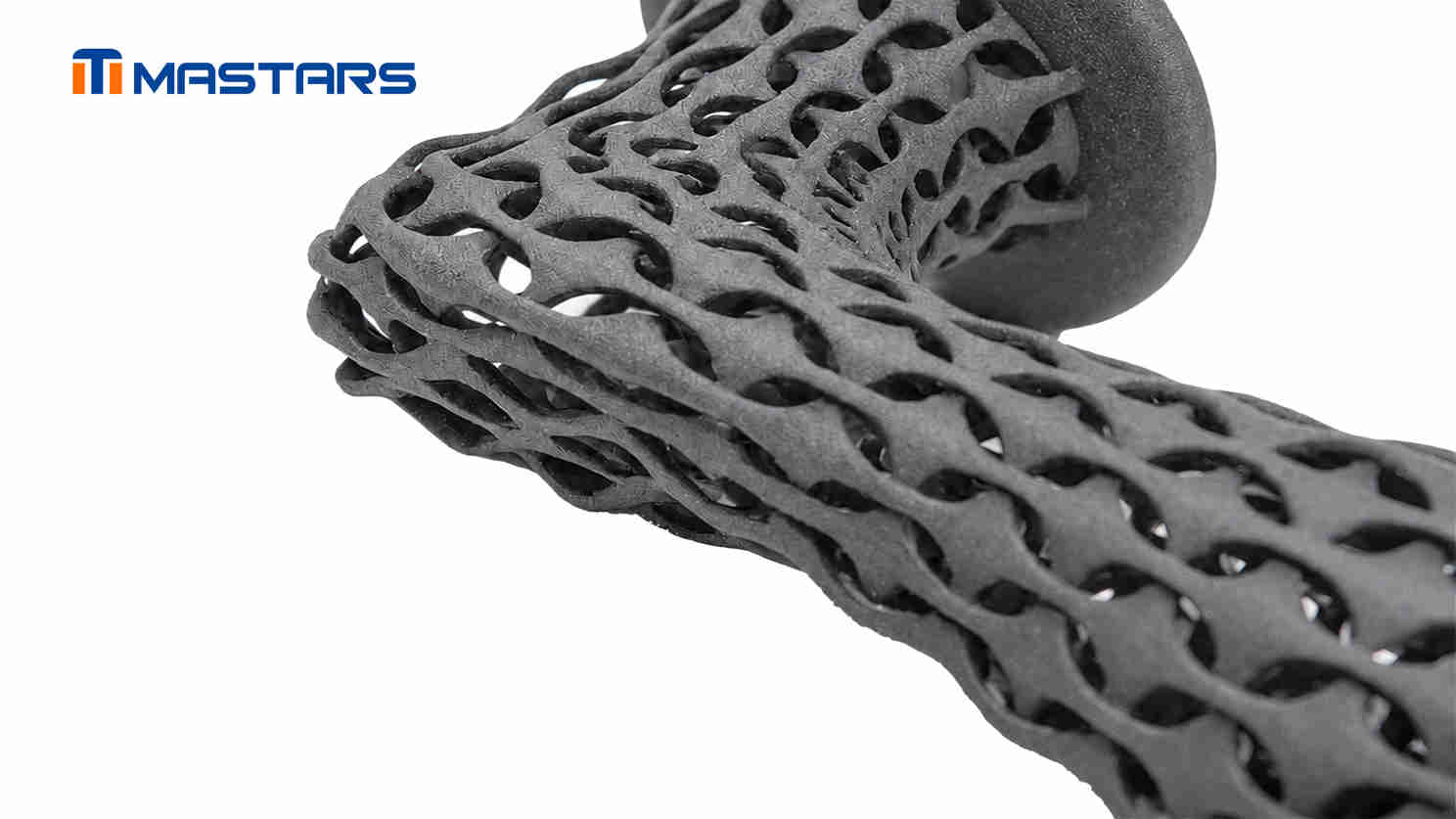
In one Mastars project involving a complex lattice structure, additive manufacturing was used because the geometry itself was the key challenge. Traditional manufacturing methods would have required additional limitations during early validation.
Using 3D printing allowed engineers to evaluate:
- Complex structural features
- Design feasibility
- Physical appearance and assembly considerations
- Further optimization before production decisions
The value of additive manufacturing was not simply speed. It was the ability to test a design idea before investing in more complex manufacturing processes.
Case 2: CNC Machining for Functional Prototype Validation
Challenge: Some prototypes need to behave closer to the final product, not just look similar.
For an automotive interior component project, Mastars used CNC machining to create aluminum prototypes for functional validation.
The purpose was not only producing a physical sample. The engineering team needed to verify:
- Dimensional accuracy
- Assembly relationships
- Surface finish requirements
- Functional experience before moving toward production
In this situation, CNC machining provided more meaningful engineering feedback because the prototype reflected the characteristics of the final metal component more closely.
Case 3: High-Complexity Structures Requiring CNC Precision
Challenge: Complex geometry does not automatically mean additive manufacturing is the best solution.
For aerospace-related structural components, the challenge often involves balancing geometry complexity, material performance, dimensional control, and assembly requirements.
Mastars applied five-axis CNC machining capabilities to produce complex aluminum structures where precision, machining strategy, and process control were critical.
The engineering focus included:
- Complex surface machining
- Multi-sided feature access
- Dimensional consistency
- Reliable manufacturing repeatability
Complex geometry alone does not determine the process. The real decision depends on material requirements, functional expectations, and production goals.
Can a 3D Printer Replace a CNC Machine?
Sometimes yes. But not in every engineering situation.
A 3D printer can replace CNC machining when the main goal is:
- Early concept validation
- Rapid design iteration
- Complex geometry exploration
- Low-risk prototype evaluation
However, CNC machining remains important when the project requires:
- Production-like material behavior
- Precise mechanical interfaces
- Machined surfaces
- Functional testing under realistic conditions
- Metal prototype validation
The two technologies should not be viewed as competitors. In many successful product development programs, they work together.
A practical workflow: Use 3D printing when you need to explore the idea. Use CNC machining when you need to prove the product.
How Mastars Helps Engineers Choose the Right Manufacturing Process
Choosing between 3D printing and CNC machining is rarely a simple equipment decision. The right process depends on understanding the part itself: what it needs to achieve, what risks must be reduced, and what manufacturing path comes next.
At Mastars, engineers do not start with a machine. We start with the engineering purpose behind the part.
Before recommending a manufacturing approach, our team evaluates:
- Design intent — what function the part needs to perform
- Material requirements — whether the prototype needs to represent final material behavior
- Critical features — dimensions, interfaces, tolerances, and assembly requirements
- Validation goals — what information the prototype needs to provide
- Production pathway — how the design can move from prototype toward manufacturing
By connecting engineering decisions with manufacturing capabilities, Mastars helps customers reduce uncertainty earlier and avoid costly changes later.
The goal is not to choose the most advanced technology. The goal is to choose the manufacturing process that makes the next engineering decision clearer.
From Prototype Validation to Production: Why Process Selection Matters Early
A common misconception is that prototype manufacturing and production manufacturing are separate decisions.
In reality, the prototype process can influence later production success.
A prototype built only for appearance may not reveal:
- Assembly issues caused by accumulated tolerances
- Material behavior under real loading conditions
- Surface treatment challenges
- Manufacturing limitations during scale-up
This is why experienced engineering teams consider the final manufacturing route early.
| Development Question | Why It Matters |
|---|---|
| Will the final product use metal or engineering plastic? | Prototype material should provide meaningful performance feedback. |
| Which features are critical for assembly? | Those areas may require tighter process control during validation. |
| Will tooling be required later? | Early manufacturing decisions can reduce redesign risk before production. |
| What information must be confirmed before launch? | The prototype process should answer the most important engineering questions first. |
Conclusion: A 3D Printer Uses CNC Principles, But It Is Not CNC Machining
So, is a 3D printer a CNC machine?
A 3D printer uses computer-controlled movement similar to CNC systems, but it is generally classified as additive manufacturing rather than CNC machining.
The more important distinction is not the machine controller. It is the manufacturing method and the type of engineering information the process provides.
3D printing helps engineers explore ideas, validate complex geometries, and accelerate early iteration.
CNC machining helps engineers verify functional performance, production-like materials, precision interfaces, and critical mechanical requirements.
The best product development strategies often use both technologies at the right stage — selecting the process that reduces the greatest risk before moving forward.
Need help choosing between 3D printing and CNC machining?
Share your CAD files and project requirements. Mastars engineers can review your design goals, materials, critical features, and validation needs to help identify a practical manufacturing path from prototype to production.
Frequently Asked Questions
Is a 3D printer technically a CNC machine?
Technically, a 3D printer uses computer numerical control principles because its movement is controlled by digital instructions. However, in manufacturing terminology, it is generally classified as additive manufacturing equipment rather than CNC machining equipment.
Why do people confuse 3D printers with CNC machines?
Both technologies use CAD data, programmed movement, multiple axes, and digital workflows. The difference is how the part is created: 3D printing adds material, while CNC machining removes material.
Do 3D printers use G-code?
Many 3D printers use G-code or similar machine instructions to control movement and process parameters. However, using G-code does not make a machine a CNC machining system. G-code controls movement; it does not define the manufacturing process.
Can a 3D printer replace CNC machining?
For some concept models and complex geometry validation tasks, 3D printing can replace CNC machining. However, CNC machining is often preferred when engineers need production-like materials, precise interfaces, machined surfaces, or functional testing.
Which process is better for prototypes?
Neither process is universally better. The right choice depends on what the prototype needs to prove. Appearance and concept validation may favor 3D printing, while functional validation may require CNC machining or another production-representative process.
Can Mastars help choose between 3D printing and CNC machining?
Yes. Mastars engineers review part geometry, material requirements, critical features, validation goals, and future production plans before recommending a suitable manufacturing approach.
Hot Articles
Hot Tags
Stay Connected!


Manufacturing on Demand
Please fill in the following information to obtain plan details (information is confidential and not disclosed publicly), we will contact you within 24 hours, please keep your phone available!
Upload a 3D/2D model to see instant pricing, lead time, and DFM feedback.