



How Much to Get a Metal Part Made: Cost by Process, Quantity, and Design


Estimating the cost of a custom metal part is difficult before the manufacturing process, material, and order quantity are defined. A simple machined bracket may cost tens of dollars per part, while a complex housing with tight tolerances, multiple setups, and surface finishing can cost several hundred dollars or more. Tooling-based processes introduce another variable: a higher upfront investment in exchange for potentially lower unit costs at production volume.
The challenge is knowing which costs are necessary for the part and which can be reduced through a different process or design. Two parts with similar dimensions and material weight can have very different manufacturing costs because of tool access, feature complexity, tolerance requirements, and secondary operations.
The sections below break down typical cost ranges, explain how manufacturing choices affect the quote, and show what to check before comparing suppliers.
How Much Does It Cost to Make a Metal Part?
For early budgeting, a simple CNC-machined prototype may cost around $150–$300 or more, while metal 3D printing can range from about $50 to over $500 for a small custom part. These are broad planning estimates; part size, geometry, material, finishing, inspection, and order quantity can move the price outside these ranges.
| Process or cost item | Indicative budget range | Main qualification |
|---|---|---|
| One CNC-machined part | About $50–$300+ | A broad prototype range; complex parts and demanding specifications can cost more |
| CNC-machined parts in a small batch | Roughly $45–$80 per part in some cases | Depends on the part and how setup costs are allocated |
| CNC-machined parts in a larger batch | Roughly $15–$50 per part in some cases | Not a guaranteed quantity-based price curve; part specifications must be comparable |
| Small metal 3D-printed part | About $50–$500+ | Alloy, build volume, orientation, and post-processing affect cost |
| Die-casting tooling | Roughly $5,000–$150,000+ | Mold complexity, part size, and cavity count can change the investment substantially |
Use these ranges to frame an initial budget, not to compare suppliers directly. They are not based on one standardized part, drawing, or quotation scope. A reliable estimate requires the actual geometry, quantity, material, finishing, and inspection requirements.
For sheet metal, the quoted price should cover the full route. Laser cutting may be only one part of the work; bending, hardware insertion, welding, deburring, coating, and inspection can all contribute to the final cost. A flat bracket and a welded enclosure should not be evaluated using the same generic per-part estimate.
Which Manufacturing Process Is Usually the Most Economical?
The right process depends on the part's geometry, required interfaces, production volume, and tooling budget. CNC machining avoids dedicated molds, sheet metal suits formed brackets and enclosures, and casting or stamping can reduce recurring costs when production volume justifies the tooling investment.
| Process | Suitable applications | Main cost drivers | Limitations to consider |
|---|---|---|---|
| CNC machining | Precision housings, brackets, blocks, and parts with critical interfaces | Machine time, setup, material removal, tool access, inspection | Deep pockets, thin walls, and tight tolerances can increase machining time |
| Sheet metal fabrication | Brackets, panels, covers, and enclosures | Cutting, bend count, hardware, welding, finishing | Springback and dimensional variation after forming can affect assembly fit |
| Die casting | Repeated production of shaped metal housings and components | Mold design, tooling, cycle time, secondary machining | Upfront tooling and process-specific design requirements |
| Metal stamping | High-volume flat or formed components | Die cost, material utilization, press cycle, secondary operations | Dedicated tooling is harder to justify for short runs or frequent revisions |
| Metal 3D printing | Complex internal geometry, lightweight structures, and difficult-to-machine shapes | Build volume, orientation, support removal, post-processing | Surface finish, material anisotropy, and post-processing may limit direct substitution for machining |
| Welding and fabrication | Frames, large structures, and multi-part assemblies | Joint preparation, weld length, fixtures, distortion control, finishing | Welding can introduce distortion and create additional inspection or machining work |
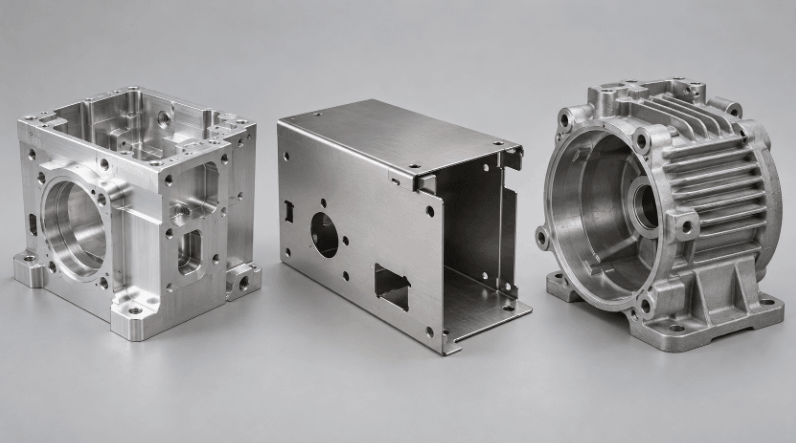
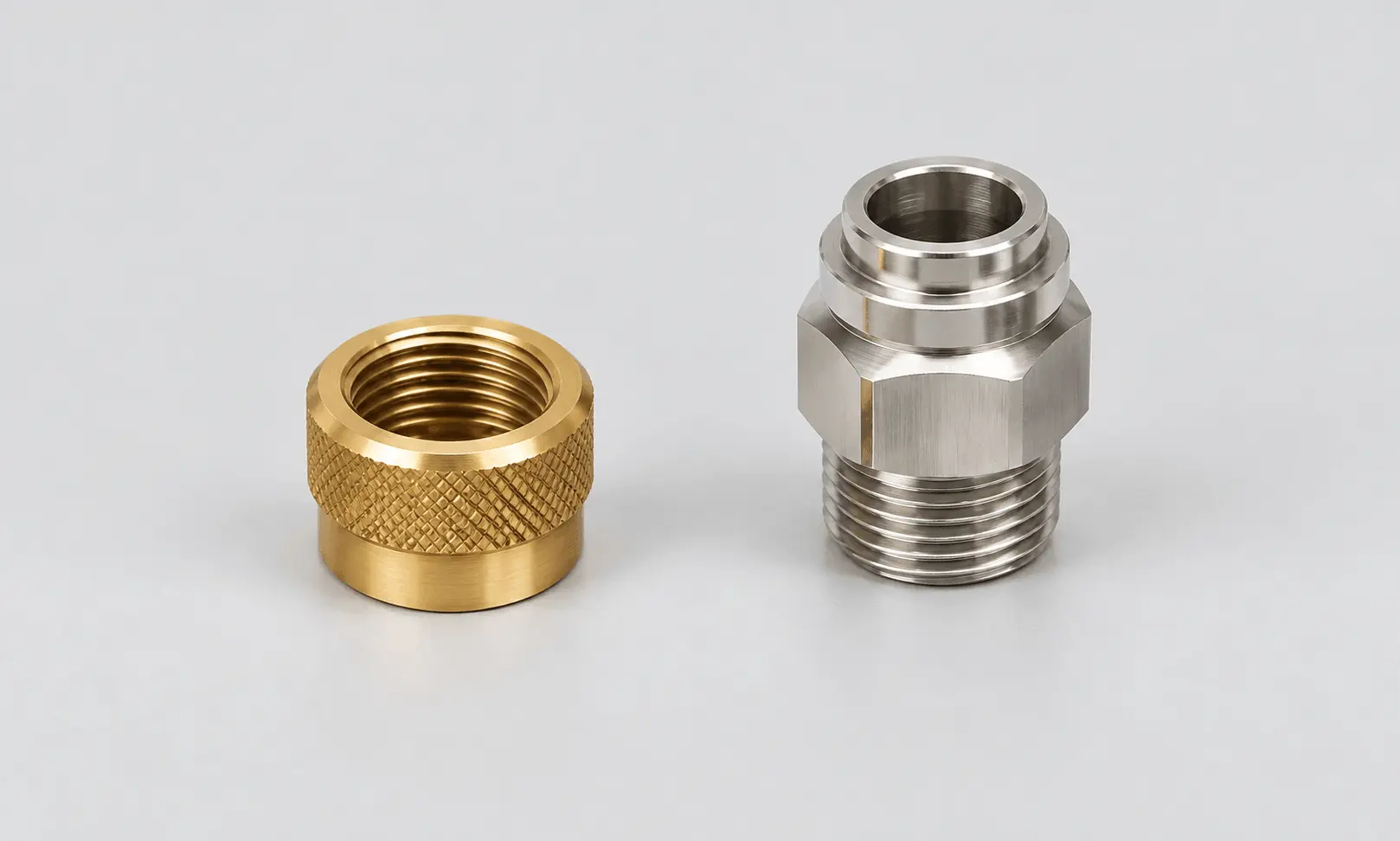
Metal parts made by CNC machining, sheet metal fabrication, die casting, stamping, and metal 3D printing
When is CNC machining a better choice than casting?
CNC machining is often a practical choice for prototypes and low-volume parts that need accurate holes, threads, sealing faces, or bearing seats. It avoids dedicated mold investment and allows design revisions without modifying production tooling. Casting becomes more attractive when the part geometry suits the process and recurring volume can spread the initial tooling cost.
A cast housing may still require machining at critical interfaces. The casting provides the general shape, while CNC machining establishes the dimensions of selected bores, mounting faces, and threads. Include those secondary operations when comparing the two routes.
Mastars has documented a motor housing project for electric surfboards that combines die casting with 5-axis CNC machining. The case illustrates how different processes can serve different features on the same component.
When does sheet metal become expensive?
Sheet metal costs rise when a part requires many bends, complex hardware, welded joints, cosmetic finishing, or tight relationships between features formed in different operations. A flat blank with straightforward holes is generally simpler to manufacture than an enclosure with multiple bend directions, vent slots, inserts, and a controlled visible surface.
Consider a mounting hole pattern that must align with a mating component after bending. Its final position depends on more than the flat-pattern coordinates: bend sequence, material springback, and feature location relative to the bend all matter. If the assembly is sensitive to that relationship, identify the critical dimensions on the drawing before requesting a quote.
How Do Material, Geometry, Tolerances, and Finishing Affect Cost?
Material affects stock cost and machinability; geometry determines tool access and setup; tolerances influence process control and inspection; and finishing adds operations or changes feature dimensions. These factors interact. For example, a thin-wall aluminum housing may be inexpensive in raw material but difficult to machine without distortion.
Material selection
| Material | Why it is selected | Cost considerations |
|---|---|---|
| 6061 aluminum | General-purpose machined parts, brackets, and housings | Commonly used for its strength-to-weight ratio and machinability |
| 7075 aluminum | Higher-strength parts where weight matters | Material and machining costs can be higher; corrosion protection may also need consideration |
| 304 or 316 stainless steel | Corrosion resistance and durability | More difficult to machine than many aluminum alloys; 316 may suit more demanding corrosion environments |
| Brass | Electrical, fluid-handling, decorative, or machined components | Often machinable, but grade and surface requirements still affect price |
| Titanium alloys | High strength-to-weight ratio for demanding applications | Higher material cost and challenging machining can make material removal expensive |
Choose a grade based on the part's function rather than material price per kilogram alone. Changing from aluminum to stainless steel can affect weight, machining time, corrosion behavior, and finishing. It may also change whether a thin feature remains sufficiently stiff or a threaded interface withstands the intended loading.
Specify the material grade and condition wherever possible. If the part requires anodizing, a defined strength level, corrosion resistance, or particular test evidence, include those requirements in the RFQ.
Geometry and machining time
A small feature can add disproportionate cost if it needs a special tool, slow cutting, or another setup. Deep narrow pockets, small internal radii, thin walls, long-reach tools, and features on several faces can all increase machining time or make the part harder to hold securely.
During a CNC design review, check the features that constrain the cutting process:
- Deep pockets: Long tools can deflect or chatter, requiring lighter cuts and longer machining time.
- Small internal corners: Cutter radius limits the achievable corner geometry. Very small radii may need additional operations or specialized tooling.
- Thin walls: Cutting forces and residual stress can cause deflection or distortion, particularly as material is removed from one side.
- Features on multiple faces: Additional orientations can require more setups, fixtures, or 4-axis/5-axis machining.
- Excess material removal: Machining a complex shape from solid stock can create more waste and cutting time than a suitable near-net-shape process.
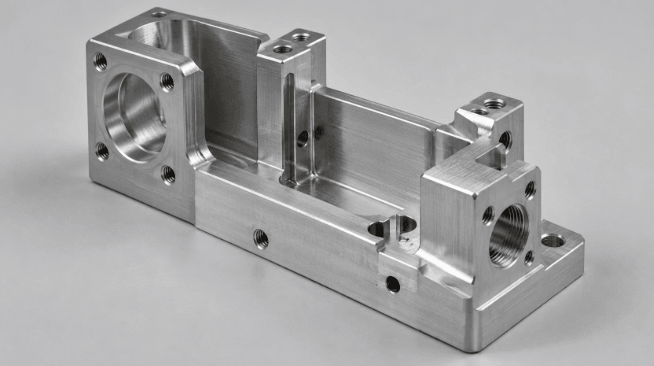
CNC-machined aluminum part with deep pockets, thin walls, threaded holes, and complex milling features
Before changing a feature, check its function. A relief slot with no functional purpose may be a candidate for removal; a pocket that provides tool clearance or a wall that controls stiffness may be essential. The aim is to reduce specific operations or constraints without compromising fit, load capacity, or assembly.
Tolerances and inspection
Tight tolerances increase cost when they require slower machining, more stable fixturing, additional finishing passes, or more detailed inspection. Applying a narrow tolerance to every dimension can therefore make a straightforward component unnecessarily expensive.
Separate critical dimensions from noncritical ones. A bearing bore, sealing face, or mating hole pattern may need close control, while an external edge that does not affect assembly may not. Where position and orientation matter, use appropriate GD&T controls rather than tightening unrelated linear dimensions.
Inspection requirements also affect the quote. Verifying a bore with a suitable gauge is different from checking a multi-feature datum relationship on a CMM. If first article inspection (FAI), a dimensional report, or 100% inspection is required, state it in the RFQ. A specified tolerance does not automatically mean a particular inspection report is included.
Surface finishing
Finishing adds process cost and can change dimensions. Anodizing, plating, powder coating, blasting, and polishing differ in appearance, corrosion protection, roughness, and dimensional impact. Specify the required result on the surfaces where it matters.
A cosmetic outer face may need a controlled texture or color, while a threaded hole or bearing seat may need masking or post-machining. Coating can affect fit if the drawing does not clarify whether dimensions apply before or after finishing. Machined tool marks and additive-manufacturing support marks may also remain visible unless the finishing requirements address them.
Identify visible surfaces, mating faces, sealing interfaces, and areas where coating is not permitted. This gives the supplier a defined scope and avoids paying for cosmetic treatment on surfaces where it serves no purpose.
How Do Quantity and Tooling Change the Unit Price?
Quantity affects how programming, setup, fixtures, and tooling are allocated across the order. CNC machining can suit small runs because it avoids dedicated molds, while stamping and die casting may reduce recurring costs after tooling investment is spread across enough parts.
For a simple illustration, assume a job has a fixed setup cost of $500. Allocated evenly, that cost contributes $50 per part across 10 pieces, $5 across 100 pieces, and $0.50 across 1,000 pieces. These figures show setup-cost allocation only; they exclude material, machine time, finishing, inspection, scrap, and other charges.
Tooling creates a different trade-off. A hypothetical $10,000 tool adds $100 per part at 100 pieces, $10 at 1,000 pieces, and $1 at 10,000 pieces before production and maintenance costs. If the design changes after the tool is made, modifications or replacement tooling may add further expense.
| Project stage | Main consideration | Processes worth evaluating |
|---|---|---|
| One-off prototype | Fit, function, assembly, and design iteration | CNC machining, sheet metal, metal 3D printing |
| Small pilot run | Repeatability, assembly validation, and revision cost | CNC machining, sheet metal, casting where tooling is justified |
| Low-to-medium volume | Recurring cost, finishing, inspection, and process consistency | CNC machining, sheet metal, casting, selected tooling-based methods |
| High-volume production | Tooling amortization, cycle time, scrap rate, and process stability | Die casting, stamping, or other dedicated production processes |
A prototype can validate fit and function without proving that the design is ready for production. Repeatability, tool access, material behavior, and inspection requirements still need to be considered for the intended production process.
For more on this transition, see A Working Prototype Is Not Yet Production-Ready.
How Can You Reduce the Cost of a Custom Metal Part?
Start with features that add machining, forming, or inspection work. For CNC parts, review deep cavities, small internal radii, thin walls, and features that require multiple setups. For sheet metal, check bend sequence, hardware choices, welded joints, and hole locations relative to bends.
A larger internal radius may allow a more practical cutter. Relaxing a noncritical tolerance may reduce finishing or measurement effort. Consolidating sheet-metal bends or standardizing hardware may simplify fabrication. Each change needs to be checked against the part's actual function: a lower-cost feature is not useful if it compromises tool clearance, stiffness, sealing, or assembly fit.
Mastars' low-volume aluminum prototype case describes a project involving 20 aluminum prototypes with curved surfaces, bosses, threaded holes, cavities, machined openings, anodizing, and inspection. The case reports a first batch in seven working days and selected machined interfaces held to ±0.05 mm.
For each proposed design change, check whether it removes an operation, setup, tool, fixture, or inspection step. Then verify that the critical interfaces and performance requirements remain intact. If production volume is expected to rise, compare the current process with the likely production route before committing to a redesign.
How Should You Compare Metal Part Quotes?
Compare quotations against the same drawing revision, material, quantity, finishing, inspection requirements, and delivery scope. A lower unit price is not a meaningful saving if the quote excludes operations that another supplier has included.
| Quote item | What to confirm |
|---|---|
| Manufacturing process | CNC, sheet metal, casting, stamping, 3D printing, or a combined route |
| Material | Exact grade, condition, thickness or stock size, and material documentation |
| Tooling and setup | Whether programming, fixtures, molds, or dies are charged separately |
| Secondary operations | Deburring, heat treatment, machining after casting, hardware, and assembly |
| Surface finish | Finish type, appearance requirements, masking, and dimensional impact |
| Inspection | Critical dimensions, measurement method, FAI, reports, and inspection frequency |
| Delivery | Quantity per shipment, packaging, shipping, duties, and delivery terms |
| Quality terms | Acceptance criteria, traceability, and handling of nonconforming parts |
Shipping, customs duties, brokerage, incoming inspection, inventory, rework, and coordination across multiple suppliers can change the overall economics. For a part with critical mating dimensions, the cost of a rejected batch or delayed assembly may outweigh a small unit-price difference.
Confirm which CAD model or drawing revision the supplier has priced. A late change to material, tooling, tolerances, or finishing can invalidate an earlier estimate.
What Information Should You Send for a Metal Part Quote?
A manufacturer can usually begin with a CAD model and a short description of the part's intended use. A complete drawing helps refine the estimate, especially when it specifies the material grade, critical dimensions, tolerances, surface requirements, and inspection criteria.
For a more useful quote, prepare:
- 3D CAD file: STEP is commonly used for geometry review.
- 2D engineering drawing: Include critical dimensions, GD&T where needed, and thread specifications.
- Material and condition: State the exact grade or identify acceptable alternatives.
- Quantity: Include the prototype quantity and expected follow-on volume if known.
- Surface requirements: Specify coating, texture, color, masking, or visible-surface expectations.
- Inspection requirements: Identify critical features and any required reports or acceptance criteria.
- Target delivery date: State the required date and whether partial shipments are acceptable.
If some details are unresolved, send the available files and identify the open questions. A preliminary estimate can help compare manufacturing routes before the final specifications are set.
Conclusion
Before comparing prices, define the order quantity, required material, critical dimensions, finish, and inspection scope. Ask suppliers to price the same drawing revision and clarify which manufacturing and delivery costs are included. If the part may move into production, include that expected volume when evaluating the process.
Get a Quote for Your Metal Part
Send Mastars your CAD model or drawing, target quantity, material requirements, and any critical dimensions or surface requirements. We can assess the proposed manufacturing route and quote scope for your prototype or production order.
Get a Quote →Frequently Asked Questions
Can I get a metal part made without a mold?
Yes. CNC machining, sheet metal fabrication, and metal 3D printing can produce many custom parts without dedicated production molds. For complex internal passages or deep cavities, compare machining access, achievable surface quality, and additive post-processing before choosing a process.
What costs might be missing from a low metal-part quote?
Check whether setup or tooling, finishing, deburring, hardware, inspection reports, packaging, freight, duties, and brokerage are included. Also confirm whether the price covers the finished component or only the part before secondary operations.
Should I prototype with the same process planned for production?
Not always. A prototype may need to validate fit, function, assembly, material behavior, or appearance, and a different process may be more practical for that stage. Before production, verify that the selected process can repeatedly achieve the required dimensions, surface quality, and material properties.
What should I do if I only have a rough drawing?
Send it with approximate dimensions, intended use, quantity, material preference, and any known critical features. You do not need every specification finalized to start a discussion. Label assumptions and unresolved requirements so a preliminary estimate is not mistaken for a final production quote.
Why do two suppliers quote very different prices for the same part?
Check that both suppliers are pricing the same drawing revision, material, quantity, finish, inspection level, and delivery scope. Then compare the proposed manufacturing routes. Differences in setup, secondary machining, finishing, and inspection can explain much of the gap. Ask each supplier to clarify the main cost assumptions before choosing based on unit price alone.
Hot Articles
Hot Tags
Stay Connected!


Manufacturing on Demand
Please fill in the following information to obtain plan details (information is confidential and not disclosed publicly), we will contact you within 24 hours, please keep your phone available!
Upload a 3D/2D model to see instant pricing, lead time, and DFM feedback.