



Comprehensive Analysis of Injection Molding Materials and Typical Application Cases


Injection molding is one of the most dominant and efficient manufacturing technologies in the modern plastic processing industry, widely applied in consumer electronics, automotive manufacturing, medical devices, household appliances, and industrial equipment. This high-precision mass production process melts plastic raw materials under high temperature, injects the molten fluid into customized molds under high pressure, and obtains standardized, complex-shaped plastic parts after cooling, solidification, and demolding. The performance, durability, appearance, and service scenarios of injection-molded products are fundamentally determined by the selection of molding materials. Reasonable material selection not only ensures product quality and structural stability but also optimizes production efficiency and controls manufacturing costs. This article systematically classifies mainstream injection molding materials, analyzes their core properties and application advantages, and combines two typical industrial product cases to elaborate on the practical application logic of injection molding materials.
1. Classification and Core Properties of Mainstream Injection Molding Materials
More than 80% of injection molding products in the market adopt thermoplastic materials, which feature reversible melting and solidification, recyclability, and excellent processing flexibility, making them the mainstream of injection molding production. A small number of special scenarios use thermosetting plastics and elastic materials to meet extreme environmental and performance requirements. According to performance grade and application scope, common injection molding materials are divided into commodity plastics, engineering plastics, and high-performance special plastics, each with distinct performance characteristics and application boundaries.
1.1 Commodity Thermoplastics
Commodity plastics are the most widely used and cost-effective injection molding materials, accounting for over 70% of global injection molding output. They have good fluidity, simple molding process, low shrinkage rate, and stable physical properties, suitable for mass production of daily and general industrial products. Typical materials include Polypropylene (PP), Acrylonitrile-Butadiene-Styrene (ABS), Polyethylene (PE), and Polyvinyl Chloride (PVC).
Polypropylene (PP) is recognized as the most versatile injection molding commodity material. It is lightweight, chemically corrosion-resistant, fatigue-resistant, and has excellent thermal stability, with a continuous use temperature of up to 100℃. PP has outstanding melt fluidity, which can fill fine mold structures, and low molding shrinkage, ensuring high dimensional accuracy of products. In addition, PP has good flexibility and tensile resistance, and will not be easily damaged after repeated bending and extrusion. Its disadvantages lie in poor low-temperature impact resistance and weak weather resistance, so it is mostly used for indoor products and structural parts not exposed to extreme low temperature. It is widely used in food containers, household daily necessities, automotive interior trim, and lightweight structural parts.
ABS copolymer is a composite material integrating the advantages of three monomers: acrylonitrile, butadiene, and styrene. It has balanced mechanical properties, with excellent tensile strength, impact resistance, and hardness. The material surface is smooth, easy to electroplate, spray, and bond, with good molding stability and dimensional accuracy. Different from PP, ABS has strong structural rigidity and is not easy to deform, making it the preferred material for electronic product shells. Its main defect is poor weather resistance, and it is prone to aging and yellowing under long-term outdoor ultraviolet radiation, so it is mostly applied to indoor electrical equipment and consumer electronic products.
1.2 Engineering Thermoplastics
Engineering plastics are high-strength, high-toughness materials with superior mechanical properties, heat resistance, and dimensional stability compared with commodity plastics. They can replace metal materials to undertake structural load and adapt to complex working conditions, and are widely used in high-precision industrial and high-end consumer products. Representative materials include Polycarbonate (PC), Polyamide (Nylon), and Polyoxymethylene (POM).
Polycarbonate (PC) is a transparent engineering plastic with high light transmittance comparable to glass. It has ultra-high impact resistance, tensile strength, and heat resistance, and can maintain stable performance in the temperature range of -40℃ to 120℃. PC features excellent dimensional stability, non-toxic and sterile properties, and can withstand high-pressure steam sterilization, meeting medical and food-grade safety standards. Its disadvantages are high melt viscosity, poor fluidity, high molding difficulty, and sensitivity to notch impact, requiring optimized mold design and injection process parameters. It is mainly used for transparent protective parts, medical device shells, automotive lighting parts, and high-strength electronic structural parts.
Nylon (PA) has outstanding wear resistance, self-lubricating property, and mechanical strength, with good fatigue resistance and chemical stability. It is often used to replace metal gears, bearings, and transmission parts, greatly reducing product weight and production cost. However, nylon has strong hygroscopicity, which will affect dimensional accuracy in high-humidity environments, requiring strict drying treatment before molding.
1.3 High-Performance Special Plastics
High-performance plastics represented by PEEK and PEI have ultra-high temperature resistance, chemical corrosion resistance, and structural stability, adapting to extreme working conditions such as aerospace, deep sea, and high-temperature industrial environments. These materials have excellent comprehensive performance but high cost and harsh molding process requirements, so they are only used in high-end precision equipment, medical implant devices, and aerospace core components, with a small application volume and high product added value.
2. Key Principles of Injection Molding Material Selection
Material selection is the core link of injection molding production, which directly determines product quality, service life, and production cost. Enterprises need to comprehensively consider three core factors: product performance requirements, service environment, and production conditions. First, according to the product’s structural strength, transparency, wear resistance, and safety standards, select materials that meet functional requirements. Second, match materials based on the service environment such as temperature, humidity, ultraviolet radiation, and chemical corrosion to avoid product aging, deformation, and failure. Third, balance production cost and efficiency: commodity materials are preferred for mass ordinary products, while high-performance engineering materials are selected for high-precision and high-load products. In addition, the fluidity, shrinkage, and molding temperature of materials need to match mold structure and injection equipment parameters to ensure smooth mass production.
3. Typical Injection Molding Product Application Cases
3.1 Case 1: Household Air Conditioner Outer Shell (ABS Material Application)
The outer shell of household split air conditioners is a typical large-scale, high-appearance, structural injection-molded product, which puts forward strict requirements on material surface finish, structural stability, impact resistance, and processability. At present, mainstream air conditioner manufacturers all adopt modified ABS materials as the core raw material of the shell, which perfectly matches the product’s use characteristics and mass production needs.
In terms of performance demand, the air conditioner shell needs to maintain flatness and no deformation for a long time in the indoor environment, and resist slight impact and scratch during transportation and use. ABS material has high surface hardness and smooth molding surface, which can meet the high appearance requirements of home appliances without obvious shrinkage marks and burrs after molding. Its excellent tensile strength and structural rigidity ensure that the large-area shell will not warp or deform after long-term use. In addition, ABS has good surface processing adaptability, which can support surface spraying, matte finishing, and color customization, meeting the diversified appearance design needs of air conditioner products.
In terms of production process, ABS has moderate melt fluidity and stable molding performance, which can fill the large-area and thin-walled shell mold uniformly, with low product defect rate and high dimensional consistency, suitable for high-volume automated production. Considering the indoor use scenario, modified ABS materials are added with anti-aging and flame-retardant additives to improve fire resistance and indoor anti-aging ability, avoiding yellowing and brittle cracking of the shell after long-term use. This case fully reflects the advantages of ABS materials in high-appearance, medium-strength, and mass-produced household electrical products, achieving a perfect balance between performance, appearance, and cost.
3.2 Case 2: Automotive Headlight Transparent Cover (PC Material Application)
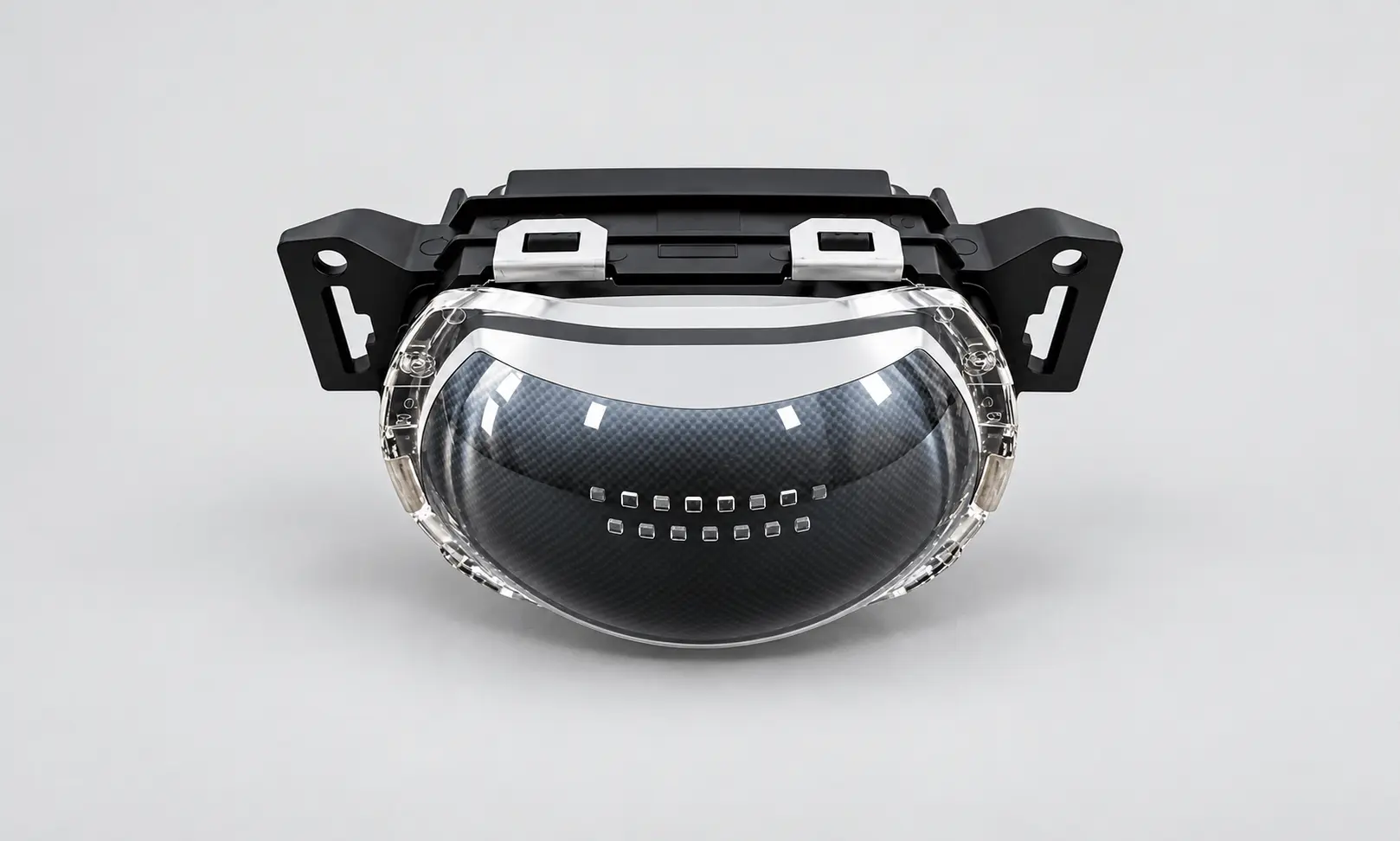
Automotive headlight transparent cover is a key functional and protective part of automobile lighting system, which needs to work stably in complex outdoor environments such as high temperature, rain, snow, ultraviolet radiation, and road impact. For a long time, glass materials were used for headlight covers, but they have the disadvantages of heavy weight, fragile breakage, and difficult molding of special shapes. At present, high-transparency modified PC materials have completely replaced glass and become the mainstream material for automotive headlight covers.
PC material’s core advantages fully meet the extreme performance requirements of automotive headlight covers. First, its light transmittance is as high as 90%, close to optical glass, ensuring the lighting effect of car headlights without light loss and distortion. Second, PC has ultra-high impact resistance, which can resist stone impact and external collision during driving, avoiding cracking and fragmentation, and greatly improving driving safety. Third, PC has excellent weather resistance and temperature resistance, which can resist ultraviolet aging, rain erosion, and high-temperature baking of lamp beads, and will not yellow, fog, or deform after long-term outdoor use, maintaining stable light transmittance.
In terms of molding process, PC can be injected into complex curved and integrated special-shaped structures, realizing integrated molding of headlight covers with various streamline designs, which is in line with the personalized and aerodynamic design trend of modern automobiles. In order to further adapt to the automotive working environment, manufacturers usually modify PC materials with anti-scratch and anti-UV additives to improve surface wear resistance and outdoor aging resistance. The application of PC materials not only reduces the weight of automobile parts and realizes vehicle lightweighting and energy saving, but also improves the product yield and design diversity of headlight covers, which is a typical representative of engineering plastics replacing traditional inorganic materials in the automotive industry.
4. Conclusion
Injection molding materials are the foundation of product performance and design innovation, and different types of materials have clear application positioning and performance boundaries. Commodity plastics represented by PP and ABS meet the mass production needs of daily consumer goods and ordinary structural parts with high cost performance and excellent processability. Engineering plastics represented by PC and nylon rely on high strength, high transparency, and high stability to support high-precision and high-reliability industrial products. High-performance special plastics undertake the extreme working condition needs of high-end fields such as aerospace and medical treatment. The two typical cases of household air conditioner shells and automotive headlight covers fully verify that accurate material selection can maximize product performance, optimize production efficiency, and reduce comprehensive costs. With the continuous development of material modification technology, new composite injection molding materials with high flame retardancy, high weather resistance, and environmental protection will be continuously launched, further expanding the application scope of injection molding technology and promoting the upgrading and innovation of the manufacturing industry.
Hot Articles
Hot Tags
Stay Connected!


Manufacturing on Demand
Please fill in the following information to obtain plan details (information is confidential and not disclosed publicly), we will contact you within 24 hours, please keep your phone available!
Upload a 3D/2D model to see instant pricing, lead time, and DFM feedback.