



Beyond Foam: Engineering Bicycle Saddle Cushioning with 3D-Printed Lattices


Rethinking Bicycle Saddle Cushioning
Bicycle saddle cushioning has traditionally relied on foam materials, thickness, and supporting structures. But what if engineers could also control cushioning behavior through three-dimensional geometry?
A 3D-printed lattice offers a different approach. Interconnected structural elements can be designed to influence how different regions respond to pressure and deformation, creating new possibilities for localized support.
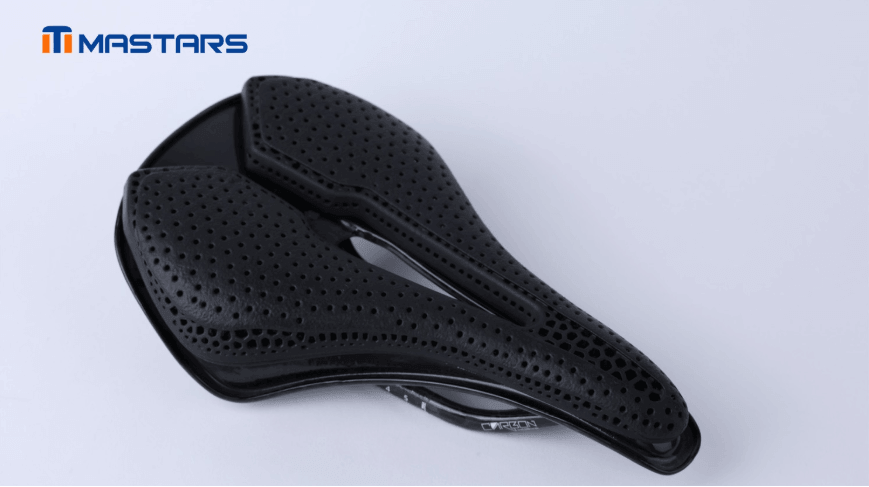
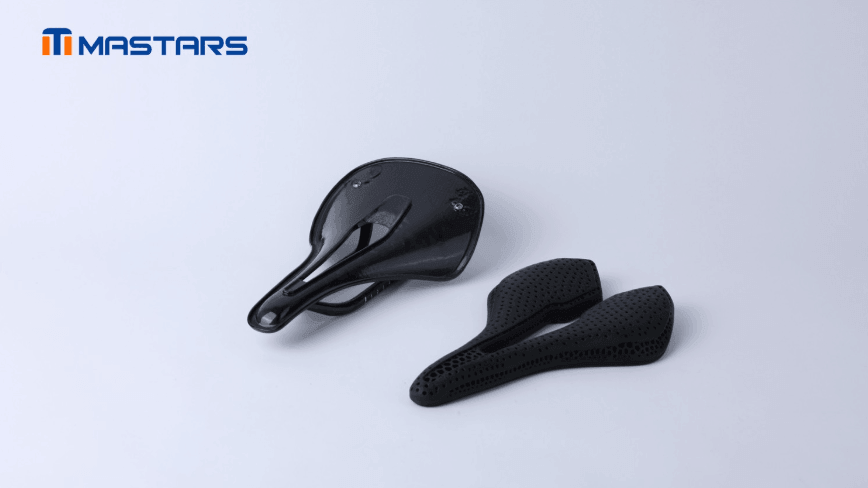
In this manufacturing case, Mastars produced a 3D-printed lattice cushioning layer for a bicycle saddle. The component features fine surface perforations, interconnected three-dimensional structures, and a central relief opening. The printed cushioning layer is separate from the supporting shell and mounting rails.
For product developers, this introduces another way to approach cushioning design: adjusting internal geometry alongside material selection.
The engineering challenge is translating that design freedom into a component that can be manufactured, assembled, and evaluated under realistic loading conditions.
Engineering Support Through Geometry
Traditional foam cushioning relies on material properties, density, thickness, and overall shape to determine how a saddle responds to load. Lattice cushioning adds another design variable: internal geometry.
By adjusting cell topology, strut dimensions, connectivity, and local structural density, engineers can develop regions with different stiffness and deformation characteristics within the same cushioning layer.
For bicycle saddles, this allows designers to explore how support and compliance vary across the seating surface without necessarily changing the base material.
Independent cycling tests have also demonstrated the potential impact on pressure distribution. In comparisons reported by German cycling publication BIKE, some 3D-printed saddle models showed localized peak pressures approximately 50% lower than their conventionally padded counterparts under the reported test conditions.
These findings illustrate the potential of engineered lattice cushioning to redistribute contact pressure. However, the result depends on the saddle design, rider, and test conditions, and lower peak pressure does not automatically guarantee greater comfort.
The objective is to select a combination of geometry and material properties that produces the intended response under actual loading conditions.
Why Additive Manufacturing Changes the Design Approach
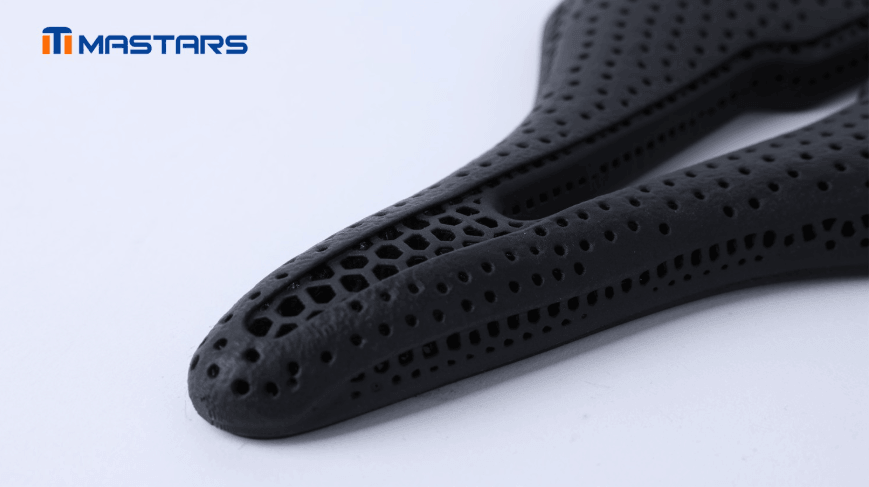
The lattice cushioning layer contains numerous interconnected features distributed across a curved surface. Producing such geometry through conventional manufacturing methods can introduce significant restrictions.
CNC machining depends on tool accessibility, while injection molding must accommodate material flow, mold separation, and part ejection. Complex open-cell networks can make these requirements difficult to satisfy.
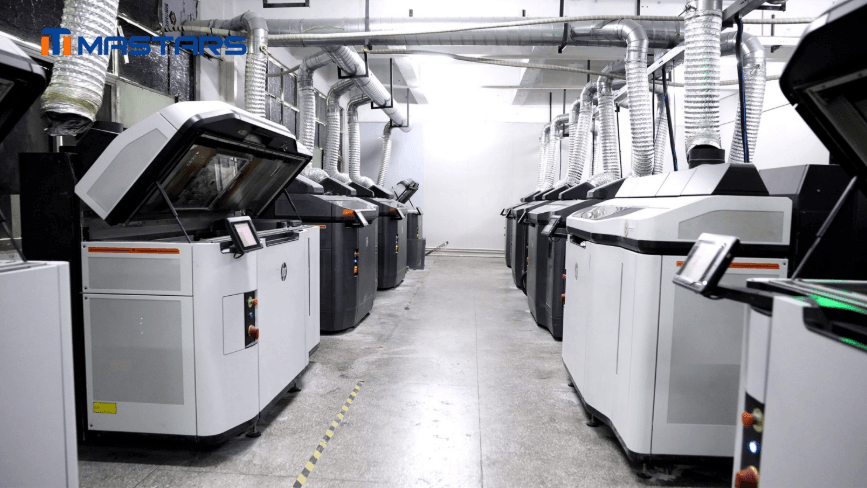
Additive manufacturing provides a different route by building the geometry layer by layer, allowing intricate structures to be produced without conventional injection mold tooling.
Polymer additive manufacturing technologies such as Digital Light Synthesis (DLS), Selective Laser Sintering (SLS), and Multi Jet Fusion (MJF) offer different approaches to producing complex components. Their suitability depends on material compatibility, feature resolution, mechanical requirements, and post-processing conditions.
For lattice cushioning applications, the manufacturing process must reproduce fine structural details while supporting the material behavior required by the design.
Mastars uses additive manufacturing to turn complex lattice geometries into physical cushioning components, providing a practical manufacturing route for structures that would be difficult to realize through conventional tooling.
From Digital Geometry to Physical Cushioning
Turning a lattice model into a physical component requires coordination between geometry, material behavior, and manufacturing conditions.
The fine interconnected elements visible in this saddle introduce considerations involving minimum printable feature size, dimensional accuracy, build preparation, and post-processing accessibility.
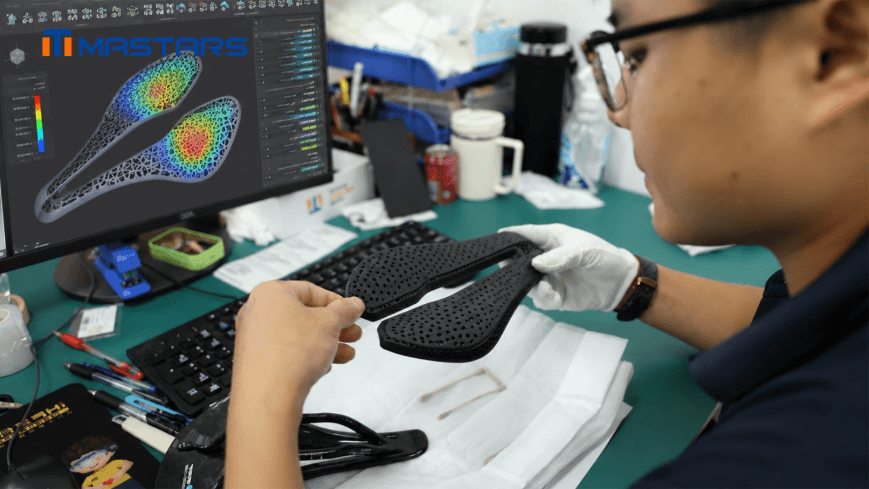
Lattice geometry can be defined through measurable parameters, including unit cell size, strut diameter or wall thickness, and relative density. These parameters allow engineers to compare structural configurations rather than relying on appearance alone.
Material selection is equally important. Flexible polymers, including thermoplastic polyurethane (TPU) and other elastomeric materials, are widely considered for applications requiring repeated deformation and recovery.
However, the mechanical response of a printed lattice depends on both material formulation and geometric architecture. Similar materials can produce different compression and recovery characteristics when their lattice designs or manufacturing conditions change.
Post-processing must also be considered during development. Depending on the selected technology, residual powder or resin may need to be removed from internal openings, followed by appropriate cleaning or finishing operations.
For components containing numerous interconnected cells, accessibility throughout the structure can influence manufacturing quality and process efficiency.
Connecting the Lattice Layer with the Complete Saddle
Although the lattice cushioning layer is the most visually distinctive feature, it remains one part of the complete bicycle saddle.
The supporting shell provides the underlying structural foundation, while the mounting rails connect the saddle to the bicycle. The printed lattice layer must fit the shell geometry and accommodate the central relief opening and perimeter transitions.
The interface between the cushioning layer and the supporting shell is particularly important.
During use, loads pass through the cushioning structure toward the underlying support. Contact regions, attachment features, and transitions between open lattice and more solid areas therefore require consideration during product development.
Manufacturing must also preserve the geometry required for assembly. Dimensional relationships and structural interfaces are important when integrating the printed cushioning layer with other saddle components.
For Mastars, this manufacturing approach connects complex geometric production with practical product-development requirements. Additive manufacturing makes intricate lattice structures physically achievable while supporting the evaluation of their fit within a larger assembly.
What Customers Gain
For product teams developing complex cushioning structures, 3D-printed lattices offer new possibilities for pressure management, tailored support, and manufacturing validation.
Approximately 50% Lower Localized Peak Pressure
In independent bicycle saddle comparisons, selected 3D-printed models showed peak pressure reductions from approximately 30 to 15 N/cm² under specific test conditions, demonstrating the potential for improved pressure distribution.
14,000 Struts and 7,799 Nodes for Advanced Cushioning Design
A commercial lattice saddle features approximately 14,000 struts and 7,799 connection nodes. This geometric complexity allows engineers to explore different levels of localized support and deformation through structural design.
No New Mold Required for Every Design Revision
Unlike conventional tooling-dependent production, 3D printing enables updated lattice geometries to be manufactured directly from revised digital models, supporting prototype comparison and design iteration.
10,000 Loading Cycles for Quantitative Durability Evaluation
In a published study, a specific lattice specimen recorded 0.77% ± 0.05% residual strain after 10,000 loading cycles, illustrating how repeated-load testing can quantify deformation recovery.
Mastars supports complex lattice component manufacturing, prototype development, and assembly evaluation through its 3D printing and coordinated manufacturing services.
Verification Beyond Printing
For bicycle saddle cushioning, successful manufacturing is one part of the engineering process. The finished lattice structure must also be evaluated against its intended mechanical behavior, dimensional requirements, and assembly interfaces.
Compression response, load distribution, cyclic fatigue, and residual deformation are important evaluation areas for cushioning applications.
Repeated loading can influence individual lattice elements as well as the interfaces connecting the cushioning layer to the supporting shell. Testing must therefore consider both the printed structure and its role within the complete saddle.
The geometry also requires attention during inspection. Fine interconnected features may contain incomplete sections, local damage, or areas affected by post-processing.
Actual riding comfort depends on additional factors, including rider anatomy, saddle geometry, riding position, and operating conditions. A lattice structure offers greater freedom to tailor mechanical behavior, but its final performance must be evaluated under representative use conditions.
This connection between manufacturing and verification is essential when developing functional products with complex internal structures.
Applications Beyond Bicycle Saddles
The same principles of geometry-driven mechanical response can be explored in other products and industries.
- Sports & Cycling Equipment: Bicycle saddle cushioning, protective padding, ergonomic grips, and performance-oriented support components.
- Medical & Rehabilitation Products: Customized cushioning surfaces, orthotic support structures, and pressure-management components, subject to appropriate validation.
- Consumer Products: Ergonomic seating, wearable cushioning, flexible support structures, and personalized accessories.
- Industrial & Robotics Applications: Compliant interfaces, energy-absorbing components, vibration-control structures, and protective elements.
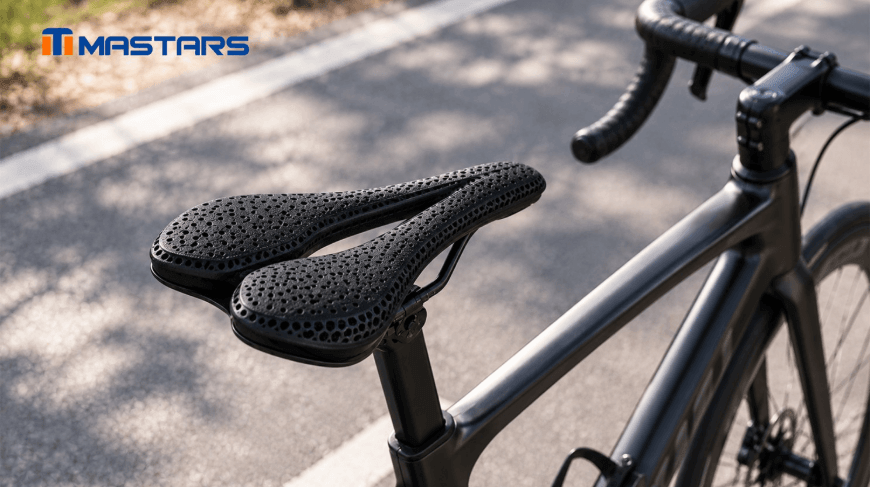
Across these applications, additive manufacturing lets engineers explore how geometry and material selection can work together to shape product behavior.
Could your next product benefit from a structure designed around localized mechanical response rather than conventional cushioning alone?
Mastars supports complex product development through 3D printing and coordinated manufacturing services, helping customers turn challenging geometries into physical components and advance their designs toward practical applications. Get a quote!

Mastars, the most trusted one-stop manufacturing services provider for low-volume production worldwide!
Hot Articles

Hot Tags
Stay Connected!


Manufacturing on Demand
Please fill in the following information to obtain plan details (information is confidential and not disclosed publicly), we will contact you within 24 hours, please keep your phone available!
Upload a 3D/2D model to see instant pricing, lead time, and DFM feedback.