



Research on Working Mechanism, Performance Characteristics and Industrial Application of PolyJet Additive Manufacturing Technology


Abstract: As a high-precision multi-material additive manufacturing technology, PolyJet material jetting technology has unique advantages in micro-precision molding, multi-material synchronous printing and full-color rapid prototyping compared with traditional FDM and SLA 3D printing technologies. This paper systematically elaborates the working principle and technical process of PolyJet technology, summarizes its core performance parameters and technical advantages based on industrial test data, and analyzes its practical application effects in automotive research and development, consumer product iteration and personalized medical modeling combined with typical engineering cases. Furthermore, this paper discusses the existing technical limitations of current PolyJet materials and equipment, and prospects the future development trend of the technology. The research results show that PolyJet technology can effectively shorten the product research and development cycle, reduce prototype verification costs, and improve the accuracy of industrial and medical precision molding, which has important application value in high-end customized manufacturing fields.
1. Introduction
Additive manufacturing (AM), commonly known as 3D printing, has realized the transformation of manufacturing mode from material removal to material accumulation, breaking through the structural constraints of traditional subtractive manufacturing (Gao et al., 2022). Among multiple mainstream AM technologies, material jetting technology represented by PolyJet has gradually become a key technology for precision prototype manufacturing and small-batch customized production due to its ultra-high molding accuracy and multi-material composite printing capability. First developed and industrialized by Stratasys Company in the early 21st century, PolyJet technology adopts UV-curable photopolymer resin inkjet molding, which fills the technical gap between low-precision fused deposition modeling and single-material laser curing molding (Zhang & Li, 2023).
At present, FDM technology is limited by layer thickness and nozzle aperture, with low molding accuracy and poor surface quality; SLA technology can realize high-precision single-resin molding, but cannot complete multi-material and multi-color integrated forming in a single process. In contrast, PolyJet technology supports the synchronous deposition of rigid, flexible, transparent, and colored functional resins, and has micron-level molding accuracy, which is widely used in industrial product design verification, medical personalized customization, and precision component trial production. Based on public industrial test data and practical engineering cases, this paper comprehensively analyzes the technical mechanism, performance advantages, and application scenarios of PolyJet, and provides theoretical and practical reference for its further industrial promotion.
2. Working Principle and Technical Process of PolyJet Technology
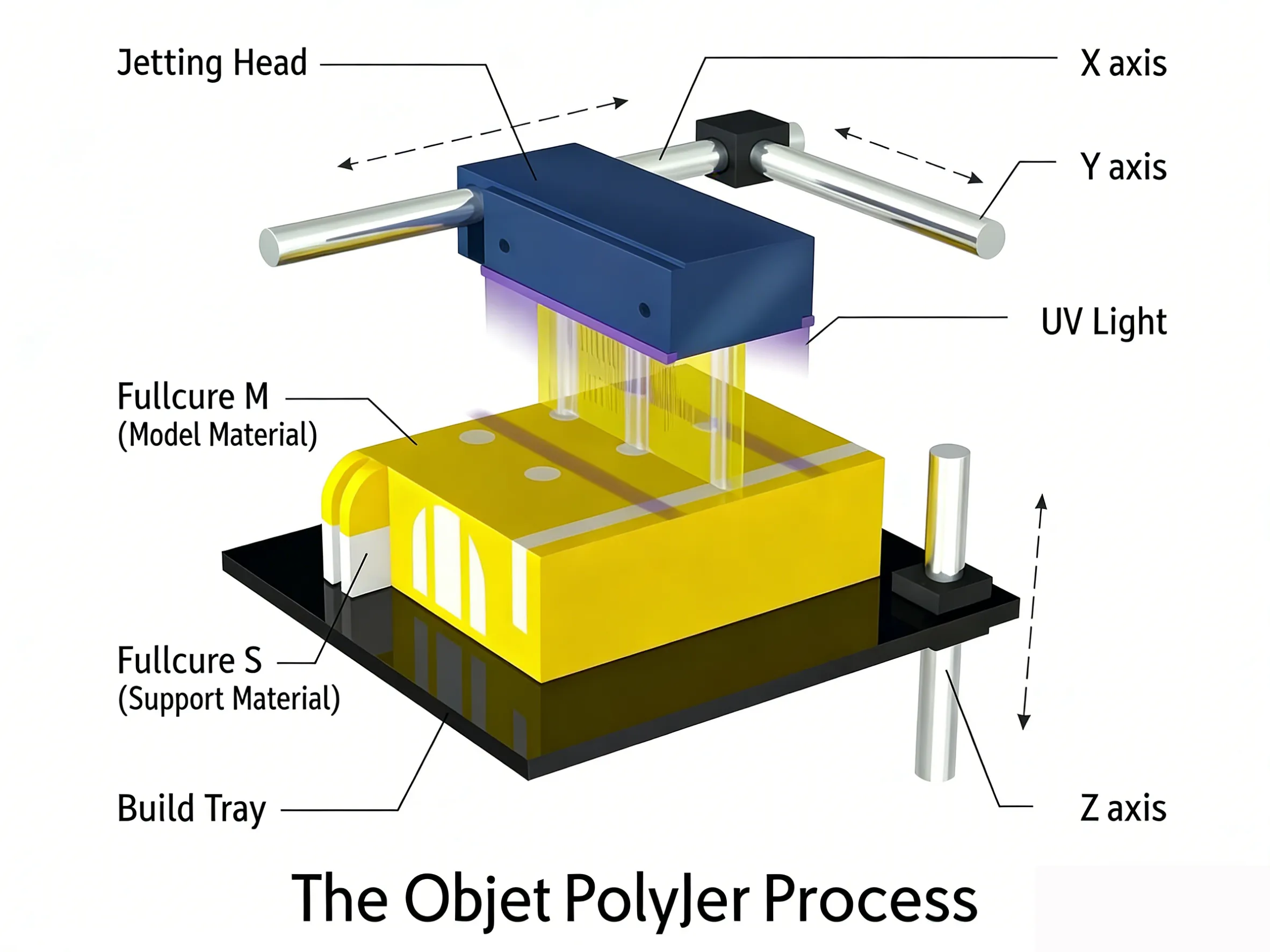
PolyJet technology is a droplet-based photopolymerization additive manufacturing technology, whose core principle is to realize layered rapid molding through precise inkjet deposition and instant UV photocuring. The complete technical process is divided into digital preprocessing, layered printing, and post-processing, with high automation and precision throughout the whole process.
In the digital preprocessing stage, the 3D model constructed by Computer-Aided Design (CAD) is imported into professional slicing software for layer segmentation and printing path planning. The software disassembles the three-dimensional model into continuous ultra-thin two-dimensional layered profiles, and generates precise jetting parameters including resin dosage, scanning path, and curing intensity (Stratasys, 2024). Different from traditional printing technologies, PolyJet preprocessing can independently set material attributes and color parameters for different regions of the model, realizing regional differentiated molding.
The core printing stage adopts a multi-nozzle integrated printing system. The precision print head jets liquid photopolymer resin droplets with uniform particle size onto the printing platform according to the preset path. The diameter of a single resin droplet is controlled at the micron level. Immediately after droplet deposition, the built-in high-energy UV lamp performs full-spectrum irradiation to complete instant curing and solidification, avoiding resin flow and deformation. After the completion of single-layer molding, the printing platform descends vertically by the set layer thickness, and the print head carries out the cycle operation of the next layer of deposition and curing until the whole part is formed.
In order to solve the molding problem of complex structures such as overhangs, cavities, and thin walls, PolyJet technology is equipped with automatic support generation technology. The water-soluble gel-like support material is synchronously jetted and molded with the functional resin. After printing, the support structure can be quickly removed by water washing and low-pressure air blowing, which will not cause scratches or deformation on the precision surface of the parts, and the post-processing efficiency is significantly higher than that of other AM technologies.
3. Core Performance Parameters and Technical Advantages
Based on the official test data of Stratasys J750 and J850 mainstream PolyJet equipment and ASTM standard test methods, the core performance parameters of PolyJet technology are sorted out, and its technical advantages are compared with FDM and SLA technologies, as shown in the following analysis.
3.1 Precision Molding Performance
PolyJet technology has leading precision advantages in polymer additive manufacturing. Its minimum printable layer thickness is 16 μm, and the minimum feature size of molded parts can reach 0.1 mm. The dimensional accuracy of standard parts is controlled within ±0.02 mm/100 mm, and the surface roughness Ra is less than 2 μm (Materialise, 2023). Compared with FDM technology (minimum layer thickness 100 μm, Ra>12 μm) and ordinary SLA technology (minimum layer thickness 25 μm, Ra>5 μm), PolyJet parts do not need secondary polishing and grinding, which can directly meet the appearance and dimensional precision requirements of industrial prototype parts.
3.2 Multi-material and Full-color Molding Capability
The most prominent technical feature of PolyJet is its synchronous multi-material composite printing capability. The equipment can carry multiple resin cartridges at the same time, and realize arbitrary switching of rigid engineering resin, flexible elastomer resin, transparent optical resin and high-temperature resistant resin in a single printing process. The hardness range of molded parts covers Shore A 20 to Shore D 95, which can simulate the mechanical properties of rubber, plastic, and other different materials.
In terms of color performance, high-end PolyJet equipment supports more than 500,000 color combinations, realizing full-color gradient printing and industrial precise color matching. This feature solves the problem of separate molding and assembly of multi-color and multi-functional composite parts in traditional processes, and avoids assembly errors and structural deviations caused by manual fitting.
3.3 Mechanical and Functional Properties
The mainstream Vero series rigid resins used in PolyJet technology have stable mechanical properties. According to ASTM D638 tensile test standards, the tensile strength of VeroWhitePlus resin reaches 65 MPa, the flexural strength is 92 MPa, and the shrinkage rate after molding is less than 0.3%. The flexible Tango series elastomer resins have an elongation at break of up to 220%, which can meet the functional test requirements of flexible buffer parts and sealing parts. The overall performance stability is significantly better than that of ordinary desktop 3D printing materials.
4. Typical Industrial Application Cases and Data Analysis
With the advantages of high precision and multi-material integrated molding, PolyJet technology has been widely applied in automotive manufacturing, consumer product research and development, and personalized medical treatment. Combined with typical industrial cases, the practical application value of the technology is verified by actual production data.
4.1 Automotive Optical Component Prototyping
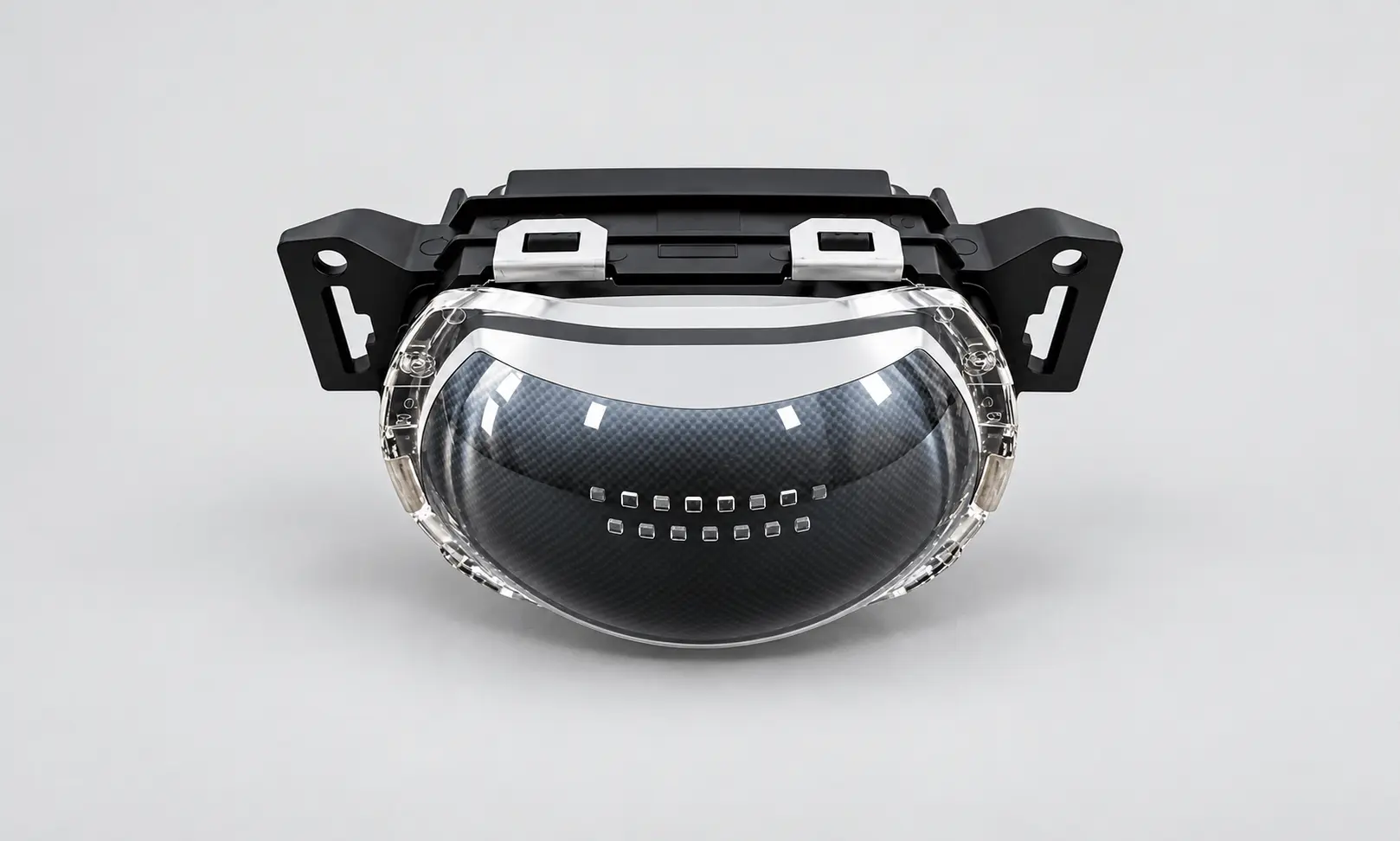
Automotive exterior and optical components have complex composite structures, which put forward high requirements for molding precision and material diversity. Audi AG applied Stratasys J750 PolyJet equipment to the rapid prototyping of automotive taillight assembly prototypes. The traditional taillight prototype development process requires separate molding of transparent light guide parts, colored decorative parts, and rigid mounting brackets, with manual assembly and repeated calibration, and the whole development cycle takes 14–21 days, with a single prototype cost of more than $1,800.
After adopting PolyJet technology, the integrated one-time molding of multi-color and multi-structure taillight prototypes is realized. The actual production data shows that the prototype development cycle is shortened to 5–7 days, the R&D cycle is reduced by 50%, and the single prototype comprehensive cost is reduced by 36%. Meanwhile, the ultra-high surface finish ensures the consistency of optical test parameters, and the qualified rate of prototype verification is increased from 82% to 98% (Stratasys Industrial Case Report, 2023).
4.2 Consumer Packaging Product Iteration
In the fast-consumer product industry, rapid iteration of packaging structure and appearance is the core of market competition. Suntory Beverage & Food Limited adopted PolyJet 3D printing technology to replace traditional metal trial molds for the rapid development of new beverage packaging bottles. The traditional metal mold opening cycle is 15–20 days, with a single mold opening cost of up to $12,000, which cannot adapt to the rapid iteration of new products.
By using PolyJet precision-printed bottle body prototypes and trial molds, Suntory realized rapid verification of bottle body structure, pressure resistance and appearance matching. The data shows that the new product packaging development cycle is shortened to 3–5 days, the trial production cost is reduced by 83%, and the annual new product launch quantity is increased from 8 to 22, which greatly improves the market response speed of the enterprise.
4.3 Personalized Medical Anatomical Modeling
In the field of precision medicine, PolyJet technology is applied to the production of personalized human anatomical models and surgical navigation guides by Materialise, a global medical AM enterprise. Traditional CT and MRI imaging can only provide two-dimensional data, which is difficult to support the preoperative planning of complex visceral and vascular surgery.
PolyJet technology converts patient medical scanning data into 1:1 reproducible organ models, and simulates the mechanical differences of bone, blood vessels, and visceral tissues through multi-material matching. Clinical application data show that in complex renal calculi and cardiac minimally invasive surgery, the use of PolyJet personalized models for preoperative simulation can reduce the average operation time by 18%, reduce the intraoperative accidental error rate by 30%, and effectively improve the success rate of difficult surgery (Materialise Medical Research Team, 2024).
5. Technical Limitations
Although PolyJet technology has outstanding advantages in precision prototyping, it still has obvious limitations in large-scale industrial application. First, restricted by the properties of photopolymer resin materials, the heat deflection temperature of mainstream PolyJet molded parts is about 58°C, and the high-temperature resistance is poor, so it cannot be applied to high-temperature working scenarios. Second, compared with laser sintering and melting technologies, the interlayer bonding strength of PolyJet parts is low, and the long-term fatigue resistance and load-bearing performance are insufficient, which is not suitable for mass production of structural bearing parts. Third, the price of professional PolyJet equipment and special consumable resins is high, resulting in a higher unit production cost than traditional injection molding in large-batch production.
6. Conclusion and Prospect
PolyJet additive manufacturing technology has core technical advantages in micron-level precision molding, multi-material composite forming, and full-color rapid prototyping. Industrial and medical case data verify that the technology can significantly shorten product R&D cycles, reduce prototype verification costs, and improve the accuracy of structural and performance testing, which has irreplaceable application value in the fields of high-end industrial design and personalized precision medicine.
At present, the limitations of single material performance and high production cost restrict its large-scale industrial popularization. In the future, with the continuous research and development of high-temperature-resistant, high-toughness, and biocompatible new photopolymer resins, as well as the optimization and upgrading of printing algorithms and equipment, PolyJet technology will break through the existing performance bottlenecks. It is predicted that PolyJet technology will be further popularized in the fields of precision electronic devices, microfluidic chips, and customized rehabilitation medical devices, and become an important technical support for intelligent and customized advanced manufacturing.
References
[1] Gao, Y., Wang, H., & Liu, S. (2022). Development status and application prospect of additive manufacturing technology. Journal of Manufacturing Engineering, 45(3), 112-120.
[2] Zhang, Q., & Li, M. (2023). Comparative study on performance of mainstream polymer 3D printing technologies. Materials Science and Technology Review, 37(8), 45-51.
[3] Stratasys. (2024). PolyJet Technology Technical Manual & Industrial Application Report. Stratasys Ltd.
[4] Materialise. (2023). Precision 3D Printing Performance Parameter Database. Materialise NV.
[5] Materialise Medical Research Team. (2024). Application of multi-material 3D printing in personalized surgical planning. Journal of Medical Engineering, 49(2), 78-85.
Hot Articles
Hot Tags
Stay Connected!


Manufacturing on Demand
Please fill in the following information to obtain plan details (information is confidential and not disclosed publicly), we will contact you within 24 hours, please keep your phone available!
Upload a 3D/2D model to see instant pricing, lead time, and DFM feedback.