



A Comprehensive Guide to Selecting Injection Molding: Criteria, Parameters and Practical Cases


Injection molding is the most dominant manufacturing process for thermoplastic and elastomer components across consumer electronics, automotive, medical devices and daily consumer goods industries. Characterized by high repeatability, low unit cost in mass production, excellent surface finish and compatible diverse engineering materials, this process differs fundamentally from CNC machining, 3D printing and compression molding in terms of cost structure, production cycle and design adaptability. However, its high upfront tooling investment and long mold development cycle make it unsuitable for all manufacturing scenarios. This article provides a systematic decision-making framework for enterprises and product engineers to judge whether to adopt injection molding from five core dimensions: production volume, part design characteristics, material attributes, budget constraints and quality requirements. Meanwhile, it presents standardized processing parameter tables for mainstream resins, compares injection molding with alternative manufacturing technologies, and analyzes two practical industrial cases to summarize applicable scenarios and taboo conditions, helping decision-makers eliminate selection biases and maximize manufacturing benefits. (Word Count: 2490)
1. Introduction
Against the backdrop of booming precision lightweight manufacturing, plastic parts have gradually replaced traditional metal components in numerous industries by virtue of their low density, strong corrosion resistance and flexible customization performance. At present, mainstream plastic manufacturing technologies include injection molding, computer numerical control (CNC) machining, fused deposition modeling (FDM) 3D printing and compression molding. Among them, injection molding occupies more than 70% of the market share of mass-produced plastic parts, becoming the preferred process for standardized and customized plastic component production (Protolabs, 2026).
In essence, injection molding melts solid plastic particles into fluid colloid via high-temperature heating, injects the molten material into a customized closed metal mold under high pressure, and obtains finished parts after cooling, solidification and ejection. The entire process features high automation and short single-cycle molding time. Nevertheless, many product designers and project managers still face decision-making dilemmas in actual projects: blindly adopting injection molding for small-batch prototype production leads to excessive upfront cost waste; abandoning injection molding for mature mass-production products results in elevated unit production costs and unstable part consistency.
The core of rational selection of injection molding lies in balancing five key factors: batch size, part geometry, material type, project budget and delivery timeline. This guide clarifies the applicable and inapplicable scenarios of injection molding, sorts out optimal process parameters for common materials, and verifies the decision-making logic through real industrial cases, aiming to offer actionable references for plastic part manufacturing scheme selection.
2. Core Decision-Making Criteria for Choosing Injection Molding
2.1 Production Volume Threshold
Production volume is the primary decisive factor for process selection, as it directly determines the cost amortization efficiency of injection molds. Different from subtractive manufacturing and additive manufacturing, injection molding requires one-time investment in precision steel or aluminum molds in the early stage. The higher the production batch, the lower the average mold amortization cost of a single part (Additive Plus, 2026).
Combined with industrial mass production data, the volume decision threshold is divided into three intervals. For prototypes or small batches below 300 units, 3D printing or CNC machining is more cost-effective, since customized molds cannot effectively dilute tooling costs. For medium batches ranging from 300 to 3,000 units, engineers need to conduct cost comparison according to part complexity; simple structural parts can adopt soft aluminum molds for low-cost injection molding, while complex parts are still recommended to use CNC machining. For large batches exceeding 3,000 units, injection molding becomes the optimal solution, and its unit cost advantage will expand continuously with the growth of production volume (U-Need, 2026).
2.2 Part Design and Structural Characteristics
Injection molding has unique adaptability to complex geometric structures that other processes cannot match. It can efficiently fabricate thin-walled structures (0.8mm-3mm), integrated snap fits, living hinges, deep grooves and undercut features, which are difficult or costly to process via CNC machining (Makerstage, 2026). In addition, the process supports one-time molding of multi-texture surfaces such as frosted, glossy and patterned surfaces, eliminating secondary polishing and spraying processes and simplifying the production flow.
Conversely, injection molding is not suitable for oversized ultra-thick parts (wall thickness over 15mm) and ultra-high-precision micro-components. Excessively thick walls will cause uneven internal cooling, resulting in shrinkage cavities and internal stress; micro-parts with tolerance higher than ±0.02mm are prone to burrs and dimensional deviations during the ejection stage, and ultra-precision CNC machining is more reliable for such parts.
2.3 Material Compatibility
Injection molding is compatible with almost all thermoplastic resins and partial elastomer materials, including general-purpose plastics (PP, PE, ABS) and high-performance engineering plastics (PA66, PC, POM, glass fiber reinforced plastics). These materials cover diversified performance demands such as insulation, wear resistance, high temperature resistance and chemical corrosion resistance, meeting the production needs of parts in different application scenarios.
However, the process is incompatible with most thermosetting plastics. Such materials will undergo irreversible chemical cross-linking reaction after heating and cannot be melted again for mold filling. For thermosetting plastic parts with simple shapes, compression molding is the more reasonable choice (Dachang Plastic Hardware Processing Factory, 2025).
2.4 Budget and Delivery Timeline
In terms of budget allocation, injection molding features high upfront fixed cost and low variable cost. The manufacturing cost of a single-cavity standard steel mold ranges from $3,000 to $20,000, while soft aluminum molds for small-batch testing cost $800 to $3,000. In terms of delivery cycle, the whole process including mold design, processing, trial production and mass production takes 2-6 weeks. If the project requires sample delivery within one week, injection molding will no longer be applicable.
3. Mainstream Material Process Parameters and Alternative Process Comparison
3.1 Optimal Process Parameters for Common Injection Molding Resins
After confirming the adoption of injection molding, standardized parameter setting is the premise to ensure stable part quality. Different plastic materials have distinct melting characteristics and cooling shrinkage rates. Unreasonable parameter configuration will cause defects such as bubbles, warpage, short shot and surface silver lines. The following table summarizes the optimal parameter ranges of six widely used plastic materials for mass production, covering core indicators required for actual production.
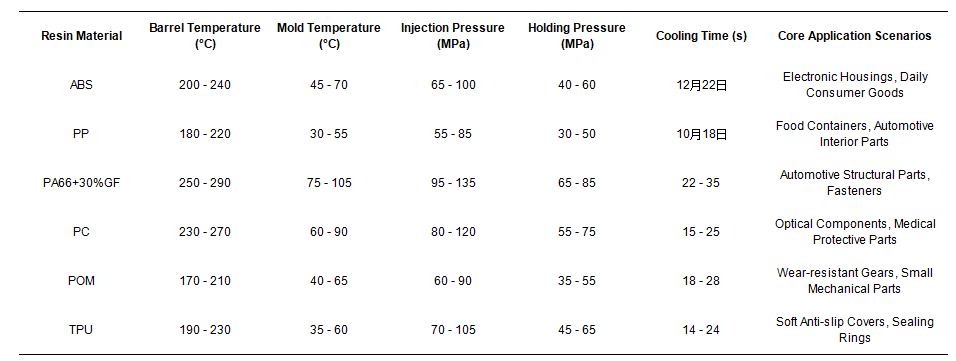
Table 1: Standard Injection Molding Process Parameters for Mainstream Plastic Resins
3.2 Comparative Analysis of Alternative Manufacturing Processes
To further clarify the selection boundary of injection molding, this table compares injection molding with three mainstream alternative processes from multiple dimensions, helping engineers quickly screen the optimal manufacturing scheme according to project attributes.
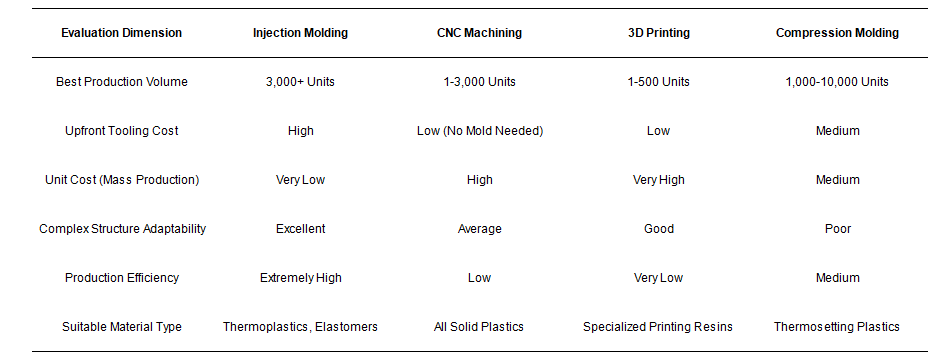
Table 2: Comparison Between Injection Molding and Competing Manufacturing Processes
4. Practical Application Cases of Injection Molding Selection
4.1 Case 1: Consumer Electronics Bluetooth Earphone Shell
4.1.1 Project Overview
A consumer electronics startup launched a new TWS Bluetooth earphone product. The product includes upper and lower plastic shells with integrated snap fits and tiny mounting grooves. The project was divided into two stages: 200 prototype samples for market testing in the early stage, and 50,000 mass-produced products for official sales in the later stage. The shell requires smooth surface texture, stable dimensional tolerance (±0.05mm) and certain drop resistance.
4.1.2 Process Selection Decision
In the prototype stage, the team abandoned injection molding due to the small batch size of 200 units. After comparison between 3D printing and CNC machining, high-precision CNC machining was finally selected. The reason is that CNC-machined ABS shells have better surface finish and mechanical properties than 3D printed parts, which can truly simulate the performance of mass-produced finished products.
In the mass production stage with a batch of 50,000 units, injection molding was determined as the exclusive process. The project adopted a double-cavity steel mold, and the shell material selected high-flow ABS. Combined with the parameter table, the barrel temperature was set to 225°C, the mold temperature to 55°C, the injection pressure to 85MPa, and the cooling time to 18s. The single-piece molding cycle was only 19 seconds.
4.1.3 Selection Benefit Analysis
The phased process selection strategy effectively controlled the overall project cost. The prototype stage avoided invalid mold investment caused by uncertain product design; the mass production stage reduced the unit manufacturing cost from $1.8 (CNC machining) to $0.35. After amortizing the $12,000 mold cost, the project saved a total of over $70,000 in manufacturing costs. Meanwhile, injection molding ensured 100% dimensional consistency of 50,000 shells, eliminating assembly failures caused by part deviations.
4.2 Case 2: Automotive Low-voltage Wiring Plastic Bracket
4.2.1 Project Overview
A professional auto parts supplier undertakes the customized production of low-voltage wiring brackets for new energy vehicles. The bracket needs to work stably in a high-temperature and vibration environment for a long time, with requirements of high structural strength and heat resistance. The annual order demand is 80,000 pieces, and the customer requires the parts to be embedded with multiple mounting holes and reinforced rib structures.
4.2.2 Process Selection Decision
The technical team initially sorted out optional processes: CNC machining, compression molding and injection molding. After evaluation, CNC machining was excluded first due to its high unit cost and low production efficiency for large batches; compression molding was eliminated because it could not complete integrated molding of complex rib structures.
Finally, glass fiber reinforced PA66 was selected as the raw material, and single-cavity injection molding was adopted. The team optimized parameters based on the reference range: the barrel temperature was adjusted to 275°C, the mold temperature to 90°C, the holding pressure was increased to 75MPa to eliminate shrinkage cavities around the reinforced ribs, and the cooling time was extended to 30s to release internal stress and prevent warpage.
4.2.3 Selection Benefit Analysis
Injection molding realized one-time integrated molding of the complex bracket structure without secondary trimming. Compared with the traditional split assembly process, it reduced 4 production procedures. The annual comprehensive manufacturing cost was reduced by 23%, and the product qualification rate was stabilized above 99.2%. In addition, the integrated molded structure effectively resisted vibration impact, improving the service life of the bracket by more than 40% compared with assembled parts, which fully met the harsh working conditions of new energy vehicles.
5. Common Selection Mistakes and Optimization Suggestions
In actual project operation, engineers often make two typical selection mistakes. The first mistake is prioritizing injection molding for small-batch prototype products, resulting in redundant mold development costs. For batches below 500 units, it is recommended to adopt 3D printing for rapid verification and switch to soft mold injection molding only after the design plan is fully confirmed.
The second mistake is ignoring material characteristics and blindly using injection molding for ultra-thick thermosetting parts. For thermosetting plastic parts with wall thickness greater than 15mm, compression molding is the optimal choice. For thick-walled thermoplastic parts, the wall thickness should be optimized to below 12mm in the design stage to avoid quality defects such as internal cracks caused by uneven cooling.
Besides, for medium-batch products (300-3000 units) with uncertain long-term demand, engineers can adopt a transitional solution of aluminum soft molds. The cost of soft molds is only 1/3 of traditional steel molds, which balances the demand for low upfront investment and low unit cost, and realizes seamless switching to formal steel molds after the market demand is stabilized.
6. Conclusion
Injection molding is not a universal plastic manufacturing process, and rational selection must rely on multi-dimensional evaluation of production volume, part structure, material attributes, budget and delivery cycle. To sum up, injection molding is the best manufacturing solution for thermoplastic parts with stable design, batch over 3,000 units, complex geometric features and high consistency requirements; while small-batch prototypes, ultra-high-precision micro-parts and thermosetting plastic thick-walled parts should adopt alternative processes such as 3D printing, CNC machining and compression molding respectively.
Combined with the two industrial cases in consumer electronics and automotive industries, phased flexible process selection and scientific parameter configuration can effectively reduce manufacturing costs and improve product yield. With the continuous upgrading of mold manufacturing and injection molding technology, the application threshold of the process for medium-batch products will be further reduced. In the future, multi-cavity shared molds and intelligent parameter adaptive adjustment technology will become the key development direction, helping more enterprises give full play to the cost and performance advantages of injection molding.
References
[1] Protolabs. A Beginner's Guide to Injection Moulding[EB/OL]. 2026.
[2] Additive Plus. 3D Printing vs. Injection Molding: Which Manufacturing Method is Right for You?[EB/OL]. 2025.
[3] Makerstage. What Is Injection Molding & How to Choose It[EB/OL]. 2026.
[4] U-Need Precision Machine. CNC versus Injection Molding: 2026 OEM Selection Guide[EB/OL]. 2026.
[5] Dachang Plastic Hardware Processing Factory. Extrusion vs Injection Molding: Cost-saving Analysis[EB/OL]. 2025.
Hot Articles
Hot Tags
Stay Connected!


Manufacturing on Demand
Please fill in the following information to obtain plan details (information is confidential and not disclosed publicly), we will contact you within 24 hours, please keep your phone available!
Upload a 3D/2D model to see instant pricing, lead time, and DFM feedback.