



Glossary of Pressure Die Casting Terms


Pressure Die Casting: Professional Terminology
Term | Definition & Context |
Pressure Die Casting | A manufacturing process where molten metal is injected under high pressure into a reusable steel mold (die). |
Hot-Chamber Die Casting | A process where the injection mechanism is immersed in a bath of molten metal. Ideal for low-melting-point alloys like zinc and magnesium. |
Cold-Chamber Die Casting | A process where molten metal is ladled into a "cold" injection cylinder for each cycle. Used for high-melting-point alloys like aluminum and brass. |
Die Casting Machine | The equipment used to hold the die and perform the injection and clamping actions. |
Clamping Unit | The part of the machine that opens, closes, and holds the two die halves together with immense force. |
Injection Unit | The assembly that forces the molten metal into the die. In a cold-chamber machine, this consists of the shot sleeve and plunger. |
Clamp Force (Locking Force) | The amount of force (measured in tons) the machine exerts to keep the die closed against the injection pressure. It determines the maximum projected area of a part that can be cast. |
Cycle Time | The total time required to complete one production cycle, from die closing to the next die closing. |
Category 2: The Die (Tooling)
Term | Definition & Context |
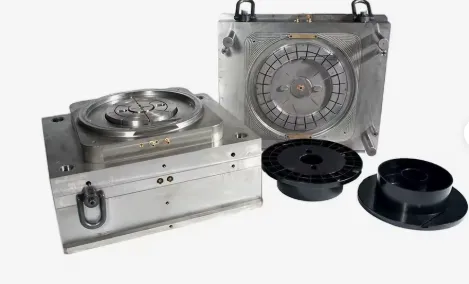
Die (Tool) | The reusable, precision-machined steel mold that forms the casting. It is the most critical and expensive component. |
Cover Die (Fixed Die) | The die half fastened to the stationary platen of the machine. It usually contains the sprue hole or the shot sleeve opening. |
Ejector Die (Moving Die) | The die half fastened to the moving platen of the machine. It contains the ejection system. |
Cavity | The hollow impression or imprint in the die that forms the external shape of the casting. |
Core | A part of the die that forms the internal features of the casting. Cores can be fixed or movable (slides). |
Parting Line (P/L) | The plane or surface where the two die halves meet. |
Slide (Angled Core) | A movable core that moves perpendicular to the die opening direction to form undercuts. It is actuated by an angle pin or a hydraulic cylinder. |
Insert | A separate piece of metal, often made of a more wear-resistant material, inserted into the main die block to form a specific, high-wear area. |
Vent | A shallow channel or slot cut into the die to allow air and gases to escape as the molten metal fills the cavity. |
Overflow Well | A small cavity connected to the main part cavity, designed to trap cold or oxidized metal that flows at the front of the melt stream, improving the quality of the main casting. |
Category 3: The Injection System & Process
Term | Definition & Context |
Shot | A single cycle of injecting metal into the die. The term also refers to the total volume of metal injected. |
Shot Sleeve (Cold Chamber) | The horizontal cylinder in a cold-chamber machine into which molten metal is ladled. The plunger moves through it to force metal into the die. |
Plunger (Piston) | The piston that pushes the molten metal through the shot sleeve and into the die. |
Gooseneck (Hot-Chamber) | The metal-filled tube in a hot-chamber machine that connects the metal pot to the die. |
Slow Shot | The first phase of the injection cycle where the plunger moves slowly to allow metal to fill the shot sleeve without trapping air. |
Fast Shot | The second, high-speed phase where the plunger accelerates to fill the die cavity rapidly before the metal solidifies. |
Intensification (Final Pressure) | The final phase where an extremely high pressure is applied to the plunger after the cavity is filled. This pressure compensates for shrinkage as the metal solidifies, creating a denser part. |
Biscuit | The solidified plug of metal left in the shot sleeve or gooseneck after the casting has solidified. |
Ladling | The manual or automated process of transferring molten metal from the holding furnace to the shot sleeve in a cold-chamber machine. |
Category 4: Gating & Feeding System
Term | Definition & Context |
Runner | The channel system that carries the molten metal from the sprue or biscuit to the gates of the part cavity. |
Gate | The controlled, often small, entrance point from the runner into the part cavity. Gate design is critical for controlling metal flow and solidification. |
Sprue | In a cold-chamber machine, the tapered entrance from the shot sleeve to the runner system. In a hot-chamber machine, it's the channel from the gooseneck. |
Ingate | Another term for the gate. |
Overflow | See Overflow Wellabove. |
Vent | See Ventabove. |
Category 5: The Casting & Defects
Term | Definition & Context |
Casting | The finished part that has been formed by the die casting process. |
Flash (Fin) | A thin web or fin of metal that escapes between the die halves (at the parting line) or around cores and ejector pins. Caused by excessive injection pressure or die wear. |
Ejector Pin Mark | The impression left on the casting by the ejector pins. |
Undercut | A feature on the casting that prevents its direct ejection from the die, requiring a slide mechanism. |
Porosity | Voids or pores within the casting, caused by trapped air or shrinkage during solidification. |
Cold Shut (Cold Flaw) | A surface defect appearing as a line or crack, caused when two streams of metal meet but do not fuse together properly. |
Soldering | A defect where the molten metal welds itself to the die steel, causing severe damage to the die surface and the casting. |
Blister | A surface bubble or raised area caused by trapped gas expanding during a subsequent finishing process like painting or powder coating. |
Category 6: Secondary Operations
Term | Definition & Context |
Trimming | The operation of removing the flash, runners, and overflows from the casting, typically done in a hydraulic press with a trim die. |
Deburring | The process of removing small sharp edges (burrs) left after trimming, often by tumbling or manual grinding. |
Shot Blasting (Bead Blasting) | Propelling a stream of abrasive media (e.g., steel shot) at the casting to clean the surface and improve its appearance. |
Machining | Performing secondary operations like drilling, tapping, or milling on the casting to achieve features that are impractical to cast directly. |
Impregnation | A sealing process where a polymer or sealant is vacuum-forced into the porosity of a casting to make it pressure-tight. |
This vocabulary provides a solid foundation for communicating effectively with die casters, tooling engineers, and product designers involved in the pressure die casting process.
Hot Articles

Hot Tags
Stay Connected!


Manufacturing on Demand
Please fill in the following information to obtain plan details (information is confidential and not disclosed publicly), we will contact you within 24 hours, please keep your phone available!
Upload a 3D/2D model to see instant pricing, lead time, and DFM feedback.