



Terminology of the Injection Molding Industry


Injection Molding: Professional Terminology
Category 1: The Machine & Process
Term | Definition & Context |
Injection Molding Machine (IMM) | The entire system used to plasticize the material and inject it into the mold. Also called a press. |
Clamping Unit | The part of the machine that opens, closes, and holds the mold shut under immense pressure during injection. |
Clamp Tonnage | The amount of force (measured in US tons or metric tonnes) the machine can exert to keep the mold closed against injection pressure. It determines the size of the mold and part that can be run. |
Injection Unit | The assembly that melts and injects the plastic. It consists of the hopper, barrel, and screw. |
Reciprocating Screw | The heart of the injection unit. It rotates to melt and convey plastic forward, then moves forward axially like a plunger to inject it into the mold. |
Hopper | The container that holds the plastic resin pellets before they are fed into the barrel. |
Barrel | A heated cylinder that houses the screw. Heaters on the outside help melt the plastic. |
Nozzle | The component at the end of the barrel that seals against the mold and allows the molten plastic to enter the mold's sprue bushing. |
Tie Bars | The large steel rods that guide the moving platen and absorb the clamp force. The distance between them defines the maximum mold size. |
Platens | The large metal plates to which the mold halves are bolted. The stationary platen is fixed, and the moving platen opens and closes the mold. |
Cycle Time | The total time required to complete one full cycle: clamp close, inject, cool, open, eject. |
Category 2: The Mold (Tool or Tooling)
Term | Definition & Context |
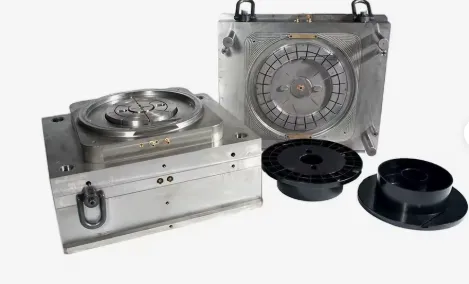
Mold (Tool) | The precision-machined metal block containing the cavities that give the plastic part its shape. Typically made from hardened steel, pre-hardened steel, or aluminum. |
Core & Cavity | The two main halves of the mold. The Cavity forms the external shape of the part; the Core forms the internal shape. |
Parting Line (PL) | The line or plane where the two halves of the mold meet. It is often visible as a faint line on the finished part. |
Mold Base | A standardized frame that holds the custom-machined core, cavity, and all other components (ejector pins, cooling channels, etc.). |
Sprue | The primary channel that delivers molten plastic from the machine nozzle to the mold's runner system. |
Runner | The system of channels that distributes the molten plastic from the sprue to the individual part cavities. |
Gate | The small, controlled entrance point from the runner into the part cavity. Its design and location are critical to part quality. |
Cold Slug Well | A small pit at the end of the sprue to trap the slightly cooled plastic from the nozzle tip ("cold slug") before it can enter the part cavity. |
Ejector System | The mechanism that pushes the cooled part out of the mold. It consists of ejector pins, ejector plates, and return pins. |
Ejector Pin Marks | Small, usually circular impressions on the part caused by the ejector pins. They are an inherent feature of the process. |
Cooling Channels | Passages drilled throughout the mold through which a coolant (water or oil) is circulated to control the mold temperature. |
Vents | Very shallow channels (often only 0.01-0.03 mm deep) cut into the mold to allow trapped air to escape as the mold fills. |
Draft Angle | A slight taper applied to the vertical walls of the part to allow for easy ejection from the mold. |
Category 3: Materials
Term | Definition & Context |
Thermoplastic | A polymer that becomes soft and moldable when heated and solidifies when cooled. This process is reversible, allowing for recycling. This is the primary material for injection molding. |
Thermoset | A polymer that undergoes a chemical change when heated, becoming permanently hard. It cannot be re-melted. (e.g., epoxy, rubber). |
Resin / Polymer | The raw plastic material, usually supplied in small pellets. |
Additives | Substances mixed with the base polymer to impart specific properties (e.g., colorants, plasticizers, flame retardants, UV stabilizers). |
Regrind | Scrap plastic from runners and rejected parts that is ground up and mixed with virgin material for reuse. |
Family Mold | A single mold containing cavities for several different parts that make up a product family. |
Category 4: Process Parameters & Defects
Term | Definition & Context |
Melt Temperature | The temperature of the molten plastic as it is injected into the mold. |
Mold Temperature | The temperature of the mold surface, critically controlled by the cooling system. |
Injection Pressure | The pressure applied by the screw to force the molten plastic into the mold cavity. |
Holding Pressure (Packing Pressure) | Pressure applied after the initial injection phase to pack more material into the cavity to compensate for shrinkage as the plastic cools. |
Back Pressure | The resistance pressure applied to the screw as it rotates and moves backward, ensuring a more homogeneous melt. |
Screw Speed (RPM) | The rotational speed of the screw during the plasticating (melting) phase. |
Short Shot | A defect where the mold cavity is not completely filled, resulting in an incomplete part. Caused by insufficient material, low pressure, or poor flow. |
Sink Marks | A depression or dimple on the surface of a part, caused by uneven cooling, often in thick sections. |
Flash | A thin layer of plastic that escapes from the cavity at the parting line, through ejector pins, or vents. Caused by excessive injection pressure or mold wear. |
Warpage | Dimensional distortion of the part after ejection, caused by uneven internal stresses or non-uniform cooling. |
Knit Lines (Weld Lines) | A visible line on the part where two flow fronts meet but do not perfectly merge. This can be a weak point. |
Category 5: Specialized Processes
Term | Definition & Context |
Insert Molding | A process where a metal or other component (the "insert") is placed into the mold, and plastic is injected around it. |
Overmolding | A two-step process where one plastic part is molded first, then placed into a second mold where a different material (often a soft TPE) is molded over it. |
Two-Shot Molding | A specialized process performed on a single machine with two injection units. The first material is injected, then the mold rotates or shifts, and the second material is injected onto the first. |
Gas-Assisted Injection Molding | A process where inert gas (Nitrogen) is injected into the core of the plastic part. This creates hollow sections, reducing weight and sink marks in thick parts. |
Micro Molding | The injection molding of extremely small, high-precision parts often weighing less than a gram. |
This vocabulary provides a comprehensive foundation for communicating effectively about design, manufacturing, and quality control in the field of injection molding.
Hot Articles
Hot Tags
Stay Connected!


Manufacturing on Demand
Please fill in the following information to obtain plan details (information is confidential and not disclosed publicly), we will contact you within 24 hours, please keep your phone available!
Upload a 3D/2D model to see instant pricing, lead time, and DFM feedback.